Football shirts can be discounted near the end of a season or during a retailer's separate promotion, but there is no fixed sale date shared by every club, brand and shop. If you are deciding when to buy, check an actual announcement and the price of your exact size and version. A past sale is evidence of what happened, not a promise that the same offer will return.
This guide looks at when football shirts go on sale in the sense of being reduced in price. A new shirt being “on sale” can also mean it has just become available at its normal price. Separating those meanings prevents a release announcement from being mistaken for a discount.
What real sale announcements show
Two club announcements illustrate why a single calendar rule is unreliable:
FC Lugano announced an end-of-season sale on 23 April 2026. Its 2025/26 home and away shirts were listed at 30% off, while the third kit had a different reduction. That is a dated example, not an offer we have verified as still available.
Liverpool FC's October 2026 adidas sale announcement included selected 2026/27 replica kit and gave an end time of 9am GMT on 29 October. That stated deadline had passed when this guide was prepared on 31 October 2026.
The examples show an end-of-season offer and a promotion involving current-season kit. They do not establish a universal discount percentage, a guaranteed annual schedule or a FootballTHJORE promotion. Always check the current seller's page for the item you actually want.
Compare buying now with waiting
Your priority
Buying now may suit you when
Waiting may suit you when
A specific shirt and size
The item matches your requirements and the total is acceptable
You are comfortable missing that exact option
A lower spend
The current total already meets your budget
Your choice of season or design is flexible
A gift or match date
You can verify suitable fulfilment timing
You have no fixed date and can reassess later
A particular older design
The actual listing meets your criteria
You want more evidence or better options, not just an assumed seasonal sale
Waiting is a choice about uncertainty. The price may fall, stay the same or the option you want may become unavailable. None of those outcomes should be presented as certain without information from the seller. Equally, a countdown should not make an unsuitable shirt become suitable.
When do football shirts get reduced?
The most useful answer is “when that seller announces or displays a reduction on that item.” End-of-season campaigns are one opportunity to watch, as the Lugano example demonstrates. Separate promotions can happen while a season is still running, as the Liverpool example demonstrates. Their timing and included products differ.
You can choose to check around a season change or a major retail event such as Black Friday, but those are reminders to investigate, not promises of a shirt discount. A banner may exclude new releases, certain brands, printed items or specific versions. Read the actual terms and test the relevant selection before relying on a headline.
For shoppers asking when football shirts go on sale in the UK, remember that a European club's season, an international tournament and a retailer's promotional calendar are different things. US shoppers looking at soccer jerseys should make the same distinction. Do not transfer a club's past promotion to another market or store.
Check that two prices refer to the same product
Before comparing the saving, compare the garment. A home shirt and an away shirt are different choices. A short-sleeve version is not a substitute for a long-sleeve requirement simply because the price is lower. A fan-oriented version and a differently described performance version may also have different specifications.
Record the team, season label, shirt role, sleeve length, size and printing selection. Keep condition and product identity separate as well. A later retro design, an original-period garment and a documented match-worn shirt are not interchangeable price comparisons.
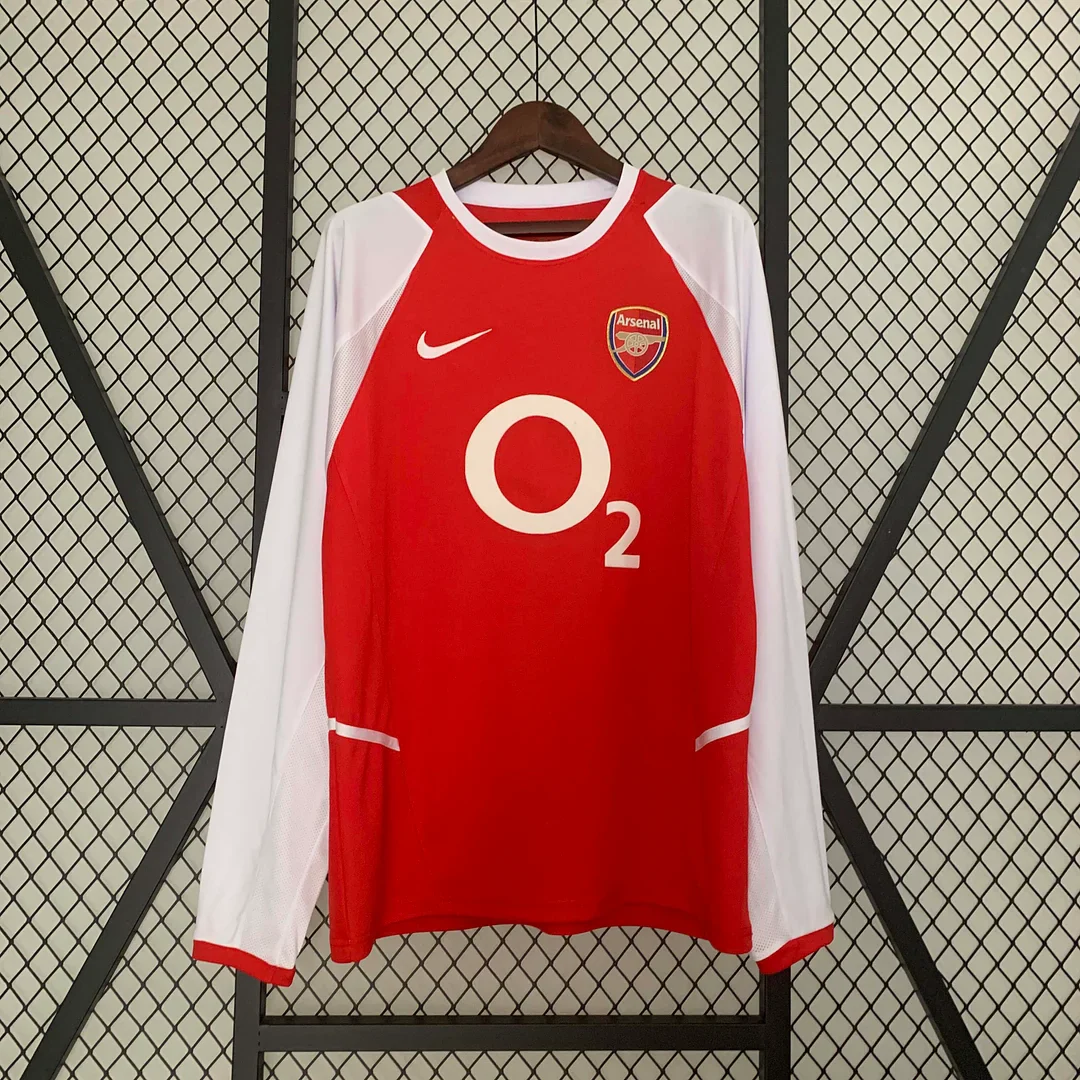
A long-sleeve retro listing is a specific product choice. The image is not evidence of a current discount, original-period manufacture or match use.
For example, the 2003-2004 retro Arsenal home long-sleeve listing has a different description from a current-season short-sleeve shirt. Read each listing in the Arsenal collection before comparing prices. This guide does not label either option as discounted or promise a future reduction.
Compare the total, not just the percentage
A useful comparison uses the same destination, currency and selected options. Write down the item price, any chosen printing, displayed delivery charge and any other applicable costs. Do not add an estimated charge as though it were confirmed, and do not assume an unshown charge is zero.
Consider this fictional example in one currency: Option A costs 60 plus 8 delivery, making 68. Option B costs 55 plus 15 delivery, making 70. With everything else equal and no other charges, the lower garment price produces the higher total. These figures are arithmetic examples, not store offers or delivery quotes.
A percentage also needs a reference point. A “30% off” label does not answer whether the final price is attractive to you, or whether another option has the same specifications. Save the actual price you observed, with the date and selection, rather than remembering only the promotional percentage.
If you compare across currencies, account for the payment method's actual conversion and any applicable charges. Do not rely on an old conversion displayed in a screenshot. Stop the comparison at what you can establish, and check unresolved costs before ordering.
Build a simple price watch
You do not need a complicated tracking system. Use one row for the exact shirt and update it when you choose to check:
Product link and date: so you can return to the same listing.
Selected size and version: so the comparison stays consistent.
Displayed price and currency: including whether a code is required.
Complete known total: with unresolved costs marked as unknown.
Your maximum acceptable total: chosen before the promotion.
Your deadline: if the shirt is needed for an occasion.
Then use a clear decision: buy if the item meets the brief, the terms work and the total is within your limit; otherwise wait, ask a question or choose another option. This avoids repeatedly moving your budget just because an offer looks urgent.
Do older shirts automatically become cheaper?
No automatic reduction follows from an older season label. The individual item's condition, type and seller still matter. A currently sold retro design is not necessarily old stock from the season in its title, and an original-period item is a different comparison again.
Our guide to retro shirt terminology explains that distinction. If you are assessing an existing collectible rather than timing a retail purchase, use the shirt valuation evidence checklist instead. A sale on a newly listed design does not establish the value of a different older garment.
Before acting on an offer
Read the current product description and terms after selecting your size. Check whether the reduction remains, whether the code applies, and whether the delivery information answers your deadline. Do not treat dispatch and arrival as the same promise.
Check return conditions before choosing optional printing or other changes. This article does not state or replace any seller's policy. If a key term is unclear, ask before purchasing. A saving does not compensate for buying the wrong size; our measurement guide can help with that separate decision.
Summary
There is no universal football shirt sale date. Use real announcements as dated evidence, verify the exact item and compare the complete cost. Waiting can make sense when you are flexible; buying at an acceptable current price can make sense when the exact choice or timing matters. Neither decision requires a prediction that every shirt will get cheaper.
Research and disclosure
Prepared by FootballTHJORE, 31 October 2026, using the linked FC Lugano and Liverpool FC announcements plus current store listing checks. Historical offers are examples, not live deal recommendations. The price comparison is fictional and the decision worksheet is editorial guidance, not a price forecast. FootballTHJORE sells linked products; the cited clubs do not endorse this guide or those products.
 USD
 ANG(ƒ)
 LKR(₨)
 EGP(EGP)
 BZD(BZ$)
 CRC(¢)
 MAD(DH.)
 OMR(RO.)
 KES(KSh)
 GHS(₵)
 UGX(USh)
 RSD(RSD)
 RON(lei)
 PGK(K)
 CDF(CDF)
 UYU($U)
 KZT(〒)
 PKR(Rs)
 MNT(₮)
 ARS(ARS$)
 COP(COP)
 MVR(Rf)
 IQD(د.ع)
 BDT(Tk)
 ZMW(ZK)
 NAD(N$)
 JMD(J$)
 AOA(Kz)
 MMK(K.)
 PEN(S/.)
 MOP(MOP$)
 BND(B$)
 LAK(₭)
 VND(₫)
 NGN(₦)
 KHR(៛)
 TWD(NT$)
 CNY(¥)
 SAR(S.R.)
 BHD(BD.)
 QAR(QR.)
 KWD(K.D.)
 UAH(₴)
 IDR(Rp)
 MYR(RM)
 AED(AED)
 JPY(円)
 INR(Rs)
 TRY(₺)
 CLP(CLP)
 KRW(₩)
 ZAR(R)
 SEK(Kr)
 ILS(₪)
 HKD(HK$)
 THB(฿)
 PLN(zł)
 NZD(NZ$)
 NOK(Kr)
 MXN(MXN$)
 HUF(Ft)
 CZK(Kč)
 SGD(S$)
 PHP(₱)
 DKK(kr.)
 CHF(CHF)
 BRL(R$)
 RUB(₽)
 CAD(CA$)
 AUD(A$)
 GBP(£)
 EUR(€)
 Barcelona
 Real Madrid
 Manchester United
 Inter Miami
 Manchester City
 Fc Bayern
 Ac Milan
 Chelsea
 Juventus
 Arsenal
 PSG
 Liverpool
 Inter Milan
 Santos FC
 Roma
 Portugal
 Al Nassr
 Atletico Madrid
 Everton
 Everton
 Germany
 Ajax
 Mexico
 Napoli
 Columbia
 Sporting lisbon
 France
 Tottenham
 Morocco
 Real Betis
 Brazil
 USA
 ltalia
 Argentina
 England
 Borussia Dortmund
 Spain
 Japan
 Netherlands
 Adidas
 Nike
 Puma
 NB
 Kappa