Why do football teams change kits every year? A new design offers something new to sell and wear, while sponsor changes, supplier changes and club anniversaries can also affect the cycle. But annual replacement is not universal. Some shirts are deliberately retained for two seasons, and different kits at the same club can follow different schedules.
For supporters, the distinction matters: a club introducing a new match design does not create a requirement to replace a shirt you already enjoy wearing. The sensible buying question is whether you want the new design, need another shirt or prefer an earlier one. A season label helps identify an item; it does not decide its value to you.
This explanation uses dated club announcements rather than assuming that every club operates in the same way. It was prepared from public sources and listing checks on 17 October 2026. FootballTHJORE sells the retail shirt linked below and benefits from its sale. We have not inspected club contracts, calculated shirt-sale revenue or physically tested the merchandise.
First, not every football kit changes every year
Brentford provides a clear counterexample. In its July 2023 home-kit announcement, the club explicitly said the design would be used for both 2023/24 and 2024/25. Its chief executive linked the two-year approach to supporter affordability and reducing waste.
That is evidence of a specific two-season design and the club's stated aims. It is not a measured environmental saving, a promise that every future shirt will last two seasons or a rule for other clubs. It does, however, answer the premise of the question: an annual change is a choice within a particular programme, rather than something demonstrated to be unavoidable for all teams.
Be equally careful with the word kit. A conversation may concern the home shirt, while another refers to an away or third design. Find out which item an announcement covers before applying its cycle to everything the club sells. One retained home design does not establish that every other shirt will be retained.
What can cause a new kit design?
A new design creates a fresh retail choice
A changed pattern, colour treatment or collar gives supporters a different product to consider. That is the straightforward commercial logic of a new design: there is something distinct to promote and buy. It is an explanation of the retail choice, not evidence of how much profit a club makes or why a particular club chose its schedule.
Do not reduce every launch to an identical financial story. The sources in this guide do not establish a universal revenue split, sales target or contractual obligation to change every year. A launch campaign can show that a product is being marketed without revealing the terms behind it.
For the buyer, separate the appeal of the new design from a claim that it is necessary. You may prefer its appearance or want a reminder of that season. Those are understandable preferences. They do not require you to treat an older shirt as unusable.
A supplier transition can interrupt a longer cycle
Brentford's 2024/25 away and third launch explains a concrete exception. The club said those would be its last kits with Umbro and that moving to a new supplier for 2025/26 meant the two designs could not roll over for two seasons.
Here the club itself connects the shorter cycle to the supplier transition. That is stronger evidence than guessing from a different logo in a photograph. Keep the scope precise: it concerns those away and third designs and that transition, rather than proving every supplier agreement demands a yearly redesign.
Partnerships and anniversaries can affect the timing
In its July 2025 home-kit announcement, Brentford described a centenary design marking 100 years in red and white. It also explained that the shirt would have a one-year cycle, referring to the centenary and its front-of-shirt partnership ending after 2025/26.
The same announcement expressed an intention to return to a two-year cycle, subject to partnership agreements. Read that as a dated intention with a condition. It does not independently confirm a later season's policy. Check the relevant later announcement if you need the current cycle.
These examples show why a club's reason can be more specific than a general claim about annual marketing. A commemorative season, a partner's term and a supplier transition are different issues. None tells you that every club has the same arrangement or that a new shirt brings a technical improvement.
Home, away and third shirts need separate checks
When you see several launches, compare their labels before drawing a conclusion about frequency. Record the club, design category and stated season or seasons. A home-shirt announcement and a third-shirt announcement may concern different cycles, even when their photographs appear close together.
Keep the club's programme separate from the retailer's item description too. A shop page can identify the design it offers. It does not necessarily establish the club's whole kit policy, the date of the next launch or the future role of an older away shirt.
For release timing and comparing new listings, see our new-season football kit guide. The question here is why a design changes and what that means for a supporter, rather than a calendar of upcoming releases.
Does a new kit mean you need a new shirt?
Start with the reason you wear the shirt. If it is a comfortable team shirt for everyday use, a design change does not answer whether you need another one. Check the condition and fit of the garment you have, then decide whether a different design adds something you want.
If matching a particular season is the goal, the season and variant become central. Compare the actual photographs and listing, rather than assuming a team name alone identifies the shirt. If the goal is a gift, establish whether the recipient wants a current design or has an attachment to an earlier one before choosing.
Buying another shirt can be an enjoyable choice. It is more useful to make that choice openly than to describe it as an automatic annual requirement. A season change supplies information about a design, not a deadline for every supporter's wardrobe.
Choice
When it may suit you
What to check
Keep the shirt you own
You still like it and it meets your needs.
Its present condition and fit. A newer launch alone does not settle those questions.
Choose a current-season listing
You specifically want that season's design.
The actual season, home/away/third variant, photos, measurements and selected options.
Choose an earlier design
You prefer its appearance or its association with a particular season.
The exact item and seller's description. Do not assume a lower price, future availability or collectible value.
This is a comparison of buying purposes, rather than a performance ranking or a claim about stock. An earlier design is not automatically a bargain, and a new season label is not evidence of better fabric, fit or durability. Compare any such claim against the exact product's verified details.
A retail example: identify the shirt you are actually considering
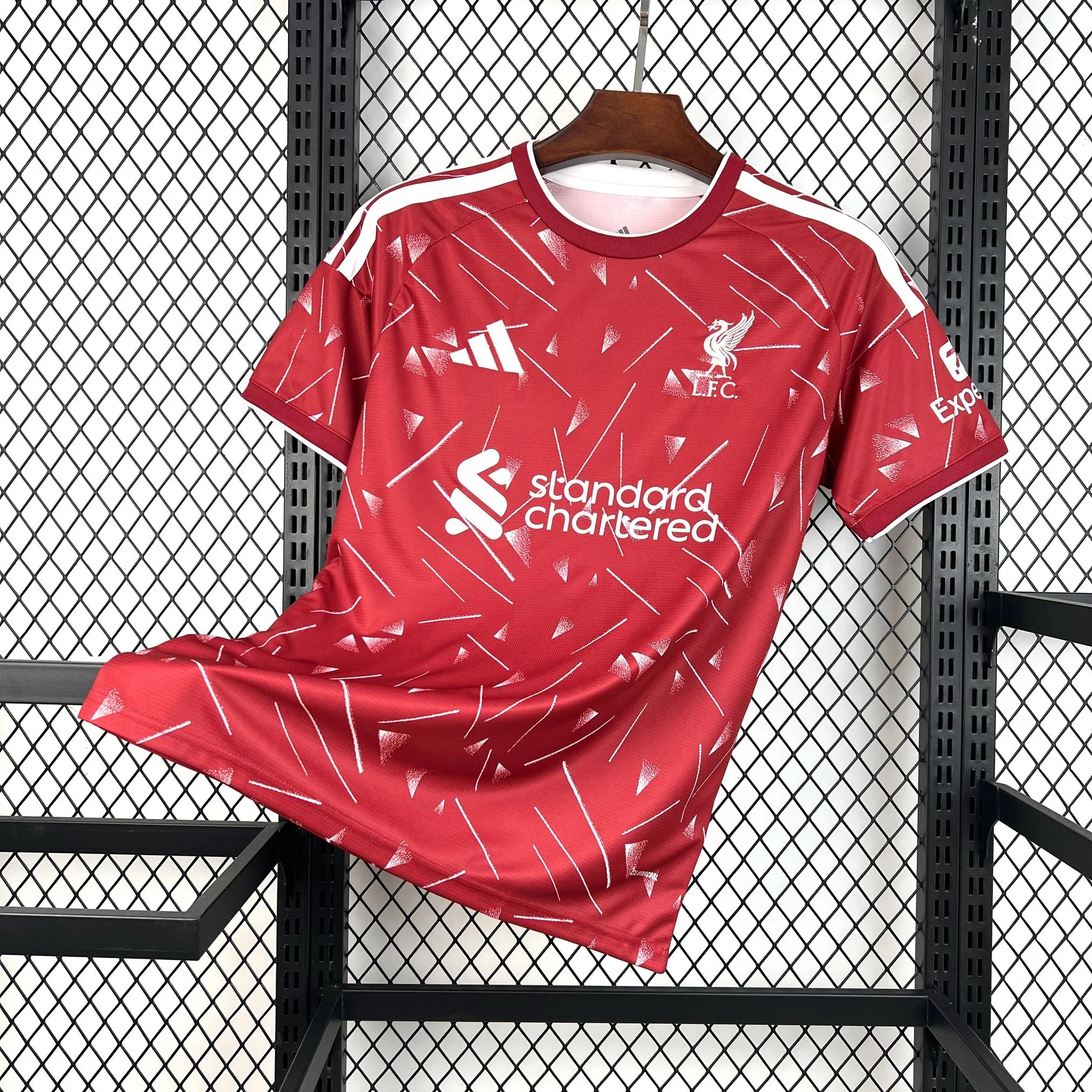
Ordinary FootballTHJORE Liverpool shirt listing photo. It illustrates a retail design, rather than evidence of Liverpool's kit-change policy or official authorisation.
FootballTHJORE's Liverpool 26/27 home football shirt listing describes a red shirt with light geometric details and white shoulder stripes, with sizes S to 2XL. Those are listing observations checked on 17 October 2026. The page is a place to inspect that offered design, rather than a source for the reasons behind Liverpool's launch decisions.
If that appearance is what you want, compare the photographs, measurement information and selected options before ordering. The Liverpool collection provides other team designs to browse. Our link does not establish licensing, match wear or a claim that this item uses a particular manufacturer's technology.
How to check the reason for your club's change
Find the club's dated announcement. Establish the year, rather than relying on a page footer or a reused image.
Identify the exact kit. Home, away and third are separate categories.
Read the stated duration. Look for named seasons and distinguish a commitment from a conditional intention.
Separate the explanation from inference. A confirmed supplier change is different from an assumption about an unseen contract.
Make your own purchase decision. Decide whether you need a replacement, want that design or prefer to keep what you have.
Also distinguish a new season design from a fresh physical shirt worn by a player. Those are different questions: a team can use multiple garments of one design. Our guide to whether footballers get a new shirt every game addresses that separate issue.
Summary: a design cycle is not a buying obligation
Football kit changes can reflect a new retail design, a supplier transition, partnership timing or a commemorative season. The documented Brentford examples also show that two-season shirts and one-year exceptions both exist. There is no sound basis here for declaring that every team must replace every kit annually.
Use the club's dated statement to understand its cycle, and the seller's actual listing to assess an offered shirt. Then choose whether to keep your current garment, buy a current design or seek an earlier one. The most useful decision follows your preference and needs, rather than the assumption that another launch makes your shirt obsolete.
 USD
 ANG(ƒ)
 LKR(₨)
 EGP(EGP)
 BZD(BZ$)
 CRC(¢)
 MAD(DH.)
 OMR(RO.)
 KES(KSh)
 GHS(₵)
 UGX(USh)
 RSD(RSD)
 RON(lei)
 PGK(K)
 CDF(CDF)
 UYU($U)
 KZT(〒)
 PKR(Rs)
 MNT(₮)
 ARS(ARS$)
 COP(COP)
 MVR(Rf)
 IQD(د.ع)
 BDT(Tk)
 ZMW(ZK)
 NAD(N$)
 JMD(J$)
 AOA(Kz)
 MMK(K.)
 PEN(S/.)
 MOP(MOP$)
 BND(B$)
 LAK(₭)
 VND(₫)
 NGN(₦)
 KHR(៛)
 TWD(NT$)
 CNY(¥)
 SAR(S.R.)
 BHD(BD.)
 QAR(QR.)
 KWD(K.D.)
 UAH(₴)
 IDR(Rp)
 MYR(RM)
 AED(AED)
 JPY(円)
 INR(Rs)
 TRY(₺)
 CLP(CLP)
 KRW(₩)
 ZAR(R)
 SEK(Kr)
 ILS(₪)
 HKD(HK$)
 THB(฿)
 PLN(zł)
 NZD(NZ$)
 NOK(Kr)
 MXN(MXN$)
 HUF(Ft)
 CZK(Kč)
 SGD(S$)
 PHP(₱)
 DKK(kr.)
 CHF(CHF)
 BRL(R$)
 RUB(₽)
 CAD(CA$)
 AUD(A$)
 GBP(£)
 EUR(€)
 Barcelona
 Real Madrid
 Manchester United
 Inter Miami
 Manchester City
 Fc Bayern
 Ac Milan
 Chelsea
 Juventus
 Arsenal
 PSG
 Liverpool
 Inter Milan
 Santos FC
 Roma
 Portugal
 Al Nassr
 Atletico Madrid
 Everton
 Everton
 Germany
 Ajax
 Mexico
 Napoli
 Columbia
 Sporting lisbon
 France
 Tottenham
 Morocco
 Real Betis
 Brazil
 USA
 ltalia
 Argentina
 England
 Borussia Dortmund
 Spain
 Japan
 Netherlands
 Adidas
 Nike
 Puma
 NB
 Kappa