Why Do Arsenal Wear Red? The Red and White Shirt Story
2026-10-27
Arsenal's red shirts date back to the club's early years, but the familiar explanation that Nottingham Forest donated the original kit is disputed by Arsenal itself. The red colour and the later white sleeves also belong to different stages of the story. Keeping those two developments separate gives a clearer answer to why Arsenal wear red and white.
Researched 27 October 2026 using Arsenal's published historical account, contemporary-record research and the current product listing below. FootballTHJORE sells football shirts. This is a source-based explanation, not a claim of first-hand access to historic garments or match-worn equipment.
Why do Arsenal wear red?
In its article dated 16 October 2026, Arsenal revisits the Nottingham Forest donation story. The club credits Fred Beardsley with suggesting red, but says the shirts were purchased locally rather than supplied by Forest. It cites David Danskin's June 1936 newspaper interview as evidence for buying the kit from an outfitter in Woolwich.
The account describes the early shirt as dark red, long-sleeved and collared, with three front buttons. That is a different image from the bright red body and contrasting white arms many supporters immediately associate with Arsenal today.
The useful distinction is between a person's connection with another club and evidence of a specific gift. Beardsley's Nottingham Forest background does not, on its own, establish that Forest provided the shirts. Repeated versions of a story should not outweigh a source that explains what its evidence actually says.
Research from the AISA Arsenal History Society discusses the contemporary newspaper descriptions of the clothing. This is more useful than treating an attractive anecdote about the inspiration as the whole explanation. The date of a design appearing and the precise moment someone first imagined it are different historical questions.
For a simple answer, remember two stages: red was an early club colour; the contrasting sleeve arrangement was a later design change. White sleeves were not part of the original purchase described in Arsenal's account.
The colour story and the shirt in your basket are different things
Question
Evidence to use
What it does not establish
Why did Arsenal adopt red?
The club's historical account and the records it cites
Who manufactured a modern retail shirt
When did the white sleeves appear?
Dated match and kit records
That every later home shirt has an identical cut or layout
Which design does a listing represent?
Its stated season and actual photographs
That the garment was made or worn in that season
Will a shirt fit?
Measurements and options for that exact item
A fit guarantee from its colour or historical association
This separation helps when buying a retro shirt. A familiar colour scheme can explain why a design appeals to you, but it cannot authenticate an item, establish its age or prove a player's use. Those claims require their own evidence. A season label is useful for locating a design; it is not a substitute for provenance.
A red-and-white example you can compare
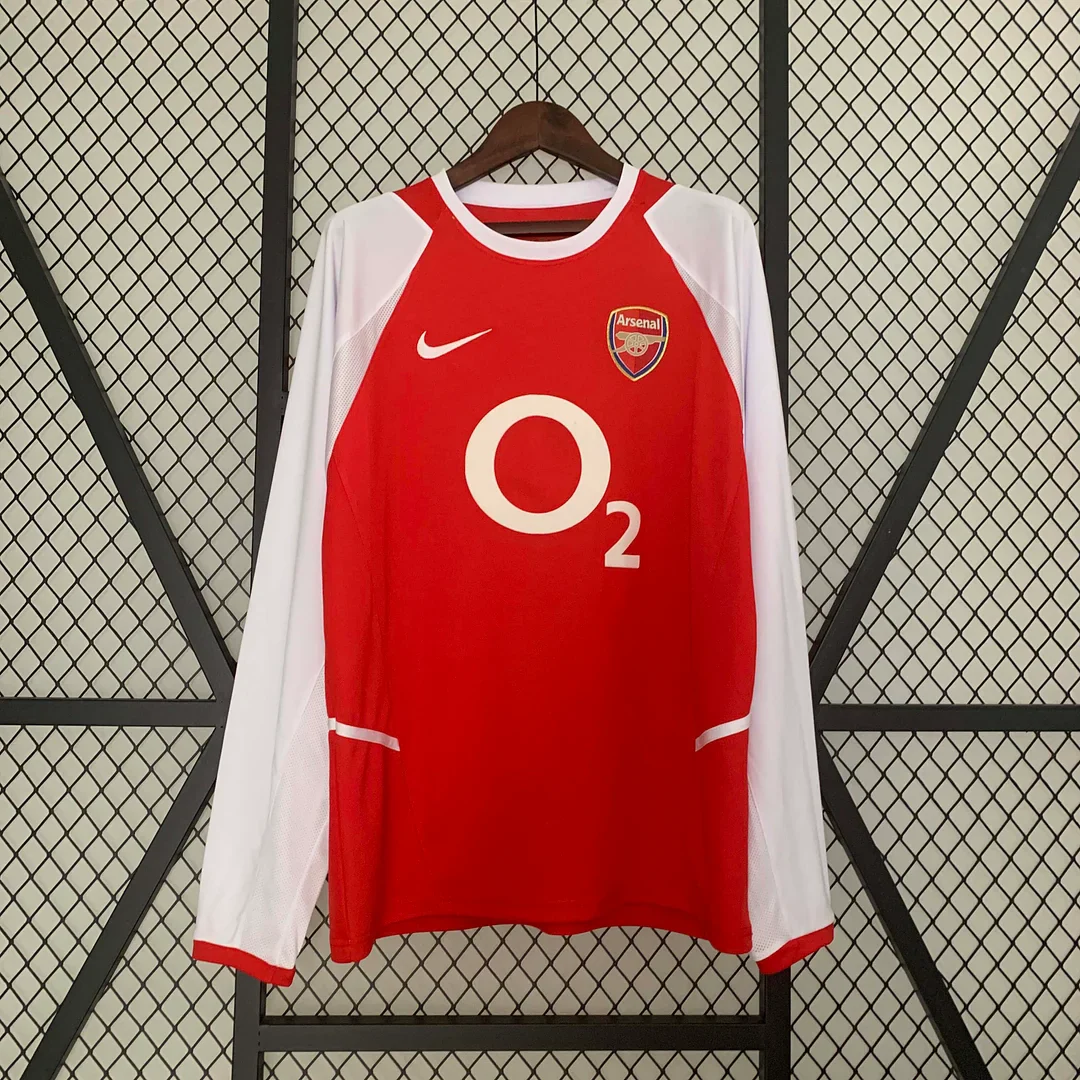
A current store product photograph, not a photograph of the original 1933 kit.
The Arsenal retro 2003/04 home long-sleeve shirt provides a visible example of the red-body, white-sleeve arrangement. Its photograph shows a white round neckline and a large O2 chest graphic. Those details distinguish this listing from the early collared shirt described in the historical account.
Compare the neckline and chest layout as well as the main colours. If you remember a particular shirt from watching Arsenal, a collar, sponsor mark or sleeve treatment may help identify the design more accurately than simply searching for a red shirt. Open the individual gallery before choosing a size or adding personalisation.
For a broader design comparison, our Highbury-era Arsenal shirt guide compares five specific listings. The Arsenal football shirts collection is the place to review current options. Neither the club history nor this article verifies licensing, original-period manufacture or match use for a retail garment.
Summary
Arsenal's red colour has early roots, while white sleeves were introduced later in 1933. The club's recent account challenges the familiar Forest donation explanation and points instead to locally purchased shirts. When choosing a design, use that history to understand its visual identity, then use the exact product page to assess the garment being offered.

 USD
 ANG(ƒ)
 LKR(₨)
 EGP(EGP)
 BZD(BZ$)
 CRC(¢)
 MAD(DH.)
 OMR(RO.)
 KES(KSh)
 GHS(₵)
 UGX(USh)
 RSD(RSD)
 RON(lei)
 PGK(K)
 CDF(CDF)
 UYU($U)
 KZT(〒)
 PKR(Rs)
 MNT(₮)
 ARS(ARS$)
 COP(COP)
 MVR(Rf)
 IQD(د.ع)
 BDT(Tk)
 ZMW(ZK)
 NAD(N$)
 JMD(J$)
 AOA(Kz)
 MMK(K.)
 PEN(S/.)
 MOP(MOP$)
 BND(B$)
 LAK(₭)
 VND(₫)
 NGN(₦)
 KHR(៛)
 TWD(NT$)
 CNY(¥)
 SAR(S.R.)
 BHD(BD.)
 QAR(QR.)
 KWD(K.D.)
 UAH(₴)
 IDR(Rp)
 MYR(RM)
 AED(AED)
 JPY(円)
 INR(Rs)
 TRY(₺)
 CLP(CLP)
 KRW(₩)
 ZAR(R)
 SEK(Kr)
 ILS(₪)
 HKD(HK$)
 THB(฿)
 PLN(zł)
 NZD(NZ$)
 NOK(Kr)
 MXN(MXN$)
 HUF(Ft)
 CZK(Kč)
 SGD(S$)
 PHP(₱)
 DKK(kr.)
 CHF(CHF)
 BRL(R$)
 RUB(₽)
 CAD(CA$)
 AUD(A$)
 GBP(£)
 EUR(€)
 Barcelona
 Real Madrid
 Manchester United
 Inter Miami
 Manchester City
 Fc Bayern
 Ac Milan
 Chelsea
 Juventus
 Arsenal
 PSG
 Liverpool
 Inter Milan
 Santos FC
 Roma
 Portugal
 Al Nassr
 Atletico Madrid
 Everton
 Everton
 Germany
 Ajax
 Mexico
 Napoli
 Columbia
 Sporting lisbon
 France
 Tottenham
 Morocco
 Real Betis
 Brazil
 USA
 ltalia
 Argentina
 England
 Borussia Dortmund
 Spain
 Japan
 Netherlands
 Adidas
 Nike
 Puma
 NB
 Kappa