How to Tell If a Football Shirt Is Fake: An Evidence Checklist
2026-10-01
If you are trying to learn how to tell if a football shirt is fake, do not trust one dramatic clue. A product code, neat stitching or a convincing badge can support a case, but none proves origin on its own. The safest approach is to look for agreement across the seller, listing, labels, photographs and construction—and to stop when two facts contradict each other.
This guide is for ordinary current and retro shirt purchases. Signed and match-worn memorabilia need stronger provenance and specialist assessment.
The quick answer: check the evidence in this order
Confirm who is selling the shirt and what they actually claim.
Match the product or style code to the same team, season and colourway.
Compare labels, photographs and design details with a reliable reference for that exact version.
Inspect printing, seams, collar, crest and sponsor application together.
Treat missing photos, inconsistent answers or conflicting codes as reasons to pause.
The aim is not to collect enough “good signs” to force a yes. It is to discover whether the available evidence tells one consistent story.
Start with the seller and the exact wording
Before studying a label, read the whole listing. Does it identify the team, season, home/away/third role, sleeve style, size and condition? Are the photographs of the actual item or only catalogue images? Can the seller provide close-ups of the internal labels, crest, sponsor and any personalisation?
Words also matter. “Replica” can describe a licensed fan-oriented product tier; it does not automatically mean counterfeit. “Player version”, “match”, “authentic”, “retro”, “vintage” and “reissue” can refer to different things. Do not convert one label into another. A season reference identifies the design being offered, but it does not by itself prove when the garment was made or where it came from.
Check the product code, then check beyond it
Many modern shirts carry a manufacturer style or article code on an internal label. Search the exact code with the brand name. Results should consistently point to the same team, season and colourway. A code that leads to an unrelated shirt is a serious contradiction.
A matching code is useful evidence, not a certificate. Codes and tags can be copied, and very old shirts may not have a code that is easy to search. Compare the code on the garment with any hangtag, then continue through the rest of the checklist.
Compare the listing photos with the exact version
Use a reference for the same shirt, not a vaguely similar one. Home and away designs may share a template. Fan and player-oriented versions may use different fits, fabric structures or badge applications. Long- and short-sleeve listings can also differ.
Compare stable details:
collar shape and internal taping;
stripe width, panel boundaries and colour placement;
position and proportions of the crest and manufacturer mark;
sponsor shape and spacing;
hem shape and side panels;
the font and placement of names, numbers and competition badges.
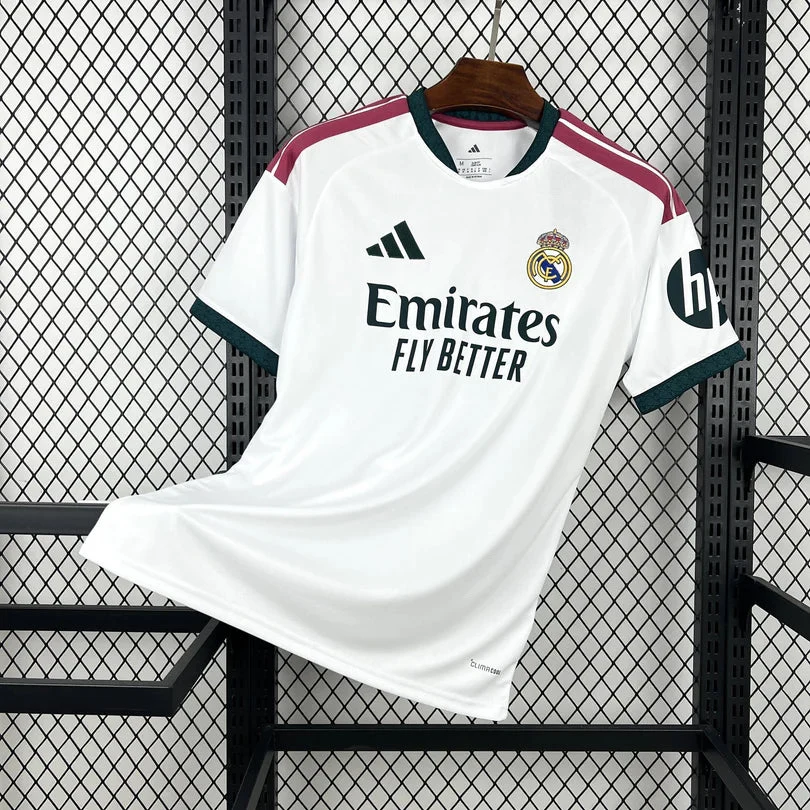
The image below is a current THJORE product photograph used only to illustrate the need to compare an exact listing. It is not an authentication result.
Inspect labels and construction as a group
Care labels should be legible and internally consistent. Check fibre percentages, wash symbols, country information and spelling. Look for clean printing rather than assuming a particular country of manufacture is suspicious. FIFA's brand-protection guidance notes that licensed products may carry relevant marks on hang tags or sewn-in labels, but the exact features depend on the product and competition.
Turn the shirt inside out. Follow the seams from the hem to the underarm, inspect how the collar is attached and look for repeated tension, puckering or loose thread ends. Then compare those findings with the listing's stated condition. Age and wear can explain some imperfections; a shirt described as new should not arrive with unexplained cracking, lifting print or heavy abrasion.
Badge, sponsor and printing checks
An embroidered badge is not automatically genuine, and a heat-applied badge is not automatically fake. Different tiers and seasons use different constructions. Compare the treatment with the exact reference shirt.
Look for clean edges, correct proportions and consistent spacing. Names and numbers should use the expected shapes for the relevant season or competition. Personalisation added later may be different from the shirt itself, so assess the garment and the printing separately.
Evidence comparison table
Check
Useful result
Warning sign
What it can prove
Seller and provenance
Clear seller identity, original photos, consistent answers
Stock images only, missing label photos, changing story
Strong context, but not garment origin by itself
Product/style code
Same team, season and colourway across reliable results
Unrelated product or inconsistent codes
Can expose a contradiction; a match is not final proof
Labels
Legible, complete and consistent with the version
Spelling errors, missing information or conflicting details
Supporting evidence only
Design comparison
Collar, panels, colours and logo placement match the exact version
Several details disagree with the reference
Strong visual consistency check
Construction
Appropriate, tidy finish consistent with stated condition
Unexplained poor finish, lifting or new-item damage
Supports or weakens the overall case
Price
Plausible for condition, age and source
Extraordinary bargain with no credible explanation
Risk signal, not proof
What to do when you are still unsure
Ask for better photographs before paying. Save the product description, seller messages and receipt. For a valuable vintage, signed or match-worn shirt, use a specialist who can assess provenance and the physical garment. If the evidence remains mixed, label the result “unresolved” rather than guessing.
When shopping on THJORE, use the product title and photographs to confirm the season and version. For example, the Real Madrid 2026 home shirt listing identifies the design and available sizing context; it should not be used to infer an unstated licensing, provenance or match-worn claim. The THJORE shopping FAQ explains how to check listing details and ask about a specific product before ordering.
Conclusion
The best way to tell if a football shirt is fake is to test whether independent details agree. Start with the seller, check the exact code and version, compare the design, then inspect labels and construction. One clue can be copied or misunderstood; several consistent checks are more useful. If a contradiction remains, pause the purchase instead of letting a low price or convincing badge decide for you.

 USD
USD
 ANG(ƒ)
 LKR(₨)
 EGP(EGP)
 BZD(BZ$)
 CRC(¢)
 MAD(DH.)
 OMR(RO.)
 KES(KSh)
 GHS(₵)
 UGX(USh)
 RSD(Din.)
 RON(lei)
 PGK(K)
 CDF(CDF)
 UYU($U)
 KZT(〒)
 PKR(Rs)
 MNT(₮)
 ARS(ARS$)
 COP(COP)
 MVR(Rf)
 IQD(د.ع)
 BDT(Tk)
 ZMW(ZK)
 NAD(N$)
 JMD(J$)
 AOA(Kz)
 MMK(K.)
 PEN(S/.)
 MOP(MOP$)
 BND(B$)
 LAK(₭)
 VND(₫)
 NGN(₦)
 KHR(៛)
 TWD(NT$)
 CNY(¥)
 SAR(S.R.)
 BHD(BD.)
 QAR(QR.)
 KWD(K.D.)
 UAH(₴)
 IDR(Rp)
 MYR(RM)
 AED(AED)
 JPY(円)
 INR(Rs)
 TRY(₺)
 CLP(CLP)
 KRW(₩)
 ZAR(R)
 SEK(Kr)
 ILS(₪)
 HKD(HK$)
 THB(฿)
 PLN(zł)
 NZD(NZ$)
 NOK(Kr)
 MXN(MXN$)
 HUF(Ft)
 CZK(Kč)
 SGD(S$)
 PHP(₱)
 DKK(kr.)
 CHF(CHF)
 BRL(R$)
 RUB(₽)
 CAD(CA$)
 AUD(AUD)
 GBP(£)
 EUR(€)
 Barcelona
 Real Madrid
 Manchester United
 Inter Miami
 Manchester City
 Fc Bayern
 Ac Milan
 Chelsea
 Juventus
 Arsenal
 PSG
PSG Liverpool
 Inter Milan
 Santos FC
 Roma
Roma Portugal
 Al Nassr
 Atletico Madrid
 Everton
 Everton
 Germany
 Ajax
Ajax Mexico
 Napoli
 Columbia
 Sporting lisbon
 France
 Tottenham
 Morocco
 Real Betis
 Brazil
 USA
USA ltalia
 Argentina
 England
 Borussia Dortmund
 Spain
Spain Japan
Japan Netherlands
 Adidas
 Nike
Nike Puma
Puma NB
NB Kappa
Kappa