Why does France have a rooster on their jersey? The bird is the Gallic rooster, a symbol associated with France through a Latin wordplay linking "rooster" and "Gallic". France's national football team uses that familiar national identity on its shirts. The French presidency's explanation provides the historical starting point.
There are two different questions inside the badge: why the animal represents France, and when it appeared on the football shirt. Keeping those questions separate makes the story clearer. It also helps explain why an old national symbol can appear in several quite different shirt designs.
The national symbol came before the football badge
The Latin word gallus connects the rooster with Gaul. According to the Elysee's history of the symbol, the bird appeared in royal imagery during the Renaissance, became more popular after the French Revolution and featured on later republican seals and coins. Its prominence changed under different regimes. That is a history of changing national symbolism, rather than a single football club choosing an animal. The presidency also identifies sporting events as a setting in which the rooster continues to represent France.
Calling the image a Gallic rooster therefore explains its cultural association. It does not mean a modern crest was designed in antiquity. A symbol can have an old meaning while the particular drawing used on a shirt is much newer. This distinction matters whenever a short account jumps directly from Latin vocabulary to a photograph of today's kit.
When did the rooster appear on France's shirt?
The French Football Federation dates the rooster's appearance on the national-team shirt to 1920 in its retrospective on 120 years of the national team. That account places the shirt milestone after the team's first international in 1904 and the federation's creation in 1919. Those are separate events: the start of the team, the formation of the organisation and the use of the emblem on the garment.
You may encounter earlier dates in general-interest explainers. This guide follows the federation's own historical account. For a historical shirt, a dated photograph or archival record of that particular design is more useful than assuming the team wore the same badge from its first match.
The distinction also prevents a common mix-up: a federation's founding date does not automatically establish the first appearance of every element in its logo. When comparing accounts, check what the date actually describes. A national symbol, an organisation's identity and a match shirt each have their own evidence.
Read the rooster, flag, letters and stars separately
Several signs can sit close together on a France shirt. They contribute to the overall design, but each answers a different question. The following comparison is useful when you are looking at a crest close-up or reading a product description.
Detail
What it identifies
How to read it
Rooster
The team's animal emblem
The bird is the subject of this origin story.
Blue, white and red flag
France's national flag
A flag motif is a separate graphic, even when the crest uses related colours.
FFF letters
The French Football Federation
The initials name the organisation.
Stars above the badge
Football honours in the relevant design
Interpret them through the team's history and the shirt's date.
The Elysee's flag account identifies the blue-white-red tricolour as France's national flag. A rooster graphic and a tricolour motif can therefore coexist without being interchangeable. For the letters beneath the bird, our separate FFF meaning guide explains the abbreviation; the initials do not provide the animal's origin story.
For the familiar two-star France design, the FFF describes 1998 as the first star and 2018 as the second. These references connect the stars with World Cup victories. The rooster has a much earlier shirt history. Our guide to stars on football shirts covers the wider distinctions between national-team honours and other star symbols.
Why does the rooster look different across shirts?
A specific dated example comes from Nike's 2024/25 France home shirt description. Nike explains that the design drew on France shirts of the 1960s and used an oversized cockerel alongside tricolour ribbing. That provides a manufacturer-documented reason for the prominent bird on that design. It should not be treated as the explanation for every France shirt from every year.
When comparing two photographs, first establish their listed years. Then look at the bird's outline, its size relative to the chest, its colour and the arrangement of surrounding lettering. These visible differences are more informative than describing both items simply as a shirt with a rooster. If your preference is a small emblem or a more prominent crest, the full front photograph lets you judge the balance of the design.
Keep the comparison visual unless the listing supplies more evidence. A gold-colour emblem describes appearance; it does not establish a particular embroidery process. Similarly, a close-up does not tell you the fabric's weight, stretch or fit. Those questions belong to the individual product's specifications and measurements.
Is the rooster the same thing as Footix?
Footix was the rooster mascot of the 1998 World Cup. The Scottish Football Museum's collection note identifies that role and records the name's unveiling in 1996. FIFA also describes Footix as the blue rooster associated with France 1998. A tournament mascot is a named character; the animal in a team badge is an emblem.
This is another reason to identify the exact graphic you are looking at. A cartoon character on tournament memorabilia and the crest on a national-team shirt can share an animal without being the same design. The presence of a rooster alone does not tell you that an item is a Footix product or dates from 1998.
Look at a current store photograph
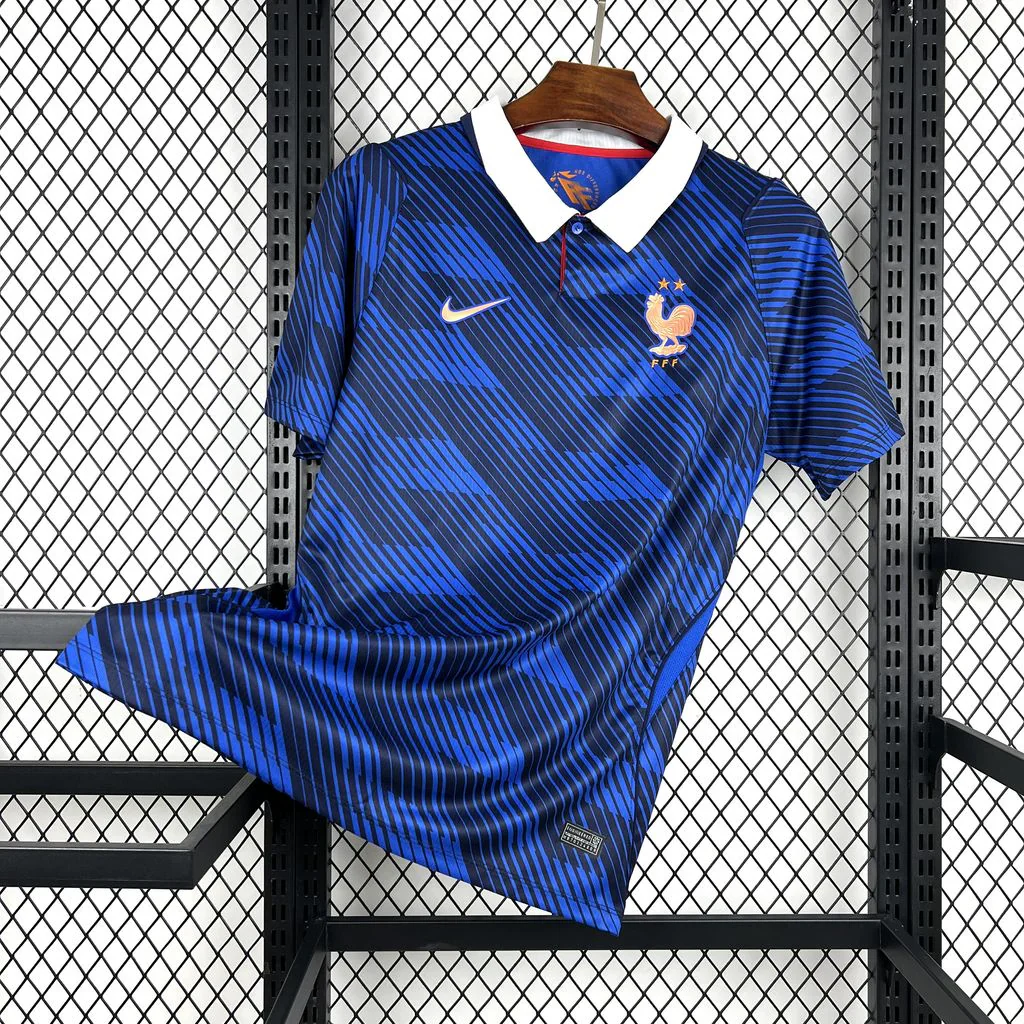
FootballTHJORE product photograph: blue shirt, layered diagonal lines, white polo-style collar and gold-colour chest graphics. This is a retail image of the listed item.
The store's France 2026 blue polo home football shirt offers a concrete design to inspect after reading the history. The listing describes a short-sleeve blue shirt with diagonal blue and navy lines and a white polo-style collar. Adult sizes S to XXL are listed, and the item is one shirt rather than a complete outfit with shorts and socks.
Open the original image before judging a small crest detail. Look at the whole shirt first, then the badge, and check the available product information for anything the photograph cannot answer. If you want a particular year's look, start from that year rather than choosing solely because the image contains a rooster.
The France shirt collection is a starting point for browsing alternatives. Compare each listing's year, home or away label and photographs, then check its own size information. Historical references in this article explain the imagery; they do not certify the manufacture or licensing of a store item. The illustrated THJORE listing does not claim official or licensed status.
Summary
France's rooster is an inherited national symbol used in football. The FFF dates its appearance on the shirt to 1920. Read the bird separately from the flag, federation initials and honour stars, and use dated references when comparing different designs. Once you recognise the emblem, the actual photograph and listing tell you which shirt you are considering.
Research and commercial disclosure
This explanation was checked on 22 October 2026 against the linked government, federation, museum and manufacturer material, together with the store's product information. FootballTHJORE sells shirts and benefits from purchases through its product links. The guide is based on research and image review, with no claim of a hands-on garment test or federation endorsement.

 USD
 ANG(ƒ)
 LKR(₨)
 EGP(EGP)
 BZD(BZ$)
 CRC(¢)
 MAD(DH.)
 OMR(RO.)
 KES(KSh)
 GHS(₵)
 UGX(USh)
 RSD(RSD)
 RON(lei)
 PGK(K)
 CDF(CDF)
 UYU($U)
 KZT(〒)
 PKR(Rs)
 MNT(₮)
 ARS(ARS$)
 COP(COP)
 MVR(Rf)
 IQD(د.ع)
 BDT(Tk)
 ZMW(ZK)
 NAD(N$)
 JMD(J$)
 AOA(Kz)
 MMK(K.)
 PEN(S/.)
 MOP(MOP$)
 BND(B$)
 LAK(₭)
 VND(₫)
 NGN(₦)
 KHR(៛)
 TWD(NT$)
 CNY(¥)
 SAR(S.R.)
 BHD(BD.)
 QAR(QR.)
 KWD(K.D.)
 UAH(₴)
 IDR(Rp)
 MYR(RM)
 AED(AED)
 JPY(円)
 INR(Rs)
 TRY(₺)
 CLP(CLP)
 KRW(₩)
 ZAR(R)
 SEK(Kr)
 ILS(₪)
 HKD(HK$)
 THB(฿)
 PLN(zł)
 NZD(NZ$)
 NOK(Kr)
 MXN(MXN$)
 HUF(Ft)
 CZK(Kč)
 SGD(S$)
 PHP(₱)
 DKK(kr.)
 CHF(CHF)
 BRL(R$)
 RUB(₽)
 CAD(CA$)
 AUD(A$)
 GBP(£)
 EUR(€)
 Barcelona
 Real Madrid
 Manchester United
 Inter Miami
 Manchester City
 Fc Bayern
 Ac Milan
 Chelsea
 Juventus
 Arsenal
 PSG
 Liverpool
 Inter Milan
 Santos FC
 Roma
 Portugal
 Al Nassr
 Atletico Madrid
 Everton
 Everton
 Germany
 Ajax
 Mexico
 Napoli
 Columbia
 Sporting lisbon
 France
 Tottenham
 Morocco
 Real Betis
 Brazil
 USA
 ltalia
 Argentina
 England
 Borussia Dortmund
 Spain
 Japan
 Netherlands
 Adidas
 Nike
 Puma
 NB
 Kappa