Spain players are not all required to use their first names on football shirts. The name seen on a shirt can be a first name, surname or recognised sporting nickname, depending on the player and the applicable competition's registration rules. Some short names that look like first names are actually the names by which players are known in football.
If you are asking why do Spain have first names on football shirts, start by questioning the assumption. There is no single naming pattern that explains every Spanish player. Understanding the difference is especially useful before ordering a personalised Spain shirt: a full name found on a biography is not automatically the intended shirt print.
First name, surname and sporting name are different
A player's biographical name identifies the individual. A sporting name is the form used in football coverage and team records. The two can be identical, but they need not be. A short, familiar label should not automatically be classified as a first name just because it contains one word.
Nor should every two-word name be treated as a pair of surnames. For a particular player, use reliable federation or club information rather than making a linguistic guess. The practical question is which name appears on the relevant team record and shirt for the season or tournament you want.
What UEFA's rules actually permit
Article 11 of UEFA's equipment regulations permits identification using surnames, first names or an approved nickname. It requires the shirt identity to correspond with the player list. This provides a regulatory basis for different naming choices rather than a blanket instruction to use surnames.
The scope matters: these are UEFA regulations. Do not assume that quoting them proves the requirements for every FIFA tournament, domestic league or amateur competition. If you need to reproduce a particular tournament shirt precisely, check that event's actual shirt and player documentation.
Pedri and Gavi show why a short name can mislead
The Spanish federation identifies Pedri as Pedro Gonzalez Lopez. The familiar sporting identity and the biographical name are therefore different forms. Writing the full biographical name on a fan shirt would not automatically reproduce the familiar PEDRI design.
The federation's Gavi profile identifies him as Pablo Paez Gavira. GAVI is another example of why a one-word football identity should not simply be described as a player's first name. These examples explain the naming distinction; they do not establish a current squad number for every competition.
The federation's Pedri merchandise collection is a useful primary reference for how that sporting identity appears in its own retail context. It is a separate official federation store. Its licensing, printing and product claims should not be transferred to a FootballTHJORE listing.
Compare the evidence before choosing a print
Reference
What it helps establish
What it does not establish alone
Federation or club biography
Player identity and full name
Exact shirt lettering for every season
Competition player list
Registered identity in that event
Retail print availability or fulfilment
Clear dated match photograph
Visible name and number on that shirt
The authenticity of a similar item for sale
Official federation shop
That shop's own current merchandise configuration
The specifications of another seller's product
FootballTHJORE listing
The options offered on that particular product page
Independent official licensing or match-use provenance
A practical checklist for a Spain shirt
First choose the shirt itself. Confirm whether you want a home, away or another design, and identify the season or tournament as accurately as the evidence allows. A product's year label alone does not prove that it replicates the precise shirt worn in a particular match.
Then choose whether you want a player name, your own name or no print. Those are different purchase decisions. A personal name does not need to imitate a player's sporting identity, while a player print should be checked against the relevant reference rather than inferred from the biography.
Verify the name and number as a pair. A player can have different numbers for club and country or in different periods. This guide deliberately does not provide an evergreen list of numbers: a stale list could lead to an avoidable ordering mistake. Check the period you actually want.
Finally, review spelling, spacing, punctuation and the seller's available character options. If the page does not clearly show the requested configuration, seek clarification before ordering it. Do not assume that selecting a generic name-and-number option reproduces a specific tournament's font, badges or application method.
What the current store listing shows
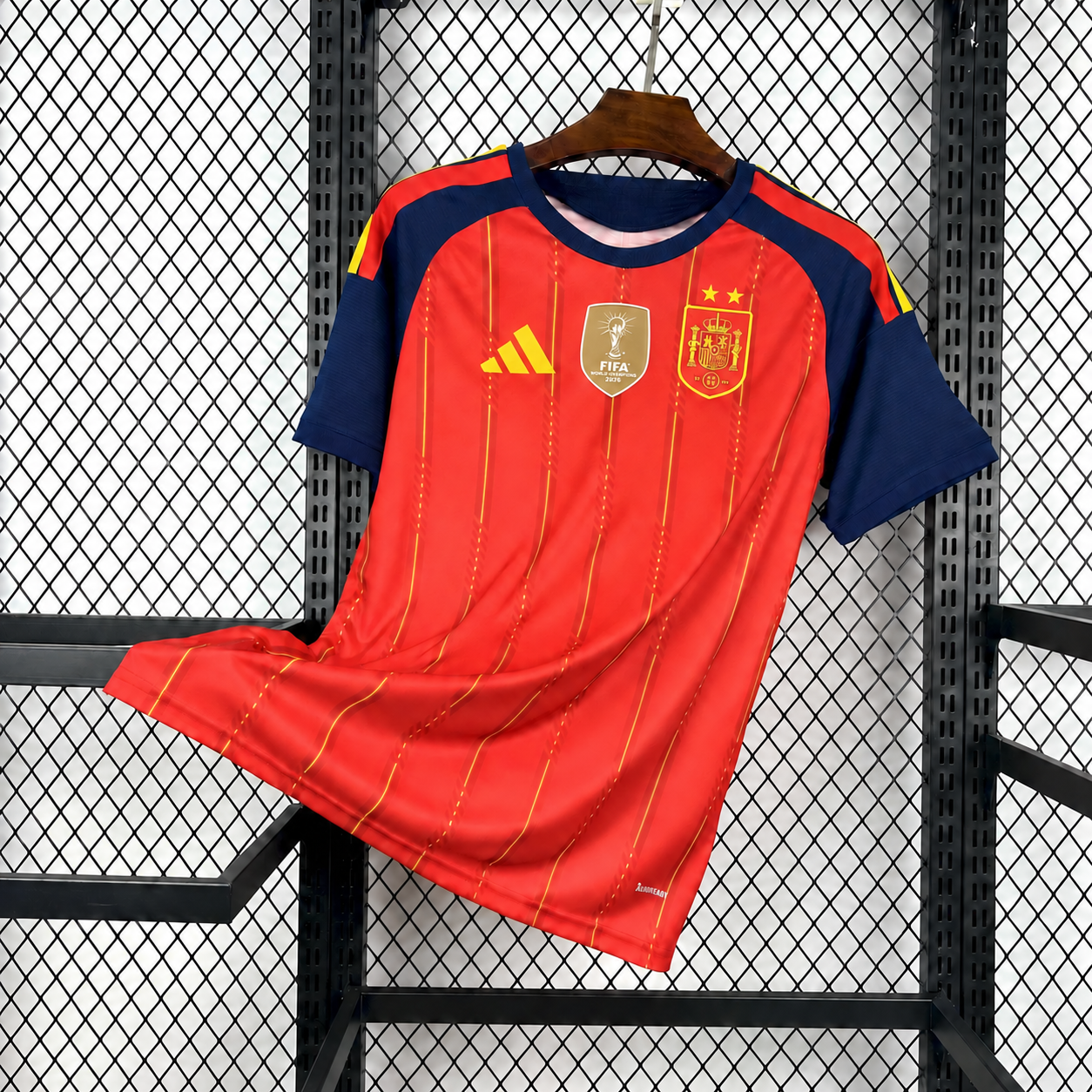
A current Spain shirt product image. It illustrates the garment listing, not a verified player's match-worn shirt.
The Spain 2026 World Cup Football Shirt listing describes a red and navy shirt with slim gold vertical lines and a crew neck. The description says the listing is for the shirt only. Its commercial name includes Champions Edition; that wording does not establish official licensing, player use or the meaning of every badge.
Compare it with the Spain shirt collection to choose the design before deciding on lettering. Confirm the live size and personalisation options on the exact listing. We have not verified that this item can reproduce every player's tournament print, so this article makes no such promise.
Our broader football shirt personalisation guide covers general ordering checks. This article answers the narrower question about Spain's naming conventions, rather than competing with that guide for a general custom-shirt query.
A name on the back is not authentication
A printed sporting name makes a garment recognisable, but it does not by itself prove that the shirt was manufactured under licence, issued to a player or used in a match. Those are separate claims requiring appropriate evidence. The same applies to a shirt shown in a memorable photograph: resemblance is not provenance.
If you are buying ordinary supporter clothing, focus on what the listing actually offers. If you are seeking documented memorabilia, ask for the relevant provenance rather than treating a name or number as proof. Keeping those goals separate makes the purchase clearer.
Summary
Spain shirts do not follow an all-first-names rule. A visible name may be a first name, surname or sporting nickname. Pedri and Gavi illustrate why one word is not enough to identify the naming category. Before choosing a print, match the player, shirt period, name and number, then confirm the actual seller's options.
By THJORE. Researched 10 October 2026 through UEFA equipment rules, Spanish federation pages and a current store listing. No player interview, hands-on product test or authentication assessment is claimed. FootballTHJORE sells football clothing; its product links have a commercial purpose. Federation references are independent sources, not endorsements of this store.

 USD
 ANG(ƒ)
 LKR(₨)
 EGP(EGP)
 BZD(BZ$)
 CRC(¢)
 MAD(DH.)
 OMR(RO.)
 KES(KSh)
 GHS(₵)
 UGX(USh)
 RSD(RSD)
 RON(lei)
 PGK(K)
 CDF(CDF)
 UYU($U)
 KZT(〒)
 PKR(Rs)
 MNT(₮)
 ARS(ARS$)
 COP(COP)
 MVR(Rf)
 IQD(د.ع)
 BDT(Tk)
 ZMW(ZK)
 NAD(N$)
 JMD(J$)
 AOA(Kz)
 MMK(K.)
 PEN(S/.)
 MOP(MOP$)
 BND(B$)
 LAK(₭)
 VND(₫)
 NGN(₦)
 KHR(៛)
 TWD(NT$)
 CNY(¥)
 SAR(S.R.)
 BHD(BD.)
 QAR(QR.)
 KWD(K.D.)
 UAH(₴)
 IDR(Rp)
 MYR(RM)
 AED(AED)
 JPY(円)
 INR(Rs)
 TRY(₺)
 CLP(CLP)
 KRW(₩)
 ZAR(R)
 SEK(Kr)
 ILS(₪)
 HKD(HK$)
 THB(฿)
 PLN(zł)
 NZD(NZ$)
 NOK(Kr)
 MXN(MXN$)
 HUF(Ft)
 CZK(Kč)
 SGD(S$)
 PHP(₱)
 DKK(kr.)
 CHF(CHF)
 BRL(R$)
 RUB(₽)
 CAD(CA$)
 AUD(A$)
 GBP(£)
 EUR(€)
 Barcelona
 Real Madrid
 Manchester United
 Inter Miami
 Manchester City
 Fc Bayern
 Ac Milan
 Chelsea
 Juventus
 Arsenal
 PSG
 Liverpool
 Inter Milan
 Santos FC
 Roma
 Portugal
 Al Nassr
 Atletico Madrid
 Everton
 Everton
 Germany
 Ajax
 Mexico
 Napoli
 Columbia
 Sporting lisbon
 France
 Tottenham
 Morocco
 Real Betis
 Brazil
 USA
 ltalia
 Argentina
 England
 Borussia Dortmund
 Spain
 Japan
 Netherlands
 Adidas
 Nike
 Puma
 NB
 Kappa