Footballers wear black armbands as a mark of mourning and respect, often following a death or as part of a commemorative tribute. The meaning of a particular match tribute comes from the club or competition announcement. A black band by itself does not tell you who is being remembered, and a photograph from a previous season cannot answer why a team is wearing one today.
For supporters looking at shirt photographs, there is another useful distinction: a temporary tribute worn during a match is not automatically a feature of the shirt sold in a shop. Here is how to identify the gesture, separate it from the captain's armband, and read the match context before drawing conclusions about a kit.
The same gesture can remember different people
Two official Premier League announcements show why context matters. In its 31 December 2022 account of tributes to Pele, the league reported a minute's applause and black armbands worn by players and match officials at matches from 30 December. That is evidence of a coordinated tribute for that period, not an explanation for every later appearance of a black band.
The league's July 2020 announcement following Jack Charlton's death likewise stated that players would wear black armbands and observe a moment of silence before the weekend's matches. These are separate commemorations. Neither example should be presented as current match news.
The practical lesson is to keep the match date attached to the explanation. Search results can preserve an accurate article long after the event it describes. If you are watching a replay, use the date of the fixture rather than the date on which you happen to watch it.
Black mourning band or captain's armband?
The captain has a separate equipment requirement. IFAB Law 4 requires a captain's armband issued or authorised by the competition organiser, or a permitted single-coloured alternative that may identify the captain. A band can therefore be part of a playing role rather than a tribute. Colour alone is an unreliable way to identify its purpose.
This comparison explains what to check; it does not assign a meaning to an unidentified photograph. Do not assume that every black captain's armband is a mourning band, or that a tribute must be limited to one player because the captain is the most visible person on screen.
How to find the reason for a particular match
Start with the teams, competition and fixture date. Look for the club's match announcement or the competition's tribute notice. Check whether it refers to one team, both teams, match officials or a whole round of fixtures. An explicit dated statement is stronger evidence than a cropped photograph or an old headline with the same shirt colours.
If the relevant announcement is unavailable, keep the answer limited: the black band may indicate a remembrance gesture, but the person or event has not been verified. It is better to leave that detail unresolved than attach the wrong bereavement to a team. This guide is an evergreen explanation, not a live list of the reasons for today's matches.
What this means when buying a football shirt
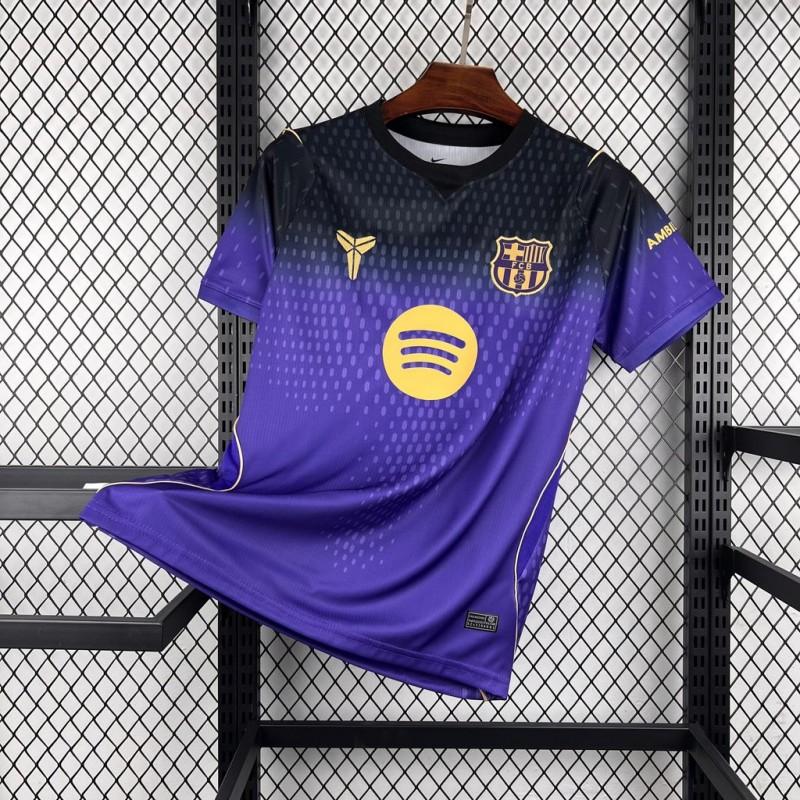
Retail listing illustration. This image is not evidence of a memorial match, match-worn provenance or an included armband.
Separate the shirt design from what a player wears with it. The Barcelona 2026 purple-and-black away shirt listing, for example, displays its own photographs and size options. Use those to evaluate that retail item. Do not infer an extra accessory, a memorial connection or a match-used history from a similar-looking shirt in television footage.
When browsing new-season football shirts, compare the exact design, listing contents and selected size. If a separate band matters to your purchase, ask whether it is included before ordering. An ordinary team shirt and a documented commemorative match item are different purchase propositions; the team name alone does not establish the latter.
For other details visible on sleeves and chests, our football shirt patch guide explains the separate listing checks. The football shirt poppy guide addresses a different remembrance symbol. Neither should be used as a substitute for the announcement identifying a particular black-armband tribute.
Summary
Why do footballers wear black armbands? Usually to express mourning or take part in a tribute. Identify the specific reason from the dated club or competition statement, and distinguish that gesture from the captain's armband. When shopping, check the actual shirt listing rather than assuming everything seen during a match comes with the retail shirt.
Sources and research scope
Reviewed on 19 October 2026 using the linked Premier League announcements and current IFAB equipment rule. Historical examples retain their original dates. This is documentary research, not first-hand participation in those tributes, an authentication service or confirmation of a current fixture. FootballTHJORE sells the linked shirt; its retail image is illustrative and does not establish an association with either historical commemoration.

 USD
 ANG(ƒ)
 LKR(₨)
 EGP(EGP)
 BZD(BZ$)
 CRC(¢)
 MAD(DH.)
 OMR(RO.)
 KES(KSh)
 GHS(₵)
 UGX(USh)
 RSD(RSD)
 RON(lei)
 PGK(K)
 CDF(CDF)
 UYU($U)
 KZT(〒)
 PKR(Rs)
 MNT(₮)
 ARS(ARS$)
 COP(COP)
 MVR(Rf)
 IQD(د.ع)
 BDT(Tk)
 ZMW(ZK)
 NAD(N$)
 JMD(J$)
 AOA(Kz)
 MMK(K.)
 PEN(S/.)
 MOP(MOP$)
 BND(B$)
 LAK(₭)
 VND(₫)
 NGN(₦)
 KHR(៛)
 TWD(NT$)
 CNY(¥)
 SAR(S.R.)
 BHD(BD.)
 QAR(QR.)
 KWD(K.D.)
 UAH(₴)
 IDR(Rp)
 MYR(RM)
 AED(AED)
 JPY(円)
 INR(Rs)
 TRY(₺)
 CLP(CLP)
 KRW(₩)
 ZAR(R)
 SEK(Kr)
 ILS(₪)
 HKD(HK$)
 THB(฿)
 PLN(zł)
 NZD(NZ$)
 NOK(Kr)
 MXN(MXN$)
 HUF(Ft)
 CZK(Kč)
 SGD(S$)
 PHP(₱)
 DKK(kr.)
 CHF(CHF)
 BRL(R$)
 RUB(₽)
 CAD(CA$)
 AUD(A$)
 GBP(£)
 EUR(€)
 Barcelona
 Real Madrid
 Manchester United
 Inter Miami
 Manchester City
 Fc Bayern
 Ac Milan
 Chelsea
 Juventus
 Arsenal
 PSG
 Liverpool
 Inter Milan
 Santos FC
 Roma
 Portugal
 Al Nassr
 Atletico Madrid
 Everton
 Everton
 Germany
 Ajax
 Mexico
 Napoli
 Columbia
 Sporting lisbon
 France
 Tottenham
 Morocco
 Real Betis
 Brazil
 USA
 ltalia
 Argentina
 England
 Borussia Dortmund
 Spain
 Japan
 Netherlands
 Adidas
 Nike
 Puma
 NB
 Kappa