What Is a Match Issue Shirt? Labels and Provenance
2026-10-24
A match issue shirt generally refers to a shirt supplied or prepared for a player, but the label does not automatically mean it was worn in a match. Sellers use the terminology differently. Before paying for a connection to a player or fixture, read the seller's definition and the evidence attached to that particular item.
The useful distinction is between a product's specification and its history. A retail shirt can resemble the on-pitch design without ever entering a team's kit supply. A player's name printed on the back also does not establish who received or wore it.
Why the seller's definition matters
The MWS / Liverpool support guide distinguishes match-worn shirts from shirts prepared for a player but not worn by that player in the game. Its match-issued examples include unused substitutes' shirts and unused shirts for players who did play. It notes that an issued shirt may nevertheless show use from a warm-up.
Classic Football Shirts' product definitions use match issue more broadly for items issued to a player that may have been worn or supplied as a spare. The practical lesson is to ask what the phrase means on the listing you are reading, rather than treating a familiar label as a universal grading system.
Compare the claim, not just the shirt
Wording
Question to ask
What not to assume
Match issue / match-issued
Issued to which player, and what use does this seller claim?
That it was worn during play
Match-worn
Which match and what evidence links this item to it?
That a general team photograph identifies this exact garment
Player version / authentic retail tier
What specifications does the retail listing confirm?
That it was allocated to a professional player
Signed shirt
What evidence supports the signature and, separately, any use claim?
That a signature proves match wear
These are questions for assessing the strength of a claim, not a remote authentication service. A photograph or a description may be insufficient to resolve them. When a distinction is important to the purchase, obtain a clear answer before treating it as part of the item's value.
Build an item-specific evidence record
Start by copying the exact claim into your notes. For example, does the listing say prepared for a named match, issued during a season, or worn in a particular fixture? Those statements are different. Do not strengthen a vague season-level description into a match-level story yourself.
Then ask what connects the evidence to the item being sold. Useful questions include whether photographs show the exact shirt, whether a document identifies it, and whether the seller explains how it came into their possession. A document describing a whole collection may leave unanswered which object it covers. A certificate's heading is less useful than its specific contents and who issued it.
Keep the listing, photographs and correspondence together. If two descriptions disagree, resolve the disagreement rather than choosing the more attractive claim. A seller might describe a garment as unused while mentioning a warm-up in a longer description. Ask for the intended meaning; do not silently translate either statement into match-worn.
What photos can and cannot tell you
Front and back views, labels, printing and visible condition help you understand what is offered. They are not, on their own, a record of a shirt's journey. Dirt is not a player identity. A pristine appearance is not a documented unused status. A number and name identify the decoration, not necessarily the recipient.
If a seller offers a comparison with match photographs, examine the claimed connection carefully. Is the comparison about the general design, or a distinctive feature of the individual garment? This is a prompt for further evidence, not a promise that every item can be reliably photo-matched by a buyer.
For the separate question of retail tiers, our authentic versus replica jersey guide compares that terminology. Retail specification and documented player use should remain separate lines in your decision.
Choose according to what you actually want
If the purpose is to wear a team design, fit, appearance, included items and the current seller's terms may be the central questions. There is no need to infer a player connection to justify liking a shirt. If the purpose is to collect an object connected with a specific player or event, that connection needs its own evidence; a similar-looking retail garment does not answer it.
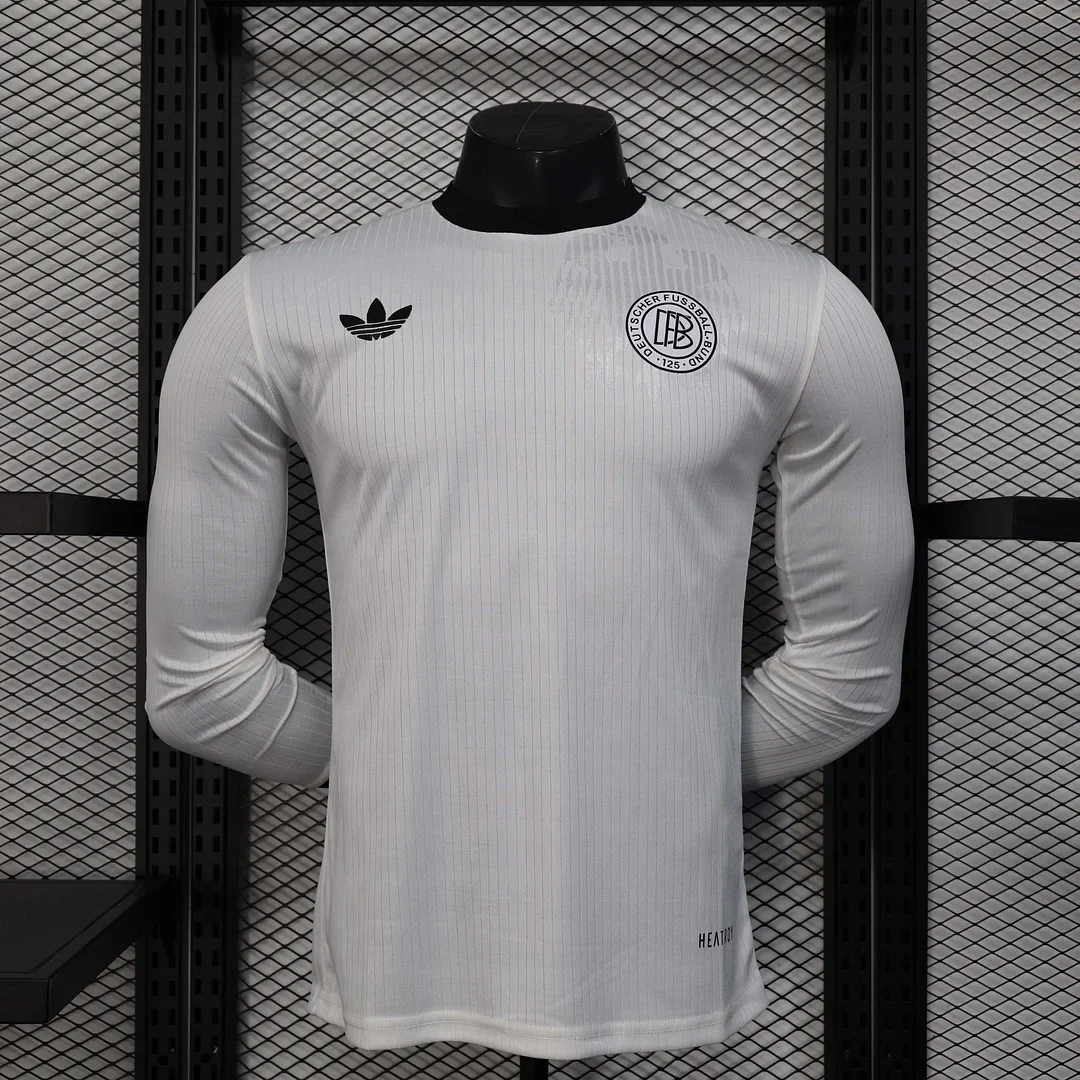
Retail design example only. This photograph is not evidence of a match-issued shirt.
The Germany 2025 pinstripe long-sleeve shirt listing illustrates the ordinary design-shopping route. Its visible pinstripes, dark neckline and cuffs can help a shopper choose a look. Neither that photograph nor its year label establishes allocation to a player. We do not present it here as match-issued or match-worn.
Use the Germany shirt collection when browsing retail designs. If documented player provenance is the reason for your purchase, look for explicit item-specific evidence rather than treating these retail examples as substitutes.
A short checklist before deciding
Write down the seller's exact definition of match issue.
Separate the garment's specifications from claims about who received or wore it.
Identify the player, season or fixture actually stated, without filling gaps yourself.
Check that supporting documents and photographs refer to the item offered.
Resolve conflicting descriptions before buying on the strength of a provenance claim.
Summary
A match issue shirt is not automatically a match-worn shirt. The most useful comparison is between the seller's precise claim and the evidence for that individual item. Choose retail designs for their confirmed features; require separate provenance when a player or match connection is what matters.
Research checked 24 October 2026 using the two seller definition pages linked above and a current store listing. FootballTHJORE sells the illustrated retail product. This guide is not an authentication, valuation or claim of personal collecting expertise.

 USD
 ANG(ƒ)
 LKR(₨)
 EGP(EGP)
 BZD(BZ$)
 CRC(¢)
 MAD(DH.)
 OMR(RO.)
 KES(KSh)
 GHS(₵)
 UGX(USh)
 RSD(RSD)
 RON(lei)
 PGK(K)
 CDF(CDF)
 UYU($U)
 KZT(〒)
 PKR(Rs)
 MNT(₮)
 ARS(ARS$)
 COP(COP)
 MVR(Rf)
 IQD(د.ع)
 BDT(Tk)
 ZMW(ZK)
 NAD(N$)
 JMD(J$)
 AOA(Kz)
 MMK(K.)
 PEN(S/.)
 MOP(MOP$)
 BND(B$)
 LAK(₭)
 VND(₫)
 NGN(₦)
 KHR(៛)
 TWD(NT$)
 CNY(¥)
 SAR(S.R.)
 BHD(BD.)
 QAR(QR.)
 KWD(K.D.)
 UAH(₴)
 IDR(Rp)
 MYR(RM)
 AED(AED)
 JPY(円)
 INR(Rs)
 TRY(₺)
 CLP(CLP)
 KRW(₩)
 ZAR(R)
 SEK(Kr)
 ILS(₪)
 HKD(HK$)
 THB(฿)
 PLN(zł)
 NZD(NZ$)
 NOK(Kr)
 MXN(MXN$)
 HUF(Ft)
 CZK(Kč)
 SGD(S$)
 PHP(₱)
 DKK(kr.)
 CHF(CHF)
 BRL(R$)
 RUB(₽)
 CAD(CA$)
 AUD(A$)
 GBP(£)
 EUR(€)
 Barcelona
 Real Madrid
 Manchester United
 Inter Miami
 Manchester City
 Fc Bayern
 Ac Milan
 Chelsea
 Juventus
 Arsenal
 PSG
 Liverpool
 Inter Milan
 Santos FC
 Roma
 Portugal
 Al Nassr
 Atletico Madrid
 Everton
 Everton
 Germany
 Ajax
 Mexico
 Napoli
 Columbia
 Sporting lisbon
 France
 Tottenham
 Morocco
 Real Betis
 Brazil
 USA
 ltalia
 Argentina
 England
 Borussia Dortmund
 Spain
 Japan
 Netherlands
 Adidas
 Nike
 Puma
 NB
 Kappa