If you are asking what are soccer shoes made of, separate the answer into components. The upper, lining, collar, insole and outsole do not have to use the same material. Leather, synthetic and textile descriptions are useful starting points, but a label describing the upper is not a specification for the whole shoe.
This guide explains how to read those descriptions before buying. It focuses on what you can establish from a model's documentation, what remains unanswered and why a photograph is not a substitute for a materials list. It is a research-based guide rather than a laboratory analysis or wear test.
Start with the part being described
The upper is the part around the foot above the sole. An upper description might identify leather, a synthetic material or a textile construction. A shoe can also have different information for its collar, lining and outsole. When comparing two listings, put equivalent components next to each other rather than treating two different details as alternatives.
For example, a textile collar and a leather upper are not necessarily contradictory descriptions: they can refer to different parts. A rubber sole description is also not an answer to the upper question. Ask where the named material is used before deciding what a product description tells you.
Write a short component list for each candidate: upper, lining, collar or tongue, insole and outsole. Leave an unanswered field blank. This creates a useful buying comparison without pretending you have a full bill of materials.
Leather, synthetic and textile: what the terms tell you
adidas's football-footwear guidance distinguishes leather uppers from synthetic and textile-mesh examples when discussing fit. It describes leather as adapting over time, while its synthetic examples tend to retain their initial fit. That is manufacturer guidance, not a guarantee that every shoe carrying a familiar family name behaves identically.
The same brand's soccer-cleat buying guide gives examples of a coated textile upper and a leather upper on different models. These are examples from that guide, not verified construction claims for FootballTHJORE's linked merchandise.
The useful conclusion is that the exact specification matters. Do not assign leather to an entire product family because an earlier generation used it. Do not assume a shoe is animal-free merely because one component is described as synthetic. An upper label leaves the other components and sourcing unanswered.
If your question is what materials are soccer shoes made of, ask which component the answer describes. Searches such as what are adidas soccer shoes made of need an exact model rather than a single answer for the entire brand.
Read the complete phrase
Leather and synthetic leather are different descriptions. Textile, mesh and a named proprietary material may also describe different levels of detail. Preserve the complete phrase in your comparison notes. Shortening a seller's wording can remove a qualification that matters to your decision.
A trade name is not a complete composition list. If a specific fibre, coating or animal-derived component matters to you, look for an explicit statement applying to the exact model. When that statement is unavailable, record the uncertainty and ask before treating a general family description as proof.
Treat feel claims separately
Words such as soft, thin or textured describe a characteristic or marketing position; they do not identify the complete material. Likewise, a photograph of a smooth surface does not prove leather, and a visible fabric pattern does not establish every layer beneath it.
Keep claimed construction and claimed benefits in separate columns. You might have a precise upper description but no independently tested durability result. Conversely, a review discussing comfort may not contain a reliable composition list. Neither observation fills the other gap.
Material descriptions compared
This table compares the information conveyed by labels. It does not rank materials by performance or claim that one category is universally better. A buying decision still needs the pair's actual specification and your requirements.
The outsole is a separate question
The material above your foot does not settle the playing-surface question. adidas's guide separates firm-ground, artificial-ground, multi-ground, turf and indoor options. It also describes rubber-studded turf soles and indoor soles. Use the exact sole designation and venue requirements rather than choosing solely by the upper's appearance.
Our AG vs FG guide covers the separate surface decision. The materials question here is narrower: which part is described, what has been stated about it, and what is missing? Do not turn a materials comparison into an unsupported recommendation for every pitch.
You do not need to identify a sole's polymer by sight. If a specific outsole composition is important, look for documented information rather than supplying a chemical name because another boot uses it. A product family and a photograph cannot resolve that question on their own.
A real listing shows the limits of a name and picture
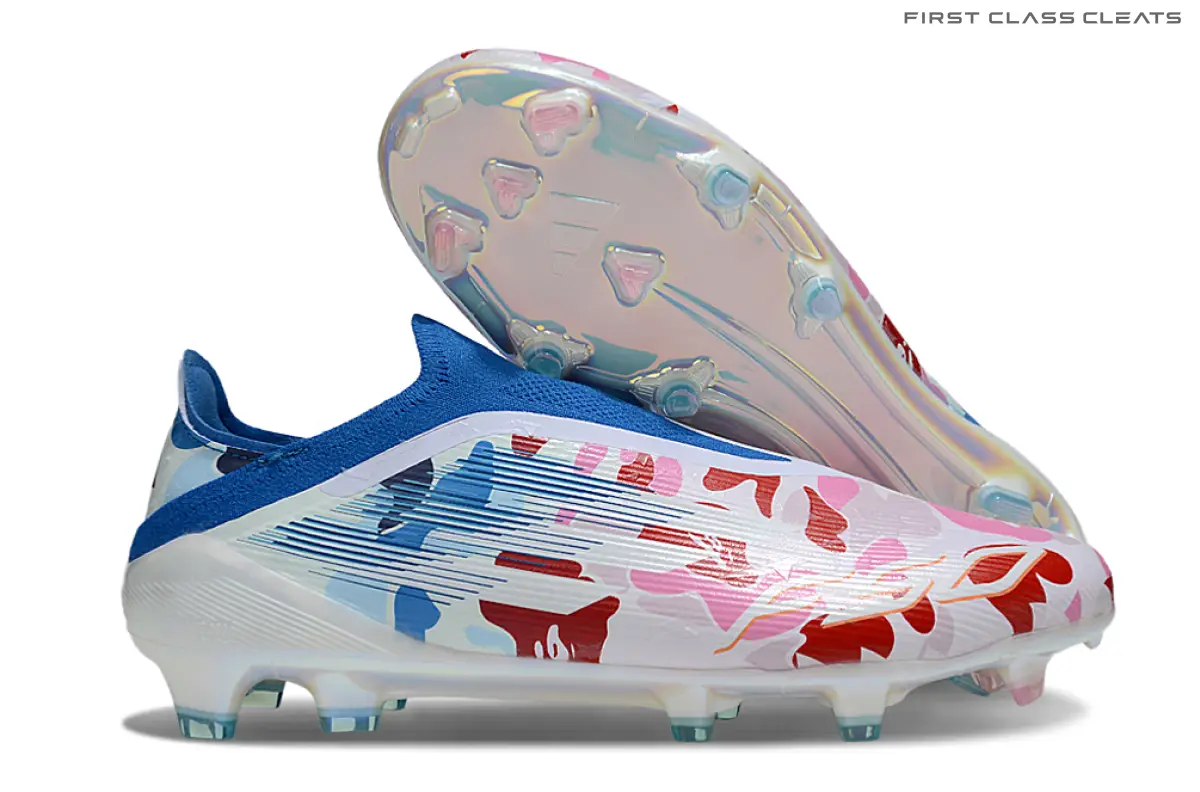
Store listing image, used to identify the example. It is not a material test or evidence of manufacturer authentication.
The F50 Elite Laceless FG X BAPE listing was inspected on 17 October 2026. Its title identifies a laceless item and contains FG. Those words do not establish upper composition, every outsole component or the construction of a removable insole.
The example is useful because it makes the unanswered fields visible. A buyer who needs a particular material should resolve those fields rather than importing specifications from a manufacturer's differently named model. Explore the football shoes collection, then inspect the individual page for the information relevant to your requirements.
Questions to answer before choosing a material
Is this the exact model and tier?
Record the model name, generation where stated, tier and sole version. If two pages identify different generations or tiers, you may be comparing several construction changes at once. Keep that difference visible instead of attributing every distinction to leather versus synthetic.
The Nike Academy vs Elite guide explains tier terminology. A premium tier is not proof of a particular upper, and a lower price does not supply missing composition information.
What requirement are you trying to meet?
A material question should lead to a concrete requirement: documented composition, care you can follow, a fit you can assess or a construction feature you can verify. Avoid choosing a category simply because it is described as traditional or modern.
If the requirement is fit, use model-specific sizing and try-on information. If it is care, check the instructions for that actual pair. Do not deliberately buy an uncomfortable size because a broad materials article mentions adaptation over time.
What is still unknown?
Make unanswered points part of the decision. Ask for the exact upper description or care instructions where necessary. If you cannot obtain a fact that is essential to the purchase, reconsider the candidate instead of turning a guess into a positive feature.
This is especially important when the listing uses a familiar family name but lacks a detailed component specification. The name helps identify the candidate; it is not independent authentication or an exhaustive technical description.
Summary
Soccer shoes use different materials in different components. Read the upper separately from the lining, collar, insole and sole, and retain qualifiers such as synthetic or coated. Compare documented statements for exact models rather than inferring composition from a picture, tier or family name. Resolve essential unknowns before buying; the best materials description is the one that answers your actual requirement accurately.
Research scope and commercial disclosure
Prepared for FootballTHJORE on 18 October 2026 using the linked adidas guidance and a store listing check dated 17 October 2026. This is documentary research, not chemical analysis, a wear test or independent authentication. FootballTHJORE sells the linked merchandise and benefits from purchases. Manufacturer descriptions explain their own models and do not authenticate or endorse the store listing.
 USD
 ANG(ƒ)
 LKR(₨)
 EGP(EGP)
 BZD(BZ$)
 CRC(¢)
 MAD(DH.)
 OMR(RO.)
 KES(KSh)
 GHS(₵)
 UGX(USh)
 RSD(RSD)
 RON(lei)
 PGK(K)
 CDF(CDF)
 UYU($U)
 KZT(〒)
 PKR(Rs)
 MNT(₮)
 ARS(ARS$)
 COP(COP)
 MVR(Rf)
 IQD(د.ع)
 BDT(Tk)
 ZMW(ZK)
 NAD(N$)
 JMD(J$)
 AOA(Kz)
 MMK(K.)
 PEN(S/.)
 MOP(MOP$)
 BND(B$)
 LAK(₭)
 VND(₫)
 NGN(₦)
 KHR(៛)
 TWD(NT$)
 CNY(¥)
 SAR(S.R.)
 BHD(BD.)
 QAR(QR.)
 KWD(K.D.)
 UAH(₴)
 IDR(Rp)
 MYR(RM)
 AED(AED)
 JPY(円)
 INR(Rs)
 TRY(₺)
 CLP(CLP)
 KRW(₩)
 ZAR(R)
 SEK(Kr)
 ILS(₪)
 HKD(HK$)
 THB(฿)
 PLN(zł)
 NZD(NZ$)
 NOK(Kr)
 MXN(MXN$)
 HUF(Ft)
 CZK(Kč)
 SGD(S$)
 PHP(₱)
 DKK(kr.)
 CHF(CHF)
 BRL(R$)
 RUB(₽)
 CAD(CA$)
 AUD(A$)
 GBP(£)
 EUR(€)
 Barcelona
 Real Madrid
 Manchester United
 Inter Miami
 Manchester City
 Fc Bayern
 Ac Milan
 Chelsea
 Juventus
 Arsenal
 PSG
 Liverpool
 Inter Milan
 Santos FC
 Roma
 Portugal
 Al Nassr
 Atletico Madrid
 Everton
 Everton
 Germany
 Ajax
 Mexico
 Napoli
 Columbia
 Sporting lisbon
 France
 Tottenham
 Morocco
 Real Betis
 Brazil
 USA
 ltalia
 Argentina
 England
 Borussia Dortmund
 Spain
 Japan
 Netherlands
 Adidas
 Nike
 Puma
 NB
 Kappa