What are soccer jerseys made of? Most modern shirts use synthetic fabric, especially polyester, because it can be light, hold colour and keep its shape through regular use. Some designs also use elastane in selected areas, while names, numbers, crests and sponsor graphics may be made or applied differently from the main fabric.
That short answer is useful, but it is not a safe shortcut for judging a particular product. Two shirts can look similar in a photograph and still use different fabric blends, panel construction or print applications. A general material guide explains what is common across the category; the care label and the current product page remain the evidence for the exact shirt you are considering.
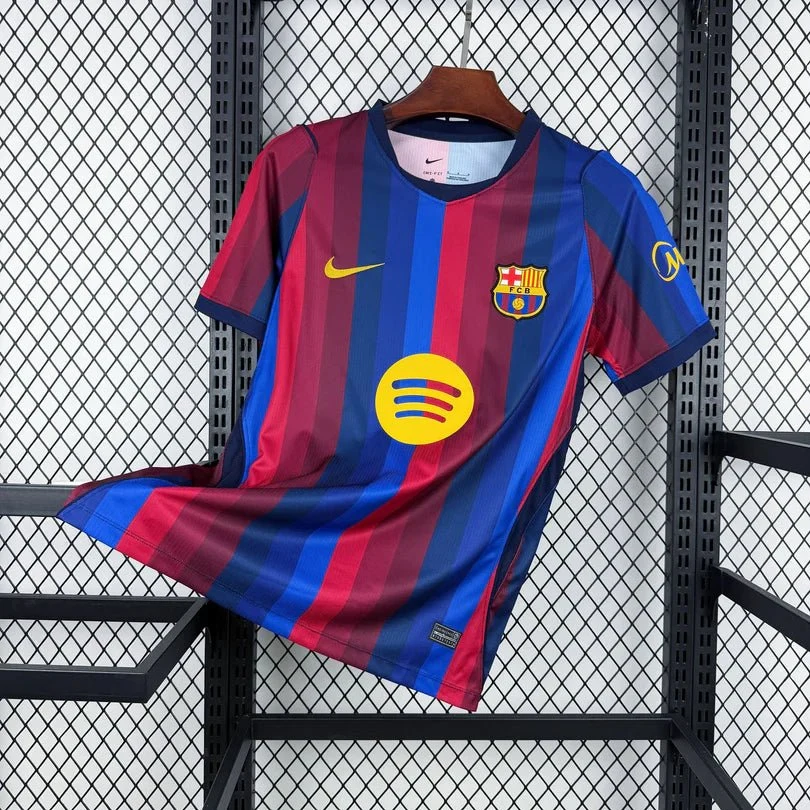
This current Barcelona listing is a useful visual example, but a photograph alone cannot confirm its fibre content. Check the live page and garment label for product-specific material information.
The main material in many modern soccer jerseys
Polyester is the most common starting point for modern football shirts and soccer jerseys. Macron's manufacturing explainer describes polyester and polyester-elastane blends as typical choices, while the Royal Society of Chemistry's football-shirt teaching resource separates the main fabric from materials used in stretch areas and printed details.
Polyester is a manufactured fibre. In practical terms, it is useful for a sports shirt because it can be made into a light knitted fabric, dyed in strong colours and designed to retain its shape. Those properties help explain why cotton, although comfortable in many casual garments, is less common as the main fabric in contemporary match-style shirts.
Some manufacturers also use recycled polyester yarn. “Recycled” describes the source of the material, not automatically the feel, weight or performance of every finished shirt. Construction, yarn, knit, panel placement and finishing still matter. A product should only be described as recycled when the maker or the specific listing supplies that information.
Why elastane may appear in a jersey
Elastane, also called spandex in the United States, can add stretch and recovery. It may be blended into a fabric or used in smaller zones such as a collar, cuff or close-fitting panel. Its presence is not universal, and a visible stretch panel does not reveal the percentage used.
This is one reason a buyer should avoid treating all “player version,” “fan version” or “premium” labels as a material formula. Those words may classify products within a seller's catalogue, but they do not prove a fibre composition by themselves. Read the description and label instead of borrowing a specification from another brand or season.
The shirt is more than its main fabric
A finished jersey can combine several kinds of component:
- Main body fabric: often a polyester knit, sometimes with mesh-like zones.
- Stretch areas: may use elastane or a different knit structure.
- Name and number: can be a separate applied film or print rather than dyed fabric.
- Crest, brand and sponsor details: may be embroidered, woven, printed or heat-applied, depending on the design.
- Thread, neck tape and labels: small components that may not match the exact composition of the body fabric.
The distinction matters for care. A washing method that the main fabric can tolerate may still be too harsh for an applied name, number or sponsor graphic. Before cleaning a printed shirt, use the garment's instructions and review this printed football-shirt care checklist.
Polyester, cotton and blends compared
This table describes categories, not the specification of every shirt. A jersey with a smooth front is not necessarily made from the same blend as another smooth-looking jersey. Likewise, a mesh appearance does not prove a particular technology or performance rating.
How fabric affects fit without determining it
Material and fit are related, but they are not interchangeable. A shirt can contain stretch and still have a narrow cut. Another can use a less stretchy fabric and still feel roomy because of its pattern and measurements.
Use the seller's size information and compare measurements with a garment that already fits you. Do not assume that polyester means “true to size,” that elastane means you should size down, or that a version label guarantees a specific cut. If numerical measurements are missing, that limitation is more useful to recognise than to fill with a guess.
How material affects care
The safest care decision starts with the label. In general, high heat creates avoidable risk for synthetic fabric and applied graphics. Hot drying or direct ironing can affect a print before it noticeably changes the body fabric. Aggressive rubbing can also stress raised or heat-applied details.
Turn the shirt inside out when the label permits, use a gentle wash approach and avoid treating the dryer as a sizing tool. If a jersey is too large, exchanging it or using a qualified alteration service is usually more predictable than trying to shrink a synthetic shirt with heat.
What to check on a product page
When you browse new-season football kits and soccer jerseys, check the exact listing rather than assuming that every design shares one specification. A useful sequence is:
- Confirm the team, season and home, away or third role in the title.
- Look for a stated fibre composition in the description.
- Check the visible size and version options without turning their labels into material claims.
- Review the care information, especially for printed names and numbers.
- Use the photographs to identify the design, while remembering that images cannot prove fibre content or texture.
For example, the Barcelona 2026 Home Shirt and Manchester City 2026 Home Shirt are separate listings with different teams and designs. Their photographs help you confirm which page you opened. They do not justify copying a material statement from one page to the other.
Common material assumptions to avoid
“All soccer jerseys are 100% polyester”
Polyester is common, but blends and component materials exist. Use “commonly” rather than “always” unless a specific label gives the composition.
“Mesh means the shirt has a named performance technology”
A visible hole or knit pattern can suggest ventilation-oriented construction, but it cannot establish a branded technology. The product description must support that claim.
“Player version tells me the exact fabric”
Version labels can be useful catalogue categories. The material still needs its own evidence.
“A photograph proves softness or weight”
Lighting and drape can show colour and design placement. They cannot reliably show tactile feel, thickness or comfort.
Conclusion
Most modern soccer jerseys are made primarily from polyester, with elastane sometimes used for stretch and other materials used in prints, crests, labels and trims. That explains the category, but it does not certify the composition of a particular product.
The best buying method is simple: use the product page to confirm the team and design, then use the material statement, care label and measurements for the physical details. When a listing does not state a fabric fact, leave it unknown instead of borrowing a claim from another shirt. That produces a more accurate comparison and helps protect printed details after purchase.
 USD
USD
 ANG(ƒ)
 LKR(₨)
 EGP(EGP)
 BZD(BZ$)
 CRC(¢)
 MAD(DH.)
 OMR(RO.)
 KES(KSh)
 GHS(₵)
 UGX(USh)
 RSD(Din.)
 RON(lei)
 PGK(K)
 CDF(CDF)
 UYU($U)
 KZT(〒)
 PKR(Rs)
 MNT(₮)
 ARS(ARS$)
 COP(COP)
 MVR(Rf)
 IQD(د.ع)
 BDT(Tk)
 ZMW(ZK)
 NAD(N$)
 JMD(J$)
 AOA(Kz)
 MMK(K.)
 PEN(S/.)
 MOP(MOP$)
 BND(B$)
 LAK(₭)
 VND(₫)
 NGN(₦)
 KHR(៛)
 TWD(NT$)
 CNY(¥)
 SAR(S.R.)
 BHD(BD.)
 QAR(QR.)
 KWD(K.D.)
 UAH(₴)
 IDR(Rp)
 MYR(RM)
 AED(AED)
 JPY(円)
 INR(Rs)
 TRY(₺)
 CLP(CLP)
 KRW(₩)
 ZAR(R)
 SEK(Kr)
 ILS(₪)
 HKD(HK$)
 THB(฿)
 PLN(zł)
 NZD(NZ$)
 NOK(Kr)
 MXN(MXN$)
 HUF(Ft)
 CZK(Kč)
 SGD(S$)
 PHP(₱)
 DKK(kr.)
 CHF(CHF)
 BRL(R$)
 RUB(₽)
 CAD(CA$)
 AUD(AUD)
 GBP(£)
 EUR(€)
 Barcelona
 Real Madrid
 Manchester United
 Inter Miami
 Manchester City
 Fc Bayern
 Ac Milan
 Chelsea
 Juventus
 Arsenal
 PSG
PSG Liverpool
 Inter Milan
 Santos FC
 Roma
Roma Portugal
 Al Nassr
 Atletico Madrid
 Everton
 Everton
 Germany
 Ajax
Ajax Mexico
 Napoli
 Columbia
 Sporting lisbon
 France
 Tottenham
 Morocco
 Real Betis
 Brazil
 USA
USA ltalia
 Argentina
 England
 Borussia Dortmund
 Spain
Spain Japan
Japan Netherlands
 Adidas
 Nike
Nike Puma
Puma NB
NB Kappa
Kappa