Retro Manchester United football shirts can mean different things to different supporters: an early-1990s away design, a home shirt associated with the Treble era, or an alternative from the team that reached consecutive European finals in 2008 and 2009. Choosing between them becomes easier when you separate the football memory, the appearance you want and the garment you intend to wear. This guide explores five visual directions across six long-sleeve listings in the FootballTHJORE range, with historical context and practical advice for narrowing the choice.
You do not need to know every United kit to make a good decision. Start with the photographs and the comparison table, then read the sections for the two or three designs that interest you. A favourite season can lead the choice, but sleeve length, fit information and whether you want a home or change shirt matter too. Someone collecting a particular era will approach the same range differently from someone choosing a first shirt or a gift.
The historical sources in this guide explain the club and its designs. They do not establish the manufacturer, licensing, fabric or age of a FootballTHJORE garment. The listed dates refer to the designs named by the store; they should not be read as a claim that the items were manufactured in those years. Where original vintage provenance is essential, obtain specific documentation for the item before buying.
Six options at a glance
The shortlist includes two home listings and four listings named away, third or third away. The two entries labelled 2008/2009 Away and Third currently show very similar blue shirts; they are not confirmed as two distinct designs. Every product name specifies long sleeves. Short-sleeve buyers can begin with the wider Manchester United collection.
There are three helpful comparisons here. The early-1990s choices contrast a blue-and-white all-over pattern with green-and-gold halves. The home choices contrast a white folded collar and sleeve detailing with a simpler red design and shallow V neckline. For a blue shirt, compare the busy 1990/1992 pattern with the mostly solid blue 2008/2009 Third photograph. These are visible differences, rather than differences inferred from a catalogue label.
Product names use “jersey”, “shirt” and “kit” in different places. Those are the store's listing names, not a promise that every item called a kit includes shorts or socks. Similarly, the shared long-sleeve wording does not establish identical dimensions across the range. This table helps you choose a design; the individual listing supplies the information needed to choose an order.
Retro design, vintage original and commemorative shirt
Before choosing an era, decide what you mean by retro. A design can refer to an older season while the garment itself is newly made. A vintage original is a different proposition: its production date, condition and provenance become part of the purchase. A commemorative shirt can honour a past event without reproducing every feature of the match shirt. These distinctions matter because two garments can refer to the same team and year while serving different collecting goals.
For example, adidas has revisited United's historic designs in later collections. Its 2020 Humanrace release explains that a new United jersey drew on the blue-and-white pattern of the 1990–92 away kit. That demonstrates how a past design can inspire a later product without the two being the same object. The adidas account of that design project does not establish that the shirt sold here belongs to its collection or carries the same specifications or authorization.
If you want a wearable reminder of a season, begin with the design and fit information. If you want an original object from a particular year, begin with provenance and condition. If you want an exact match to a specific final, research that match's shirt separately. A general season name is not enough to establish competition badges, final embroidery, sleeve format or the precise configuration worn by a player.
This distinction also avoids paying for the wrong attribute. Someone interested in the look may place little value on period packaging; a collector seeking an original may consider documented age central. Neither preference is wrong. What matters is that the description and supporting information answer your actual reason for buying, rather than relying on the emotional pull of a famous year.
1990/1992 away: an early-1990s starting point
The 1990/1992 away long sleeve is the earliest dated option in this six-shirt comparison. It is a useful starting point if your interest lies in the United team immediately before the Premier League era, or if you want an away design rather than a familiar home-shirt reference.
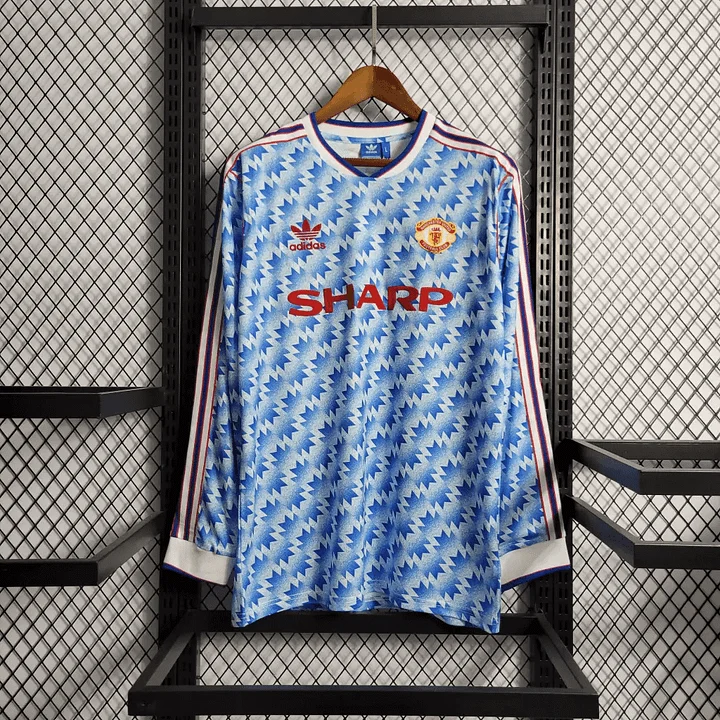
The date range deserves attention because a football season crosses calendar years. A 1990/1992 listing names a broader period than a single 1991 date. An event taking place during that period can explain a supporter's attachment to it, but does not automatically identify the exact shirt in every match or photograph. Think of the range as the starting point for a design comparison, not as a complete account of its match use.
In the product photograph, jagged blue-and-white shapes run diagonally across the body and sleeves. A white round neckline and white cuffs provide a quieter frame, with red-and-blue edging adding small accents. This is the most densely patterned blue option in the shortlist. The visual effect comes from repeated shapes across a large area, rather than one small detail that only becomes noticeable close up.
Adidas calls the historic 1990–92 reference a snowflake print in the Humanrace account linked above. That gives a useful name to the historical design language. Here, the photograph is the basis for describing the offered shirt's appearance; the historic name is not a promise about its printing method, fabric or origin. If you like the blue colour but prefer less pattern, the 2008/2009 Third listing offers a more restrained visual comparison later in this guide.
For a first retro purchase, ask whether it is the early-1990s period or this particular appearance that attracts you. If the period is decisive, place this page beside the 1992/1994 third-away option below. If the appearance is decisive, consider whether you want the shirt to be the strongest visual element in an outfit or one part of a more coordinated football look. That is a styling preference, independent of how important the season is to club history.
This is also a useful option for a collection organised around change shirts. Starting with away designs lets you explore a different part of United's visual identity from a sequence of home shirts. You do not have to assemble a complete set: one clearly chosen example can represent the period more meaningfully than several purchases made only because their dates are adjacent.
1992/1994 third away: the opening Premier League years
The 1992/1994 third-away long sleeve moves the comparison into the first Premier League seasons. The product name distinguishes it from an ordinary away listing, making it a separate choice from the 1990/1992 shirt rather than a substitute with a slightly different date.
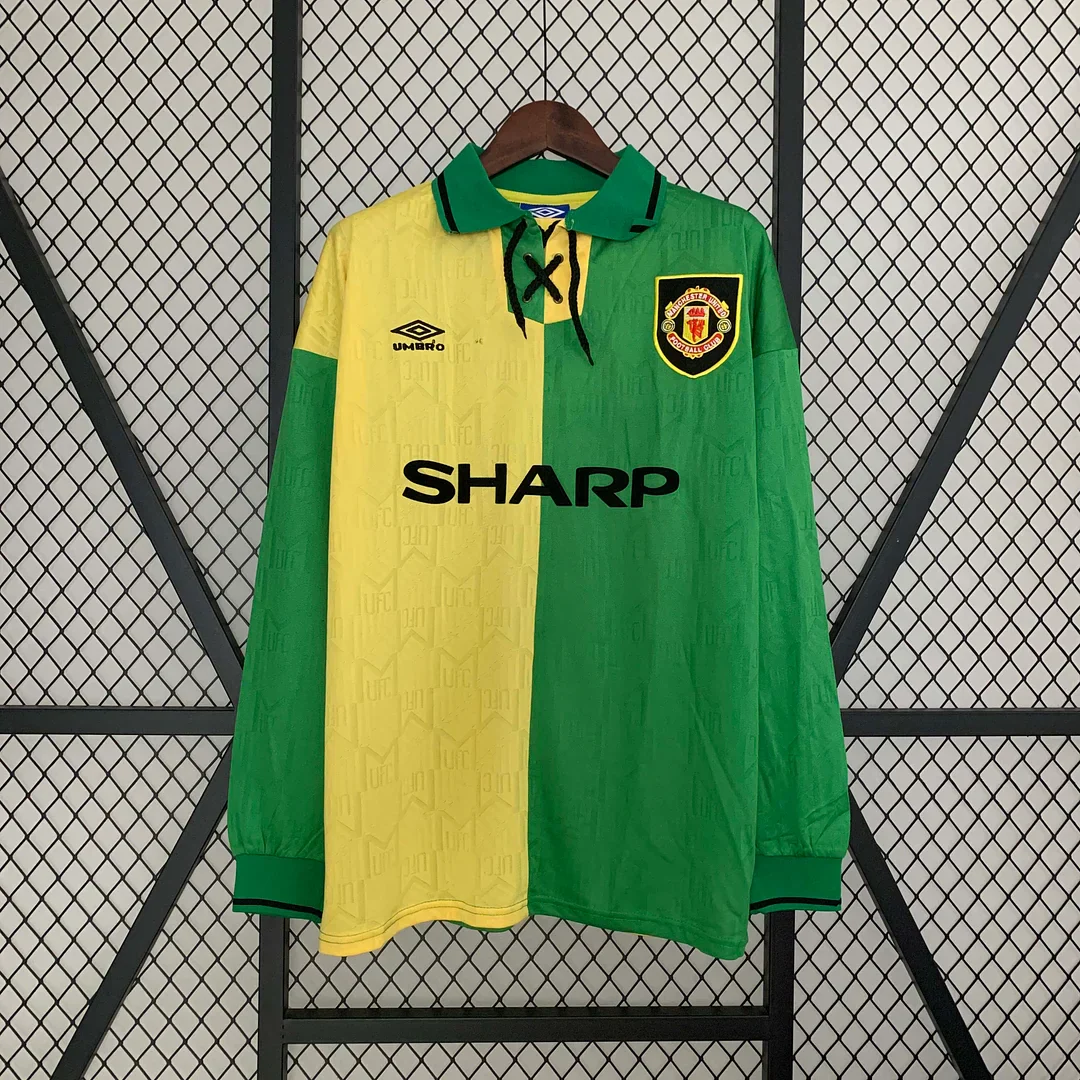
The photograph shows green and gold halves, a green folded collar with dark edging, black lacing at the neck and a black SHARP wordmark across the chest. Those features make this a substantially different visual choice from the blue-and-white pattern above. The large blocks divide the front, while the laced opening creates a strong central detail. There is no need to treat the two early-1990s options as interchangeable simply because their dates sit close together.
For someone who enjoys a pronounced neckline, the collar and lacing may be the deciding features. Someone who prefers a simple round neck may favour the 1990/1992 design. This comparison concerns the shapes visible in the photographs, not a claim that one opening is more comfortable or that either collar will behave in a particular way when worn. Those judgments require the garment and the wearer's preferences.
The period has an identifiable place in United's story. The Premier League records that the club won the inaugural 1992/93 competition, ending a 26-year wait for a top-flight championship. Its review of the following season records a league and FA Cup Double. Those achievements help explain why a supporter might favour the early Premier League years over a later, equally successful era. They describe the team, not the provenance or match use of the store's garment. See the league's 1992/93 review and 1993/94 review.
This period can appeal to someone who wants a different story from the Treble or Moscow. A collection does not need to focus only on its most famous final. The beginning of an era, the season someone first followed the club, or a remembered family shirt can be a stronger reason for choosing. If that is your motive, the 1992/1994 date is doing real work in the decision rather than acting as a decorative label.
Compare this option with the 1990/1992 away shirt when you are choosing between two early-1990s references. Compare it with the 2008/2009 third shirt when you are more interested in alternative designs across time. Those are different questions, and separating them can reveal why one candidate feels more appropriate. The first is primarily an era decision; the second is a decision about the kind of collection or wardrobe you want to build.
For a gift, “early Premier League United” is still a broad description. A recipient may remember a home, away or third shirt from those years. If you can establish which category they prefer, you can avoid choosing a historically meaningful shirt that is nevertheless the wrong design for them. The aim is a personal match, not a lesson in which period they ought to value most.
1998/1999 home: the Treble-era choice
The 1998/1999 home jersey long sleeve is the late-1990s home option in this selection. For a buyer who wants the season rather than an alternative-shirt collection, it offers a clear starting point. It also makes a useful comparison with the 2007/2008 home listing: both are home designs with long sleeves, but they point to different generations of the club.
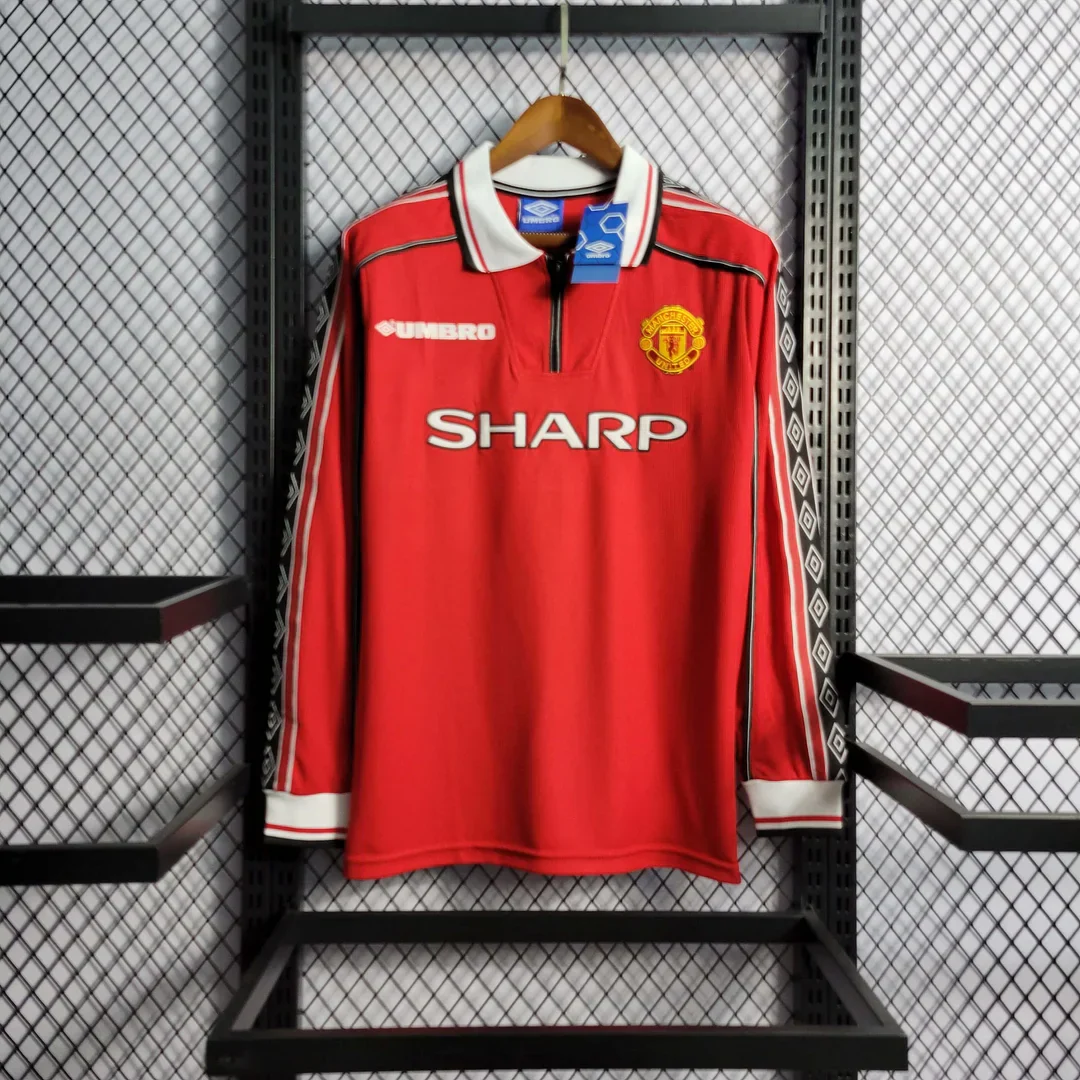
The listed shirt's photograph gives you several concrete features to compare: a red body, a white folded collar with dark and red edging, a short black zip at the neck, and white cuffs with contrasting edging. A black-and-white diamond band is visible down the outer sleeves. The detailing therefore continues beyond the chest, which matters when choosing long sleeves specifically for their appearance.
That sleeve treatment gives this option a different balance from the later red home shirt. With an open jacket, the collar may remain prominent while much of the sleeve band is covered. Worn on its own, more of the patterned sleeve detail is visible. If the sleeves are what attract you, think about your usual way of wearing a shirt before letting the famous date make the entire decision.
The historical association is well documented. United's 1998/99 campaign brought the Premier League, FA Cup and Champions League Treble. UEFA's account of the European final records the late goals by Teddy Sheringham and Ole Gunnar Solskjær that turned the match against Bayern into a 2–1 win. That is why a reference to this season can carry meaning beyond the shirt's appearance. The UEFA final retrospective provides the historical background.
The official club store's description of the era's home design identifies a red body, white collar and zip front. Those details provide useful historical reference points when comparing a late-1990s home look with a later shirt. They describe that documented design; the image and product information for the FootballTHJORE item determine the exact item offered here. See the club-store description of the 1998–00 home design.
There is another distinction worth making: a season home shirt and an exact final configuration are not necessarily the same shopping request. The club's retro range lists a 1998–00 home shirt separately from a 1999 Champions League final shirt. If a specific final appearance is essential to you, establish those details rather than assuming every shirt dated 1998/1999 supplies them. This guide does not claim that the listed long sleeve is an exact final edition.
Choose this period when the Treble season is central to the purchase, or when you prefer the late-1990s home reference over a change shirt. If you already own a red home design from this era, the blue 2008/2009 Third photograph may appeal as a different colour direction. The right addition depends on what is missing from your own collection, not on a universal ranking of historic shirts.
2007/2008 home: a later European-winning generation
The 2007-2008 home kit long sleeve is the later home option here. It is a natural comparison for someone choosing between a late-1990s memory and the United side of the following decade. Keeping home designation and long sleeves constant allows the era and appearance to become the main differences.
UEFA's match report records United's 2008 Champions League final against Chelsea in Moscow: a 1–1 draw followed by a 6–5 penalty-shoot-out victory. The Premier League's season review also identifies 2007/08 as a title-winning campaign for United. Together, those events give the period its own strong identity rather than making it simply the next home shirt after the 1999 story. The UEFA final report and Premier League season review are the historical references.
For some supporters, this is the more personal era because it was the team they watched growing up. For others, the 1998/1999 season carries that role. When both designs interest you, begin with that personal connection, then consider the garment's appearance. There is little benefit in choosing the more widely discussed season if the other is the one you actually want to wear or display.
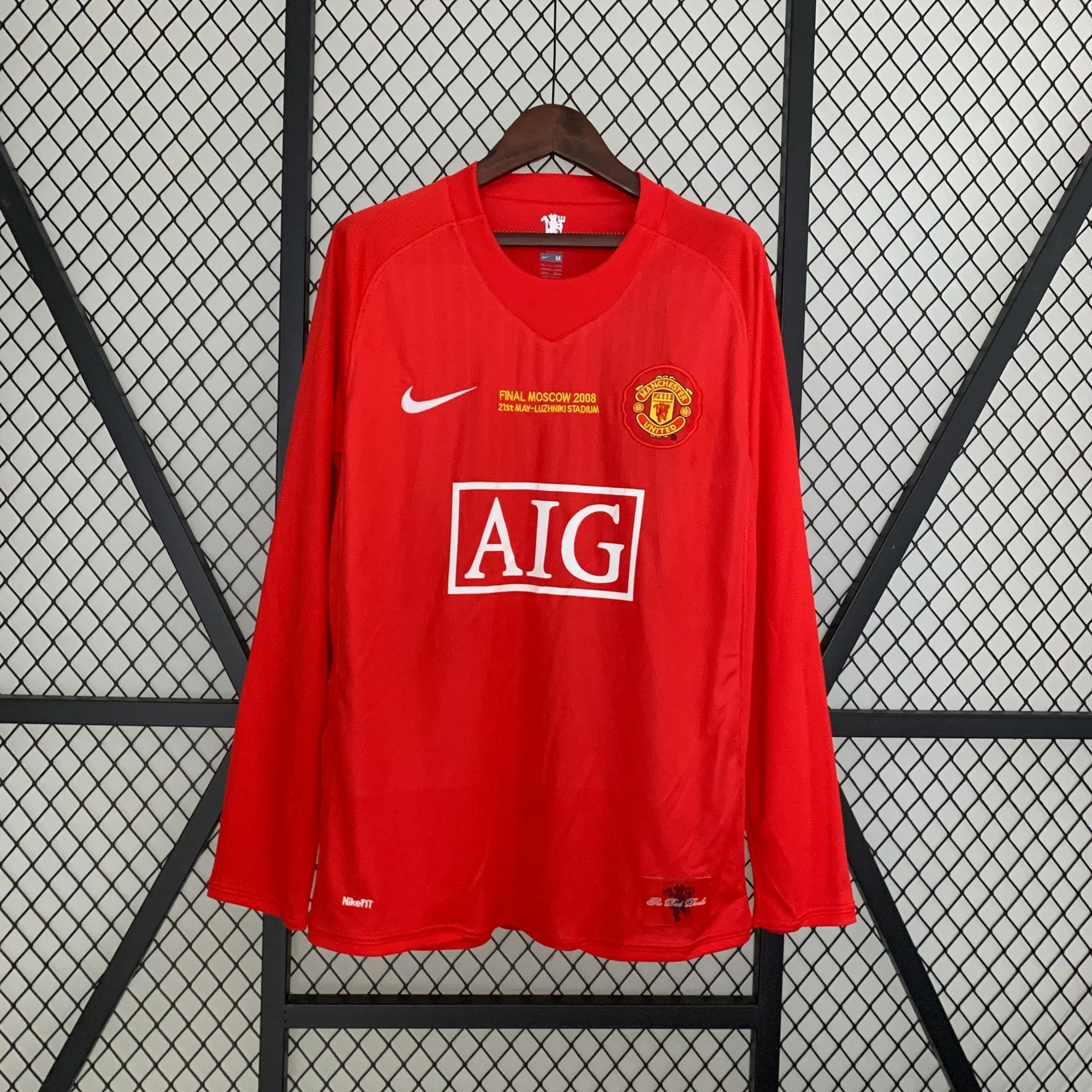
The FootballTHJORE photograph shows a red body with a shallow V neckline, white AIG lettering inside a white rectangular outline, and gold chest lettering referring to Final Moscow 2008. That visible lettering is relevant if the final memory attracts you. It does not establish official licensing, original age, match use or an exact reproduction of every detail worn in Moscow. Those would require separate evidence.
Beside the 1998/1999 image, the neckline is a particularly clear difference: shallow V versus a folded white collar and short zip. The later shirt also has a quieter sleeve appearance in the main photograph. If the collar and diamond sleeve bands draw you to the older shirt, choose it for those details; if you prefer the later shirt's larger areas of red, the 2007/2008 option may suit your visual taste. Neither photograph establishes how the fabrics feel.
This home choice also provides a red counterpart to the blue 2008/2009 Third photograph. If you want a small group from a closely connected period, that is a visible colour contrast to consider. If you want only one shirt, however, there is no need to buy a companion piece for the sake of completing a theme.
The two 2008/2009 labels need a careful distinction
There is an important limitation in the store's 2008/2009 listings. The page named 2008-2009 away kit long sleeve and the page named Third below both show blue shirts with round necklines and white AIG lettering. Their main photographs look highly similar. The different names alone do not establish two different designs, and a difference in photographic lighting is not enough to establish a separate colourway.
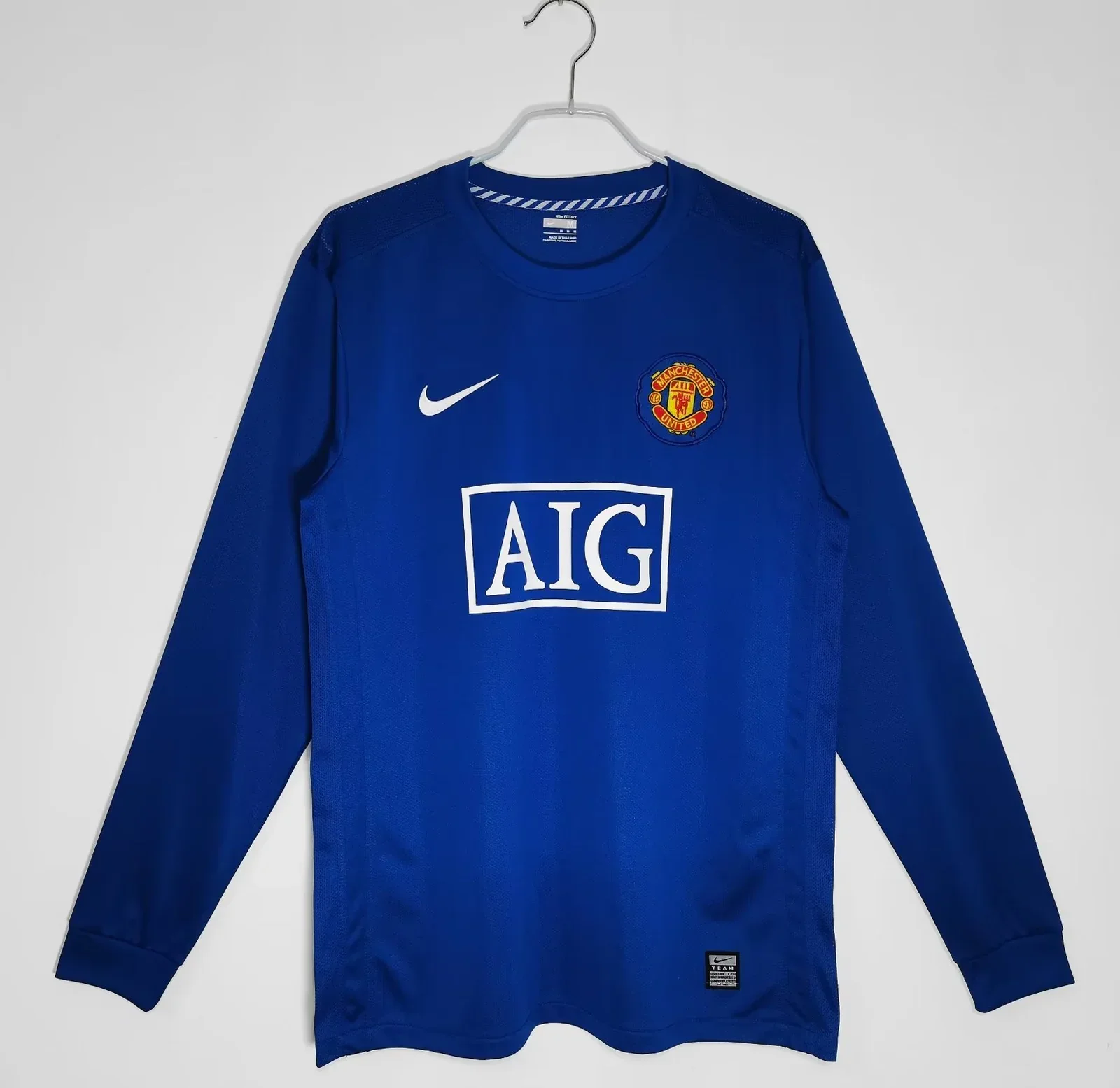
It is easy to blur 2007/2008 and 2008/2009 because the dates sit next to each other and United reached the Champions League final in both seasons. The outcomes were different. UEFA records that Barcelona beat United 2–0 in Rome in 2009. That is useful context when someone asks for a shirt connected with “the 2008 final” or “the Rome season”: those requests should not be treated as interchangeable. See UEFA's account of the 2009 final.
The purpose of the historical distinction is not to reduce a season to a result. A favourite shirt may come from a disappointing match, a memorable journey or the first season a supporter watched regularly. Historical context helps identify the reference; personal attachment decides how much that reference matters. It does not resolve an inconsistency between a store's product name and photograph.
If you specifically want the historically correct away designation for 2008/2009, ask the seller to identify the intended item and its corresponding photographs before ordering this listing. If the blue appearance is what attracts you, the Third entry provides the clearer starting point for the visual comparisons below. This guide does not recommend buying both entries as a two-design set.
Abbreviated dates can add another small source of confusion: 2008-2009 and 08/09 can refer to the same season. That abbreviation is not the issue here. The unresolved point is whether the two differently named pages intend to offer the same blue design or different items. Until that is clarified, treat them as separate listings with unconfirmed differences.
2008/2009 third: a mostly solid blue option
The 2008/2009 third kit long sleeve has a mostly solid blue appearance in its main photograph, with a round neckline and white AIG lettering in a white rectangular outline. Its most useful contrast in this guide is the patterned blue-and-white 1990/1992 shirt. Both offer a blue direction away from the red home options, but their visible patterns are very different.
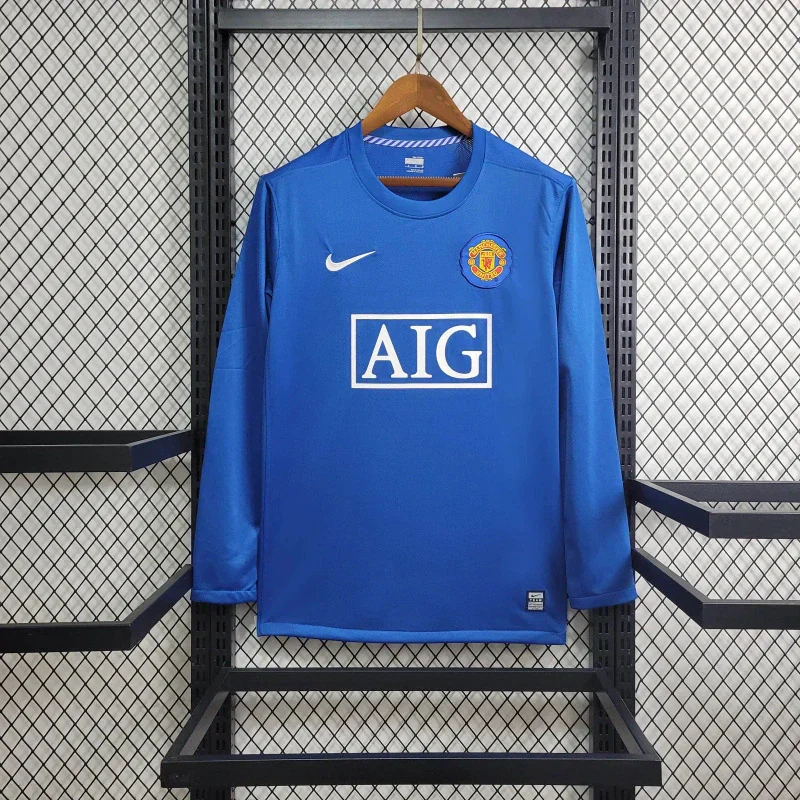
“Third” is a kit designation, not a statement that the shirt is less important or a lower-grade product. It also does not tell you how often a historical design was worn. If a particular fixture or player appearance is the reason for the purchase, use a source for that match rather than treating the designation as a full record of use. Here, the blue body and round neckline are photographic observations, not a claim about its complete historical match configuration.
The third option can be an effective addition to a home-heavy collection. It changes the type of design while retaining a season that may already be meaningful to you. By contrast, a collector trying to represent different decades might prefer the early-1990s pair. The question is whether the next shirt should deepen an existing theme or introduce a new one; both approaches can produce a coherent small collection.
For everyday styling, the choice between the two blue directions is fairly direct. The early-1990s photograph spreads its jagged pattern across the body and arms. This later photograph gives the blue background more uninterrupted space. If your other clothes already have prominent patterns, you may prefer the quieter shirt; if the shirt is intended to be the focal point, the earlier design may appeal more. These are styling options rather than rules about how either shirt must be worn.
The two blue references also sit far enough apart in time to serve different personal memories. A supporter drawn to the opening years of the 1990s may favour the earlier design even if they normally prefer plain clothing. Someone who remembers the later team may make the opposite decision. Decide how much the era matters alongside appearance; neither needs to win every time. This is a meaningful comparison between the 1990/1992 and 2008/2009 photographs, unlike the unconfirmed distinction between the two 2008/2009 catalogue labels.
Compare the visible design differences
The early-1990s pair asks how tightly you want to define the period. The 1990/1992 away design points to the years before the Premier League began, while 1992/1994 overlaps its opening campaigns. If a family memory or first season of support is the reason for buying, that boundary can matter more than whether both garments are long sleeves.
The home pair asks which generation speaks to you. The 1998/1999 and 2007/2008 listings offer two home references connected with well-documented successful seasons. They are the most straightforward comparison for someone who wants a home shirt but has not chosen the era. Their shared designation reduces the number of decisions you are making at once.
The blue comparison asks whether you prefer an all-over pattern or larger areas of one colour. It crosses from 1990/1992 to the 2008/2009 Third listing, so the period changes along with the appearance. If either era is central to your choice, give that preference its proper weight. The two blue 2008/2009 listings should not be treated as a separate style comparison until their naming is clarified.
This comparison does not rank quality. There is no verified basis here for saying that one listing has better fabric, construction or performance than another. The useful differences are the design reference, designation, sleeve format and the information available for your size and intended purchase.
Long sleeves: shape, layering and everyday use
Long sleeves change how much of a shirt's design remains visible when you wear it. They also make sleeve length and cuff position part of the fit decision, which can be overlooked when a buyer concentrates only on the chest measurement. A shirt that suits your body width may still feel too long or short through the arms.
Think about how you expect to wear it. If you usually add a jacket, consider how the sleeves and cuffs of both garments will sit together. If you plan to wear a layer underneath, use a reference garment that accommodates the kind of layer you mean. This is a practical way to describe your preferred fit; it is not a reason to assume every long-sleeve football shirt should be ordered one size larger.
The season in a product name does not establish warmth or technical performance. A 1990s design can be reproduced in a garment with different construction from an original, and a photograph cannot establish fibre composition or insulation. Choose long sleeves because you want the format and appearance, then use the product's own information for any material or performance requirement.
For everyday styling, let the shirt's visual role guide the rest of the outfit. If you want it to be the focal point, simpler surrounding pieces may be your preference. If you prefer a full football-inspired look, coordinated sportswear may suit you better. These are optional styling approaches, not historical rules or claims about what supporters wore during a particular season.
Measure for fit without borrowing another brand's size chart
A size label is the end of a measuring process, not the starting fact you need. First establish whether the chart you are looking at describes body measurements or the dimensions of the finished garment. A chest circumference around a person and a width measured across a shirt laid flat are different quantities. Treating them as interchangeable can produce a large sizing error.
For a body-based chest measurement, use a flexible tape around the fullest part of the chest and keep it horizontal. Adidas uses that method in its official measuring guidance. The technique is useful; its numerical size boundaries belong to adidas products and should not be copied onto a FootballTHJORE listing. Use the chart or confirmed measurements for the item you intend to order.
If a seller supplies garment measurements, compare them with a shirt whose fit you already like. Lay your reference shirt flat without stretching it and use the same start and finish points as the seller's diagram. Chest width, body length and sleeve length answer different questions, so one matching measurement should not hide a mismatch elsewhere. For long sleeves, the sleeve-measurement method is particularly important because different diagrams may begin at different points.
Record units with the measurement. If you work in inches and a chart uses centimetres, convert consistently before comparing rather than mentally mixing the two. Keep body measurements and garment measurements in separate notes. A concise description such as “garment width, measured flat” is more helpful than a bare number whose meaning you may forget later.
Allow your preference to influence the comparison, but do not invent a universal allowance. Someone who likes a close fit and someone who prefers room for layering may choose differently from the same measurements. The appropriate choice depends on the actual garment and the chart's instructions. If those instructions are absent, ask for the missing measurement rather than assuming that a retro design always runs large or small.
The FootballTHJORE shirt-size guide provides a separate place to work through measuring before returning to the design shortlist. This article's six product links help with the season choice; they are not a substitute for item-specific dimensions. No numeric size conversion for these six garments is supplied here because a verified measurement table is not available in this comparison.
Personalisation: decide what the name is meant to represent
A name or number can change the meaning of a retro shirt. One buyer may want a personal name, another a player associated with the period, and another a plain shirt that keeps the design uncluttered. Decide which of those goals you have before looking for an option, because a historically specific request requires more information than a personal preference.
If you want a particular player's configuration from a particular match, the player, competition, season and number style are separate details. Do not assume that a player associated with the club wore the same number or lettering in every context. Use a reliable match or club reference for the exact appearance you mean, then establish what the seller can actually supply.
This guide does not promise personalisation on any of the six listings. If an individual page offers it, read that page's available choices and conditions. A photograph showing lettering is not by itself proof that you can select every name, number, font or badge. Likewise, a plain product image does not establish that customisation is impossible; it means the service needs its own confirmation.
For a gift, personalisation is best considered after the recipient's design and size are settled. Correct spelling is only one part of a successful choice. The recipient may prefer a plain back, a different player, or a shirt associated with another season. Review any relevant order conditions before committing to an option that changes the item.
For a fuller discussion of the decision, use the guide to football-shirt names and numbers. It can help you prepare the right questions without turning an unconfirmed feature into a promise about this particular retro range.
Buying for someone else without choosing the wrong era
The most useful gift question is often about a memory rather than a product. Ask which United side they first followed, which season they talk about most, or whether they prefer home shirts to alternatives. Those answers can narrow the choice while leaving some surprise in the final design.
A request for “a 1999 United shirt” still leaves room for misunderstanding. It might mean the regular home design associated with the season, a final-specific appearance, a shirt carrying a particular player's name, or an original garment produced at the time. Those are materially different wishes. Clarifying one or two of them can be more valuable than choosing a more expensive or more famous option.
For someone who already collects shirts, find out what would add variety. A second home design may be welcome if they follow a season-by-season theme. An away or third design may be more useful if their existing collection is mostly home shirts. Avoid assuming that a collector always wants the oldest available date; their theme may be sleeves, a particular period, or designs they remember wearing.
When the design is settled, keep the practical matters separate. Use actual sizing information, establish the gift date without assuming a delivery promise, and read the current policy that applies to the order. This guide does not offer a shipping deadline or return entitlement. If you cannot confidently resolve fit or a personalised detail, a shared shortlist of exact products may make a better gift decision than a surprise built on guesses.
Building a small collection with a clear theme
A coherent collection does not require buying one of every design. Begin by deciding what connects the pieces. A sequence of home shirts tells a different story from a group of away and third designs. A collection centred on the years you first supported United is different again from one chosen mainly for the way the shirts look together.
These listings offer several possible starting themes. The early-1990s pair creates a compact period comparison. The 1998/1999 and 2007/2008 home pair contrasts two generations. The patterned 1990/1992 and mostly solid blue 2008/2009 Third offer a colour-led comparison. Choosing a theme first makes it easier to decide whether the next shirt adds something distinct. The unconfirmed difference between the two 2008/2009 listings is a reason to clarify the item, not a reason to add both to a collection.
Keep a simple record of what each item actually is. Separate its named design season from any documented manufacturing date, and keep the seller's description and your order information together. If provenance matters, record what was supplied to establish it. This is useful personal organisation; it is not an assertion that the products in this guide are investment pieces or will increase in value.
Budget for your own purpose rather than a claim of future rarity. A shirt chosen for regular wear can be worthwhile without any resale story. A display piece can be meaningful because of a family connection or a remembered season. The important distinction is between buying something you want and buying because a vague label suggests that every old-looking shirt is scarce.
If your interest moves beyond this shortlist, return to the Manchester United football-shirt range. Use it to find other periods or formats, while keeping the same theme in mind. Broadening a collection is most useful when it follows a question you actually want the next shirt to answer.
Care and storage: follow the garment's own instructions
The care label on the garment takes priority over a generic rule for football shirts. A historical design does not establish its present-day fibre content, printing method or permitted treatment. Do not borrow the washing instructions from an original shirt, a modern official reissue or another retailer's version simply because they refer to the same season.
GINETEX explains that care symbols specify permitted treatment for the complete textile item, including relevant finishes and applications. Its guidance distinguishes washing, bleaching, drying, ironing and professional care. That is why one instruction should not be guessed from another: permission to wash does not automatically settle tumble drying or ironing. Refer to the GINETEX care-label guidance if a symbol is unfamiliar.
Read any additional instructions supplied for printing or other selected options as well. If the label and accompanying instructions appear inconsistent, ask the seller to clarify before treating the garment. If a label is missing or unreadable, do not invent a temperature, detergent choice or heat setting from the shirt's appearance. A cautious question is more useful than a universal cleaning recipe that may not suit the item.
For storage, follow any item-specific guidance and make sure the garment has completed the permitted drying process before putting it away. Keep its care information accessible, especially if someone else will wash it. For a piece intended mainly for display or long-term collecting, seek appropriate textile-care advice rather than assuming that every hanger, frame or storage method suits every garment.
Summary: choose the era, then the design and fit
The strongest starting point depends on what you want the shirt to represent. Compare the blue-and-white 1990/1992 away with the green-and-gold 1992/1994 third away for an early-1990s choice. Compare the folded collar and sleeve detailing of 1998/1999 home with the shallow V neckline of 2007/2008 home for two different generations. For blue with less pattern, consider the 2008/2009 Third photograph. Clarify the similar blue Away listing before treating it as another design.
Use the photographs and historical context to decide what appeals to you, then use the individual product's information for fit, options and order details. Keep a design's season separate from the garment's manufacturing date, and do not assume a general season listing is an exact final edition. Those distinctions let you choose retro Manchester United football shirts for a clear personal reason, with the practical details understood before you buy.

 USD
USD
 ANG(ƒ)
 LKR(₨)
 EGP(EGP)
 BZD(BZ$)
 CRC(¢)
 MAD(DH.)
 OMR(RO.)
 KES(KSh)
 GHS(₵)
 UGX(USh)
 RSD(Din.)
 RON(lei)
 PGK(K)
 CDF(CDF)
 UYU($U)
 KZT(〒)
 PKR(Rs)
 MNT(₮)
 ARS(ARS$)
 COP(COP)
 MVR(Rf)
 IQD(د.ع)
 BDT(Tk)
 ZMW(ZK)
 NAD(N$)
 JMD(J$)
 AOA(Kz)
 MMK(K.)
 PEN(S/.)
 MOP(MOP$)
 BND(B$)
 LAK(₭)
 VND(₫)
 NGN(₦)
 KHR(៛)
 TWD(NT$)
 CNY(¥)
 SAR(S.R.)
 BHD(BD.)
 QAR(QR.)
 KWD(K.D.)
 UAH(₴)
 IDR(Rp)
 MYR(RM)
 AED(AED)
 JPY(円)
 INR(Rs)
 TRY(₺)
 CLP(CLP)
 KRW(₩)
 ZAR(R)
 SEK(Kr)
 ILS(₪)
 HKD(HK$)
 THB(฿)
 PLN(zł)
 NZD(NZ$)
 NOK(Kr)
 MXN(MXN$)
 HUF(Ft)
 CZK(Kč)
 SGD(S$)
 PHP(₱)
 DKK(kr.)
 CHF(CHF)
 BRL(R$)
 RUB(₽)
 CAD(CA$)
 AUD(AUD)
 GBP(£)
 EUR(€)
 Barcelona
 Real Madrid
 Manchester United
 Inter Miami
 Manchester City
 Fc Bayern
 Ac Milan
 Chelsea
 Juventus
 Arsenal
 PSG
PSG Liverpool
 Inter Milan
 Santos FC
 Roma
Roma Portugal
 Al Nassr
 Atletico Madrid
 Everton
 Everton
 Germany
 Ajax
Ajax Mexico
 Napoli
 Columbia
 Sporting lisbon
 France
 Tottenham
 Morocco
 Real Betis
 Brazil
 USA
USA ltalia
 Argentina
 England
 Borussia Dortmund
 Spain
Spain Japan
Japan Netherlands
 Adidas
 Nike
Nike Puma
Puma NB
NB Kappa
Kappa