The attraction of retro Juventus football shirts is not limited to black-and-white stripes. There is the memory of a European final in blue, the rapid changes between three successive teams in the 1990s, and the return of pink in a much later away design. A Juventus shirt can remind you of a player, mark a particular season or introduce a different colour into a collection already full of home shirts.
Choosing between those possibilities is easier when the year has a story attached to it. A 1995/96 reference and a 1996/97 reference sit next to one another on a timeline, but they are not interchangeable for a supporter whose interest is Gianluca Vialli or Zinedine Zidane. Equally, a home shirt and an away shirt from 1997/98 can represent the same team while doing different things in your wardrobe.
This guide focuses on six season-and-style combinations from THJORE's Juventus range: three consecutive 1990s away listings, two older home references and the 2015/16 away long sleeve. Two additional 1997/98 home pages are discussed as alternatives, rather than counted as proof of different historical designs.
The shop's product names and image associations were checked on 23 September 2026. Historical context comes from Juventus and UEFA. Those sources explain the teams and official designs behind the season references; they do not certify the manufacture, licensing or original age of the separate THJORE items. Treat a retro date as the design's reference year unless the seller supplies evidence about the physical garment itself.
Start with the part of Juventus history you want to wear
Use this shortlist to connect a reason for buying with a product. Every main listing below explicitly identifies long sleeves. That allows the comparison to concentrate on season and home or away category without pretending that a recent shirt is retro simply because its arms are covered.
No row is a recommendation for every buyer. Start with the memory or design direction that interests you, then read the relevant section. If you are choosing your first Juventus retro jersey, one clearly defined reason is enough. You do not need to buy a sequence of seasons to appreciate a single shirt.
Black and white, blue and pink each tell a different story
Black-and-white stripes form the most familiar Juventus identity, but their history has a specific starting point. Juventus credits Tom Gordon Savage with bringing the colours of Notts County to Turin in 1903. The club's account of the connection with Notts County helps explain why a striped home shirt can feel connected to the club across very different generations of players.
For a buyer, that continuity is part of the appeal. A home reference can make sense even when you are not trying to commemorate one final. The season still matters, because the arrangement of a shirt can change, but the broader visual association reaches beyond a single result. This is a useful starting point for someone who wants an older Juventus home design without constructing a collection around one trophy.
Blue has its own place in the club's memory. In the announcement of its 2016/17 away kit, Juventus explicitly referred back to the blue shirt worn in the 1995/96 Champions League. That later announcement is evidence of an enduring reference, not evidence that every blue Juventus shirt belongs to 1996. See the club's explanation of the blue away tradition.
Pink reaches further back again. The official 2015/16 launch described a return to a colour worn in the club's earliest years, before black and white. That makes pink a historical Juventus choice in its own right. When comparing home stripes, an older away reference and the 2015/16 away listing, you are choosing among several parts of club identity. None needs to be treated as an imitation of the others to have a clear place in your collection.
1995/96 away: begin with Rome if the European triumph is your reason
For a supporter whose first association is Juventus lifting the trophy in Rome, 1995/96 is the season to identify precisely. The Champions League final against Ajax finished 1–1 after extra time, following goals from Fabrizio Ravanelli and Jari Litmanen. Juventus won the shoot-out 4–2 under Marcello Lippi. UEFA's account of the 1995/96 final provides that match context.
The 1995-1996 away long sleeve is the corresponding season-led starting point in this selection. Its attraction may be the team's European story, an attachment to Vialli's captaincy or the away-design tradition connected with that campaign. Those are stronger reasons to begin here than simply choosing the oldest date in the table.
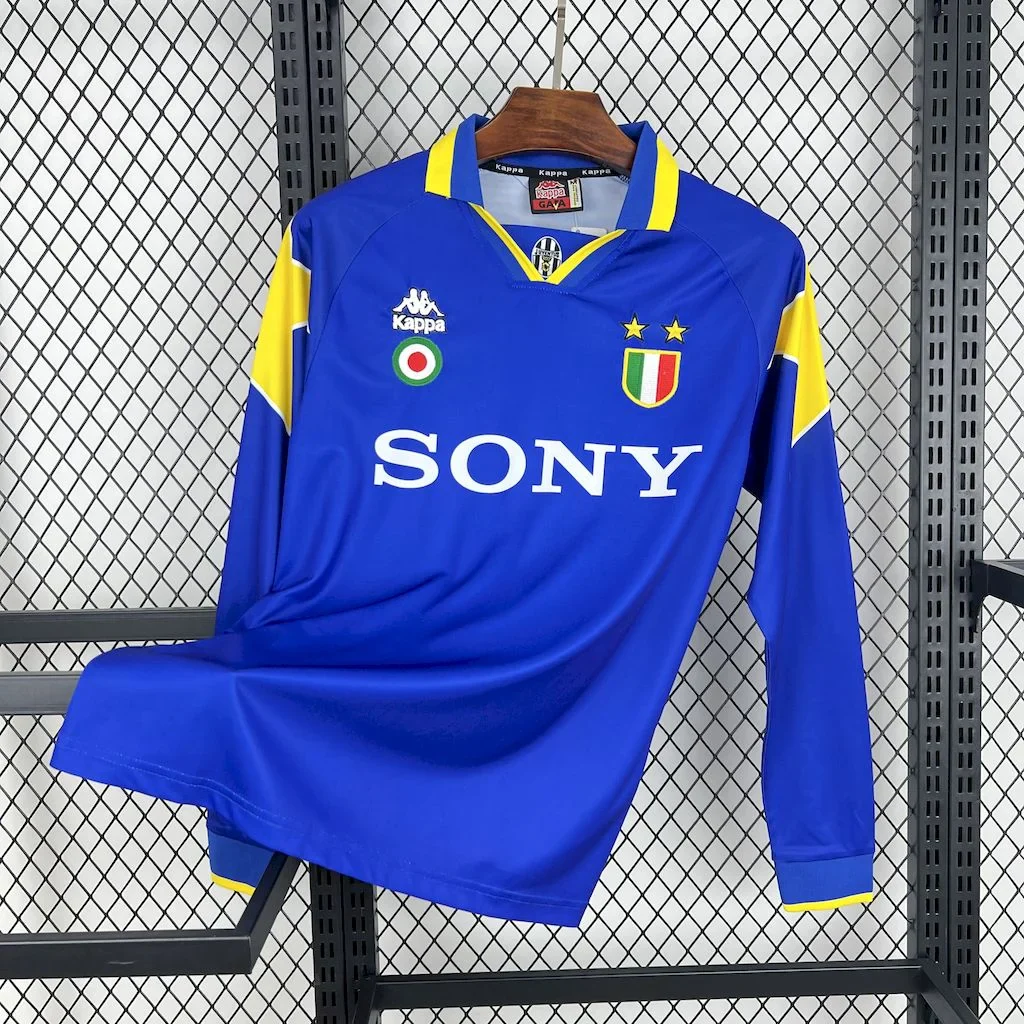
The final also shows why a remembered year should be written as a season. “Juventus 1996” can refer to the end of 1995/96 or the beginning of 1996/97. Those periods included important changes in personnel. If you are choosing for a particular player or occasion, the two-part season date is more useful than the calendar year alone.
A final-inspired purchase can be broad or very specific. You may simply want a shirt that brings that period to mind. Alternatively, you may want a particular sleeve configuration, back number or set of match details. The latter requires a dated visual reference and confirmation of the exact offered item. A product's season and away designation do not establish that every detail recreates the final as played.
For a display, consider which part of the story you want visible. A front-facing shirt can introduce the team's design; a back-facing display shifts attention towards a player or number. Decide that before requesting any additions. The historical meaning can be clear without describing the shop item as an original shirt from Rome or as something worn by the players.
1996/97 away: the next season brought a different team
The change from 1995/96 to 1996/97 was more substantial than one number in a product title. Juventus's official history records the departures of Vialli and Ravanelli and the arrivals of players including Alen Bokšić, Christian Vieri, Nicola Amoruso, Paolo Montero and Zidane. Del Piero then scored the decisive goal against River Plate in the Intercontinental Cup in Tokyo, and Juventus also won the league. The club's account of that transition separates the two campaigns.
That gives the 1996-1997 away long sleeve a reason to be considered on its own. It is not merely the next available date after the European-winning year. For someone interested in the start of Zidane's Juventus period, or the brief Juventus chapter of Vieri's career, the later reference is the relevant one.
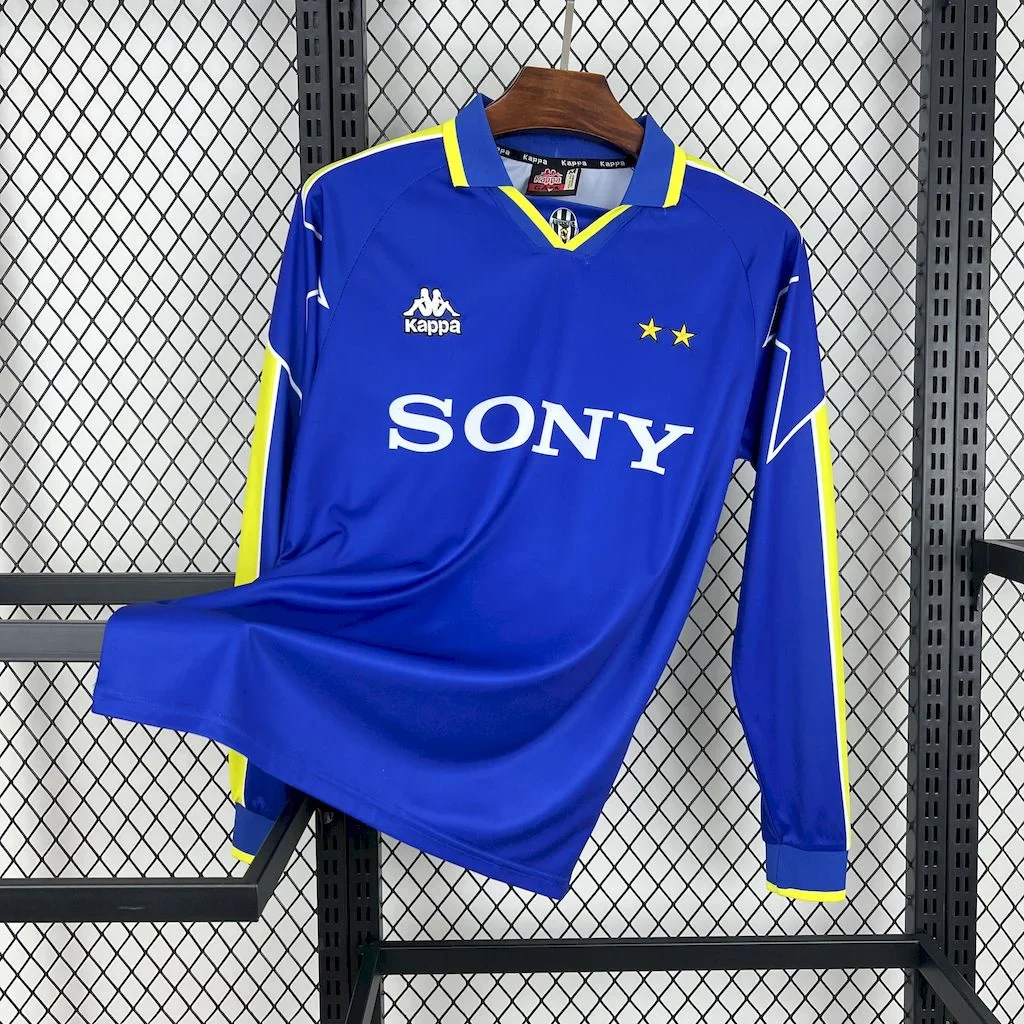
The distinction matters for gifts as well as collecting. A supporter may remember the mid-1990s as one continuous run, yet have a favourite player who belongs to a particular part of it. Asking which version of the team they mean can turn a vague “nineties Juve shirt” request into a much more thoughtful choice.
When comparing 1995/96 and 1996/97, keep the reason for selecting the year visible beside the images. One may be the Rome campaign; the other may be the team that followed it. You can then make a separate decision about the visual details you prefer in the two product galleries. This avoids letting a famous result decide a purchase that was actually meant to celebrate a different player.
There is no need to assemble every adjacent year immediately. If the first shirt already represents your preferred chapter, another should add a meaningful difference. The 1996/97 option is most useful when its team, occasion or appearance fills a distinct place in what you want to own.
1997/98 away: a season that can be remembered through the journey
The 1997-1998 away long sleeve completes the three-year away sequence in this guide. By this point, a shopper can compare neighbouring seasons while holding the stated shirt category and long sleeves constant. That is a more focused choice than comparing a 1990s away shirt with a recent home design and trying to explain every difference at once.
The 1997/98 European campaign contained memorable performances before its final. Juventus's account of the home semi-final against Monaco records a 4–1 win, including a Del Piero hat-trick and a Zidane goal. The two-leg tie took the team into another final. The club's Monaco retrospective provides a useful reference for that part of the season.
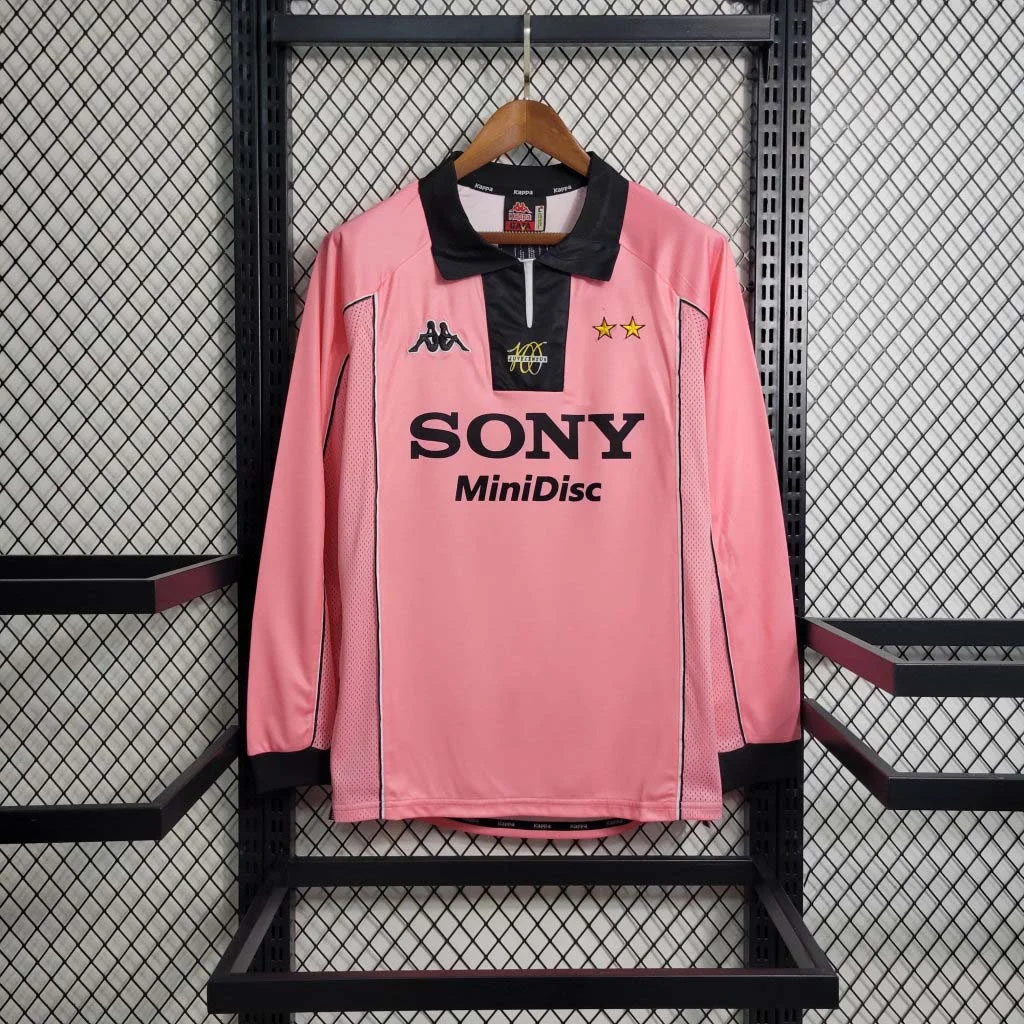
A shirt's meaning does not have to depend entirely on the last result of the campaign. A supporter may remember following the knockout rounds, seeing a favourite player develop or watching matches with family. Choosing the 1997/98 away reference can represent that wider experience. It should not be labelled a European-winning season simply because the surrounding era is associated with a successful side.
The away category also gives this year a useful role beside a home shirt from the same season. If you want a focused pair, 1997/98 lets you build one around the same team rather than jump across decades. That pairing is about a shared historical reference. It does not establish that two current listings have identical measurements, construction or included pieces.
If your memory begins with a particular away match, identify it before choosing. “Away shirt” is a product category, not proof that the club wore that design in every away fixture. Match photographs should decide a match-specific recreation. For a broader season tribute, you have more freedom to choose the product whose design and format you prefer.
1997/98 home: the league story offers another reason to choose the year
For a home-shirt collector, the 1997-1998 retro home long sleeve brings the same period into a different category. The domestic story supplies its own memorable occasion. Juventus clinched the league title with a 3–2 win over Bologna on 10 May 1998, when Filippo Inzaghi scored all three Juventus goals. The club's account of Inzaghi's title-clinching hat-trick explains the significance of that game.
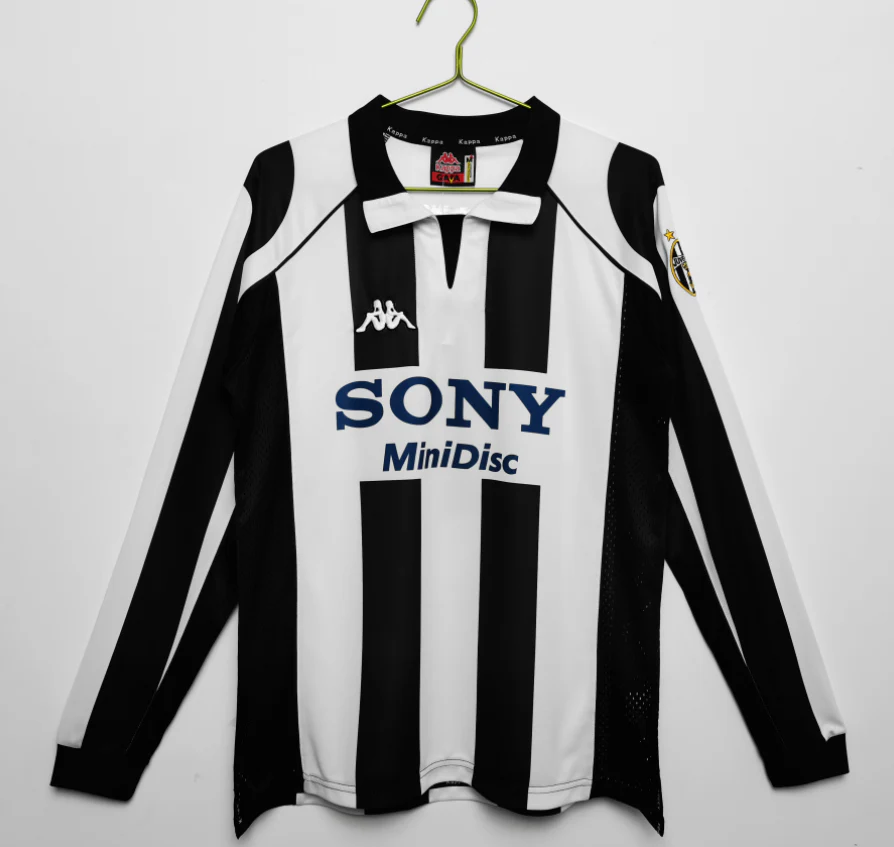
This makes 1997/98 a useful choice for someone interested in the partnership of Inzaghi and Del Piero, or in Juventus's league history rather than a single European night. It also creates a straightforward first-purchase option if your strongest preference is an older home reference with long sleeves. You can place the season within its football context without needing to describe the offered garment as a match replica of that Bologna game.
Think about what you want a home shirt to contribute visually. For some buyers, the broad association with Juventus's striped identity is the point. Others are drawn to the way one particular season arranges its front, shoulders or neckline. Those preferences should be assessed from the exact product gallery rather than assumed from the word “home”. A familiar category can contain designs with quite different proportions.
There is also a difference between a shirt associated with the club's centenary period and a specifically identified commemorative release. A year alone does not establish a special edition. None of the 1997/98 home products discussed here needs an extra anniversary claim to explain its appeal. Keep the title, season and actual offered design together when comparing it with another page.
For a gift, this home reference can be a clear way to say “the Juventus team of 1997/98”. If the recipient has asked for a precise version, however, use that request to choose among the available pages. A shared season should help you narrow the search, not erase the differences between listings.
1999/2000 home: a different part of the same personal timeline
The 1999-2000 retro home long sleeve moves the comparison towards the turn of the century. It offers another home reference without switching to a recent design. For someone whose memories centre on Juventus around that moment, it may be a more natural choice than buying a shirt from an earlier trophy season they feel less connected to.
The club's retrospective on mid-season fixtures recalls Del Piero, Zidane and Darko Kovačević scoring against Perugia during the 1999/2000 campaign. That provides a specific glimpse of the team's attacking names at the time. See Juventus's mid-season history. A season can matter through familiar attacking partnerships, even when a trophy ceremony is not the memory that draws you to it.
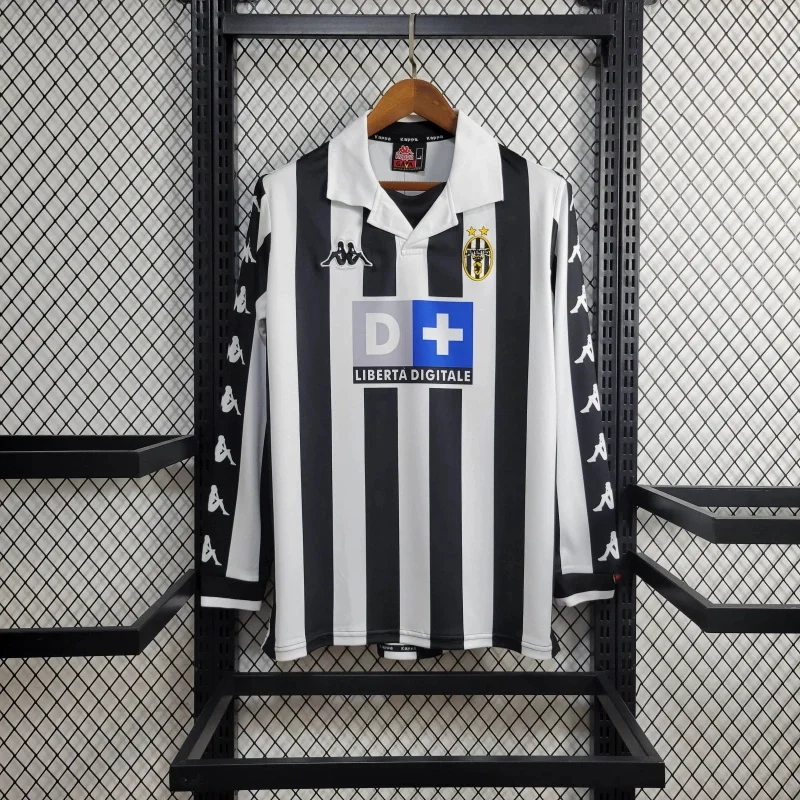
The European story around this date also rewards a more precise look. On 10 August 1999, Juventus played the first leg of an Intertoto final against Rennes in Cesena, winning 2–0 through two Inzaghi goals. Juventus's retrospective on matches against French clubs records that occasion. It is a different reference from the Champions League finals discussed earlier, even though several familiar players connect the periods.
The club faced Olympiacos twice at home during the calendar year 1999, in two different competitions and seasons. Its March meeting belonged to the 1998/99 Champions League campaign; the December meeting belonged to the UEFA Cup and took place in Palermo. The official Olympiacos retrospective separates those matches. A photograph described only as “Juventus versus Olympiacos, 1999” therefore leaves important information unresolved.
For a collector trying to connect a shirt with a remembered European night, the opponent and calendar year may not be enough. Add the month and competition to the reference before deciding which season you need. This is particularly useful around the turn of the century, when a familiar squad and repeated opponents can make images from neighbouring campaigns easy to mix together.
The venue can make the memory more specific too. A Juventus home fixture did not always mean a match in Turin, as the Cesena and Palermo examples show. If your connection is a match you attended elsewhere in Italy, identify that occasion directly. The home product here can still be a season-level choice, but the title alone does not establish the shirt configuration used at either of those games.
The useful comparison is with 1997/98 home. Both main product names state home and long sleeve, leaving the season reference as the first meaningful decision. If you have a strong memory of one team, begin there. If you prefer one design, investigate that preference in the galleries. There is no rule that the season with the more celebrated achievement must be the better shirt for you to own.
A collection of personal memories can include seasons that were complicated or disappointing. Following a club is not only a sequence of trophy presentations. A design may remind you of the first match you attended, a player you tried to copy or the first shirt you were given. Those reasons can make a 1999/2000 reference an important part of your collection, even if somebody else's shortlist starts elsewhere.
Avoid treating “1999” and “2000” as separate products unless the listing does so. The two years here describe one football season. Keeping that notation intact helps when saving photographs, comparing home shirts or discussing a possible name and number with the seller.
2015/16 away: why pink belongs in a Juventus retro comparison
The 2015-2016 away long sleeve moves beyond the 1990s while retaining a defined older-season reference. Its design context is particularly useful for buyers who assume a historical Juventus shirt must be black and white. In the official launch text dated 1 July 2015, Juventus described an away design built around pale pink, brighter pink details, white elements and a black round neck. The announcement linked that palette to the club's early pink shirts.
The official 2015/16 home and away launch is the source for those design details. It explains the historical idea behind that season's release. Its fabric technologies, brand specifications and version descriptions are not automatically attributes of the separate THJORE retro listing.
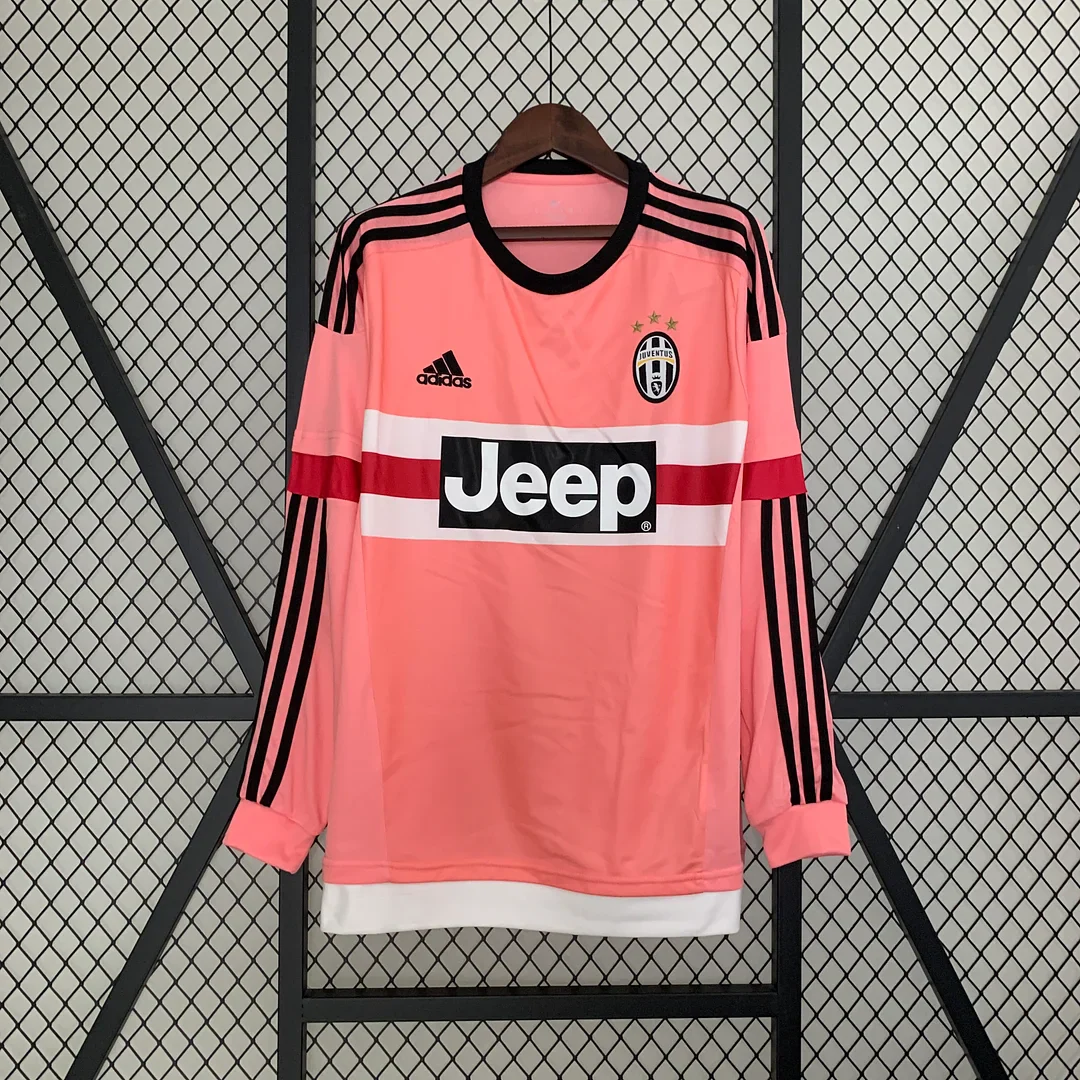
For a buyer, pink can provide a different kind of club connection. It may appeal because of its colour, because it recalls the team of that season or because it reaches back to the club's beginnings. These reasons can overlap, but they are worth distinguishing. Someone buying for the early colour story may be satisfied by several interpretations; someone buying for a specific 2015/16 memory needs that season's reference.
The later date also changes the comparison with the 1990s away shirts. You are moving to another football generation, not just picking the next step in a short annual sequence. That can make a two-shirt collection more varied: one item represents the mid-1990s and another the side roughly two decades later. If you prefer a tightly focused collection, however, the earlier three-year away sequence may be more coherent.
Use the pink design as a deliberate colour choice. Compare it with the clothes you already wear and with the other shirts you own. An away shirt that adds a different visual role can be more useful than another product chosen only because it carries a famous season. The historical explanation gives the colour meaning; your own preferences decide whether it belongs in your wardrobe.
The 2015/16 team makes the pink reference more specific
There is also a football reason to distinguish 2015/16 from neighbouring seasons. Juventus's season history records a summer of change: Pirlo, Vidal, Tevez and Llorente departed, while arrivals included Dybala, Khedira, Mandžukić, Cuadrado and Alex Sandro. After a difficult league start, the team recovered to claim a fifth consecutive title and another domestic league-and-cup double. Those are the principal points in the club's 2015/16 historical review.
This matters if a player is the starting point of your purchase. A memory of Tevez at Juventus and a memory of Dybala's first Juventus season lead to different reference years. A shirt should not be assigned a player association simply because the club and the broader decade are right. The transition between seasons is part of what makes each design meaningful.
For someone who followed the team through that recovery, the away reference can represent the process of the season rather than only its finish. It may recall the feeling of watching a changed squad come together. That is a different story from the 1995/96 European campaign, and it gives a collection containing both a clear contrast without relying on claims about rarity or resale value.
If you are buying the shirt for its appearance alone, the history can remain background. You do not need to memorise a squad list to enjoy a design. It becomes useful when it prevents an unwanted mismatch: the wrong season for a favourite player, the wrong role for a planned collection, or a later interpretation mistaken for an older original.
Compare the three 1990s away seasons without merging them
The 1995/96, 1996/97 and 1997/98 away listings are the most focused group in this guide. They share an away category and explicitly stated long sleeves. Their season references, however, cross a period of significant changes in personnel and football memories. Treat the three as neighbouring chapters, not as alternative spellings of the same shirt.
If those football associations do not settle the decision, let appearance lead. Compare the full front and back of each product, paying attention to the features that differ in the actual galleries. A season label cannot tell you which collar you will prefer or how prominent you want the chest graphics to be. A side-by-side view is more useful than remembering a small search thumbnail.
The purpose of holding the category steady is to make a close decision easier. You are not simultaneously choosing between short and long sleeves, home and away, and widely separated decades. That leaves more attention for the historical reference and the details you can actually see.
Choose one before deciding whether to collect the sequence. Buying all three only makes sense if the succession itself interests you. A single carefully selected away shirt can communicate your connection to Juventus more clearly than a group bought simply because the dates were available.
Home or away in 1997/98: change the look while keeping the team
The 1997/98 home and away listings offer the opposite comparison: the season stays fixed while the category changes. That is especially helpful if you know you want the Juventus of that year but have not decided what you want to wear. You can keep the football association and concentrate on the design's role in your wardrobe or display.
A home reference is a natural starting point if you want to connect the purchase with Juventus's established striped identity. An away reference may suit someone who already owns a home shirt, or who wants a different visual route into the same team. Neither category is inherently more serious as a collecting choice. The useful question is what the second option adds for you.
For a two-shirt display, the same-season pairing can make the comparison easy to explain. Put the shared year at the centre and distinguish home from away underneath it. You are showing two categories within one campaign, rather than implying that every older shirt belongs to a different squad. If you display one front and one back, make that a conscious choice about which details you want visible.
For regular wear, think about the layers and trousers you already reach for. A shirt whose strongest feature will usually be hidden under a jacket may not be the right choice for the way you dress. Conversely, if the neckline is what you like most, it can remain useful even when the rest is partly covered. Choose for the outfit you will actually wear, not only for the isolated product photograph.
Keep the measurements separate despite the common year. Two products naming 1997/98 can still have different dimensions. The season answers the historical question; the individual garment information answers whether it will fit the way you want.
More than one 1997/98 home listing does not mean another design
The catalogue includes a second page named Juventus Retro 1997-1998 Long Sleeve Home Kit, alongside the home-jersey page used in the main table. Both titles refer to 1997/98 home and long sleeves. Their separate URLs do not, by themselves, prove a different historical design, fabric or edition.
There is also a page titled Juventus 1997-98 home kit. Its title does not state the sleeve format. It is an additional listing to examine if you want to explore that season, rather than evidence for a third distinct 1997/98 shirt design.
This is a situation where a small amount of comparison prevents an unnecessary duplicate purchase. Match the actual galleries and descriptions before treating two pages as separate additions to a collection. If your objective is one home shirt from the season, select the listing that clearly establishes the item and options you require.
The word “kit” also needs its own clarification. It does not settle whether additional pieces are included in the selected offer. The existing Juventus shirt versus full kit guide covers that purchasing distinction. Resolve the contents once for the item you choose rather than assuming two similar product names describe the same package.
Buying for a player: write down the season before the name
A player-led purchase is one of the easiest ways to choose a shirt with personal meaning, but it benefits from a precise date. In this shortlist, the biggest traps lie around transitions. Vialli's final Juventus appearance came in the 1996 European final, while Zidane joined for the following campaign. UEFA's interview with Vialli about Rome provides the first part of that distinction.
The same principle applies later. A 2015/16 design belongs to the season after several established players departed and a new group arrived. If a name is central to your choice, confirm that relationship before thinking about how the back should look. A famous player and an attractive Juventus shirt do not automatically form an accurate historical pairing.
Next decide what kind of tribute you want. An unpersonalised design can represent the whole team. A name and number can make the shirt more personal. A precise match recreation adds further requirements, such as the exact appearance of the lettering and any competition details. Those are three different levels of specificity, and none should be assumed from a season label alone.
For a specific recreation, use a dated reference that shows the relevant part of the shirt. A front photograph cannot establish the back number's shape or position. A photograph from another year cannot settle the lettering for the year you selected. Keep the reference focused on the configuration you want rather than gathering many images that contradict one another.
Any available personalisation service, charges or limitations must be established for the chosen product. This guide does not assume that every retro listing offers the same additions. If the item you want is best left without a name, that is a complete choice: it preserves a team-level reference rather than forcing a player connection you did not need.
A retro design and a period original are different purchases
The word “retro” tells you that a listing looks back to an earlier period. It does not tell you when the particular garment was manufactured. That distinction is central if you are comparing a current shop listing with an individual older shirt sold elsewhere. A matching year in their titles is not enough to make the two offers equivalent.
For a wearable design reference, the practical questions concern the offered appearance, dimensions, contents and suitability for your intended use. For a period original, the object's history becomes part of the decision. You may need evidence of the labels, condition, repairs, printing and the seller's account of its age. An original retail shirt, a match-issued item and a match-worn item also make different claims about provenance.
Do not let a familiar sponsor, badge or number resolve those questions on its own. A visible design element can help identify what a shirt is trying to represent, but it does not establish the whole history of the object. Equally, a new-looking garment is not evidence that it has been preserved since the 1990s. The claim about age requires its own support.
This guide compares the current THJORE listings as described, without certifying them as period originals or licensed reproductions. Their value to your purchase decision is the clearly named season and shirt category, together with the offered images and product information. If documented original production is a fixed requirement, ask for that evidence before deciding whether a listing meets your brief.
There is no need to turn a preference for a wearable retro design into a claim about rarity. Enjoying a historical reference and collecting an original artifact are both coherent interests. Keeping them distinct makes it easier to compare appropriate offers and to explain accurately what you have bought.
Make a small collection tell a clear Juventus story
There are several coherent ways to build from this selection without buying everything. A sequence of 1995/96, 1996/97 and 1997/98 away references would follow a short, concentrated period. Its purpose would be the change from one squad chapter to the next. That is different from building a broad collection of every Juventus away colour you happen to like.
A 1997/98 home-and-away pair would be narrower still. It would show two shirt categories for one season, making it useful if that team is your main interest. Before adding a second home listing from the year, establish whether it actually gives you a different item. A duplicate page should not become a duplicate purchase merely because the product names are arranged differently.
A pair built around 1995/96 away and 2015/16 away would tell another story: two distinct football generations and two different historical colour references. The link would be Juventus's willingness to express identity beyond the home stripes. That can be a satisfying approach for someone who collects visually distinctive away designs rather than following a strict year-by-year sequence.
The home references from 1997/98 and 1999/2000 can suit someone who prefers to stay within the club's home tradition. Here the interest lies in the passage between seasons and in the specific designs offered. Choose them because that progression matters to you, not because every collection is supposed to contain a prescribed list of famous years.
Whichever approach you take, give each proposed purchase a purpose before adding it. A collection can stop at one or two shirts and still have a clear identity. The connection between the pieces often matters more than the number of dates represented.
Long sleeves: judge the whole silhouette and the measurements
Long sleeves are common to the six main listings, so the practical comparison is how each offered garment fits your intended use. More arm coverage does not establish insulation, fabric weight or performance. If your priority is the visual shape, consider where you want the sleeve to end and how much room you want through the body.
Use a shirt you already like as a reference. Measure it flat without stretching it and keep the measuring method consistent when comparing with a product chart. Chest width, body length and sleeve length answer different questions. A garment can be comfortable across the chest while finishing too low at the hem or too far over the wrist for your taste.
Ask where the sleeve measurement begins. A number measured from the shoulder seam cannot be compared directly with one measured from the centre of the back without understanding the method. Similarly, a flat chest width and a body circumference should not be treated as interchangeable figures. The useful comparison is between measurements that describe the same part of both garments.
If you intend to wear a layer underneath, use a reference shirt you already wear that way. If you prefer a closer outline, measure an example of that fit instead. This is more reliable than automatically sizing up because a title says “retro”, or assuming that every shirt associated with the 1990s will have the same proportions.
For a gift, a known garment measurement is usually more useful than a guess based on the recipient's favourite player or usual jacket size. Keep the preference for long sleeves separate from the required dimensions. The season chooses the story; the measurements help the shirt become something the recipient can actually enjoy wearing.
Use the colour direction to decide where the shirt fits
A Juventus shirt can be the main visual element of an outfit or one part of a quieter layered look. Begin with the clothes you already use. If your wardrobe contains plenty of dark trousers and plain jackets, a patterned home reference can supply contrast. If you already own several home shirts, an away design may offer the change you were looking for without requiring a different club.
The historical colour stories can help clarify that choice. Home stripes connect with the club's long-established black-and-white identity. The blue reference discussed around 1995/96 points towards a European memory. The 2015/16 pink story connects a later away season with the club's beginnings. Decide which direction you are drawn to, then judge the actual product's appearance from its own gallery.
For everyday wear, consider which details remain visible under your usual outer layer. A neckline or part of a chest graphic may be all that shows beneath a jacket. For a shirt worn on its own, the balance of the full front and sleeves matters more. Neither approach requires elaborate styling; it simply changes what you should pay attention to when choosing.
For a display, think about whether the front, back or a pairing of two shirts best communicates your theme. Keep any description attached to the display accurate about season and product type. A clear label such as a retro reference to a named season can tell the story without suggesting the garment is a documented original or that it appeared in a particular match.
Summary: select the Juventus chapter that belongs in your collection
Begin with the football story or design direction that matters most. The 1995/96 away reference connects with the Rome European campaign; 1996/97 points to the changed team that followed it; and 1997/98 offers both home and away routes into the same season. The 1999/2000 home long sleeve extends the older home comparison towards the turn of the century. The 2015/16 away listing introduces a later team and the historical meaning of pink.
Use the neighbouring away seasons when the year is your main decision. Compare 1997/98 home with away when the year is already settled. Treat the extra home pages as alternative listings until their differences are established. That keeps the comparison useful without inventing separate designs, editions or product qualities.
Open the Juventus collection once you know which chapter you want to explore. Compare the exact item's gallery, dimensions and selected offer, and distinguish a retro design reference from a documented period original. The best choice among retro Juventus football shirts is the one whose history, appearance and fit all serve the reason you wanted it.

 USD
USD
 ANG(ƒ)
 LKR(₨)
 EGP(EGP)
 BZD(BZ$)
 CRC(¢)
 MAD(DH.)
 OMR(RO.)
 KES(KSh)
 GHS(₵)
 UGX(USh)
 RSD(Din.)
 RON(lei)
 PGK(K)
 CDF(CDF)
 UYU($U)
 KZT(〒)
 PKR(Rs)
 MNT(₮)
 ARS(ARS$)
 COP(COP)
 MVR(Rf)
 IQD(د.ع)
 BDT(Tk)
 ZMW(ZK)
 NAD(N$)
 JMD(J$)
 AOA(Kz)
 MMK(K.)
 PEN(S/.)
 MOP(MOP$)
 BND(B$)
 LAK(₭)
 VND(₫)
 NGN(₦)
 KHR(៛)
 TWD(NT$)
 CNY(¥)
 SAR(S.R.)
 BHD(BD.)
 QAR(QR.)
 KWD(K.D.)
 UAH(₴)
 IDR(Rp)
 MYR(RM)
 AED(AED)
 JPY(円)
 INR(Rs)
 TRY(₺)
 CLP(CLP)
 KRW(₩)
 ZAR(R)
 SEK(Kr)
 ILS(₪)
 HKD(HK$)
 THB(฿)
 PLN(zł)
 NZD(NZ$)
 NOK(Kr)
 MXN(MXN$)
 HUF(Ft)
 CZK(Kč)
 SGD(S$)
 PHP(₱)
 DKK(kr.)
 CHF(CHF)
 BRL(R$)
 RUB(₽)
 CAD(CA$)
 AUD(AUD)
 GBP(£)
 EUR(€)
 Barcelona
 Real Madrid
 Manchester United
 Inter Miami
 Manchester City
 Fc Bayern
 Ac Milan
 Chelsea
 Juventus
 Arsenal
 PSG
PSG Liverpool
 Inter Milan
 Santos FC
 Roma
Roma Portugal
 Al Nassr
 Atletico Madrid
 Everton
 Everton
 Germany
 Ajax
Ajax Mexico
 Napoli
 Columbia
 Sporting lisbon
 France
 Tottenham
 Morocco
 Real Betis
 Brazil
 USA
USA ltalia
 Argentina
 England
 Borussia Dortmund
 Spain
Spain Japan
Japan Netherlands
 Adidas
 Nike
Nike Puma
Puma NB
NB Kappa
Kappa