Can You Pull Shirts in Football? Holding and Match Decisions
2026-10-11
Pulling an opponent's shirt to hold them is an offence in association football. It is not a permitted technique simply because it happens during televised matches. To understand a decision, separate the contact, the effect on the opponent, the restart and any disciplinary sanction. Those are connected questions, but they are not interchangeable.
This guide answers the question about shirt pulling in football using the current IFAB rules and UEFA refereeing guidance. It concerns football played under association-football laws, not American football or a computer game's controls. It is a viewing guide, not an assessment of a specific incident or a claim of referee qualification.
The short rule
IFAB Law 12 lists holding an opponent as a direct-free-kick offence. A defender's such offence in their own penalty area can result in a penalty. Holding that begins outside and continues inside the penalty area also results in a penalty. The card decision is separate: stopping a promising attack or denying an obvious goal-scoring opportunity can bring disciplinary consequences.
Do not assume that awarding a penalty automatically reduces every offence to a yellow card. In an obvious-goal-scoring-opportunity situation, IFAB distinguishes a challenge for the ball from holding or pulling. The actual circumstances determine the sanction. Consult the full rule for its conditions rather than judging only from the colour of the shirt or the player's reputation.
Why the replay needs context
UEFA's holding and pushing guidance directs attention to the contact's nature, its effect on the opponent's ability to play or reach the ball, and possible exaggeration. That explains why a useful review asks more than whether two players touched each other. UEFA's examples provide a better starting point than a social-media caption attached to a single photograph.
When watching, try to identify the start of the interaction and what each player is attempting to do. An isolated frame cannot show the full sequence. Resist filling gaps with assumptions about a player's intention, whether the referee saw the incident or what another camera angle might show.
A simple comparison of the questions
Question
What you are trying to establish
What it does not establish by itself
Was there contact?
The interaction between the players
The full effect or the complete decision
Was movement affected?
How the incident developed
Everything that happened outside that camera view
Where and when did it happen?
The match context for assessing the restart
The disciplinary answer on its own
What did the referee award?
The decision made during the match
A complete explanation of the referee's reasoning
How to use a clip without overstating the conclusion
First, watch the sequence at normal speed. Then use a replay to look at the particular point you missed. Keep track of whether you are reporting something visible or interpreting it. For example, saying that the fabric is visibly stretched is an observation. Explaining exactly how much a player was prevented from moving may require more of the sequence.
Next, compare the evidence with the relevant guidance. Avoid selecting only the section that supports the answer you wanted. If the video ends before the referee acts, say that the decision is not shown. If a crucial camera angle is missing, leave that limitation in the explanation. A confident description is not a replacement for complete evidence.
Finally, distinguish a rules explanation from a verdict on a particular match. This page does the former. It does not claim to overturn a referee's decision, settle a disputed penalty or provide an unseen match report. That boundary makes the explanation more useful when a clip is incomplete.
The shirt's design does not answer the rules question
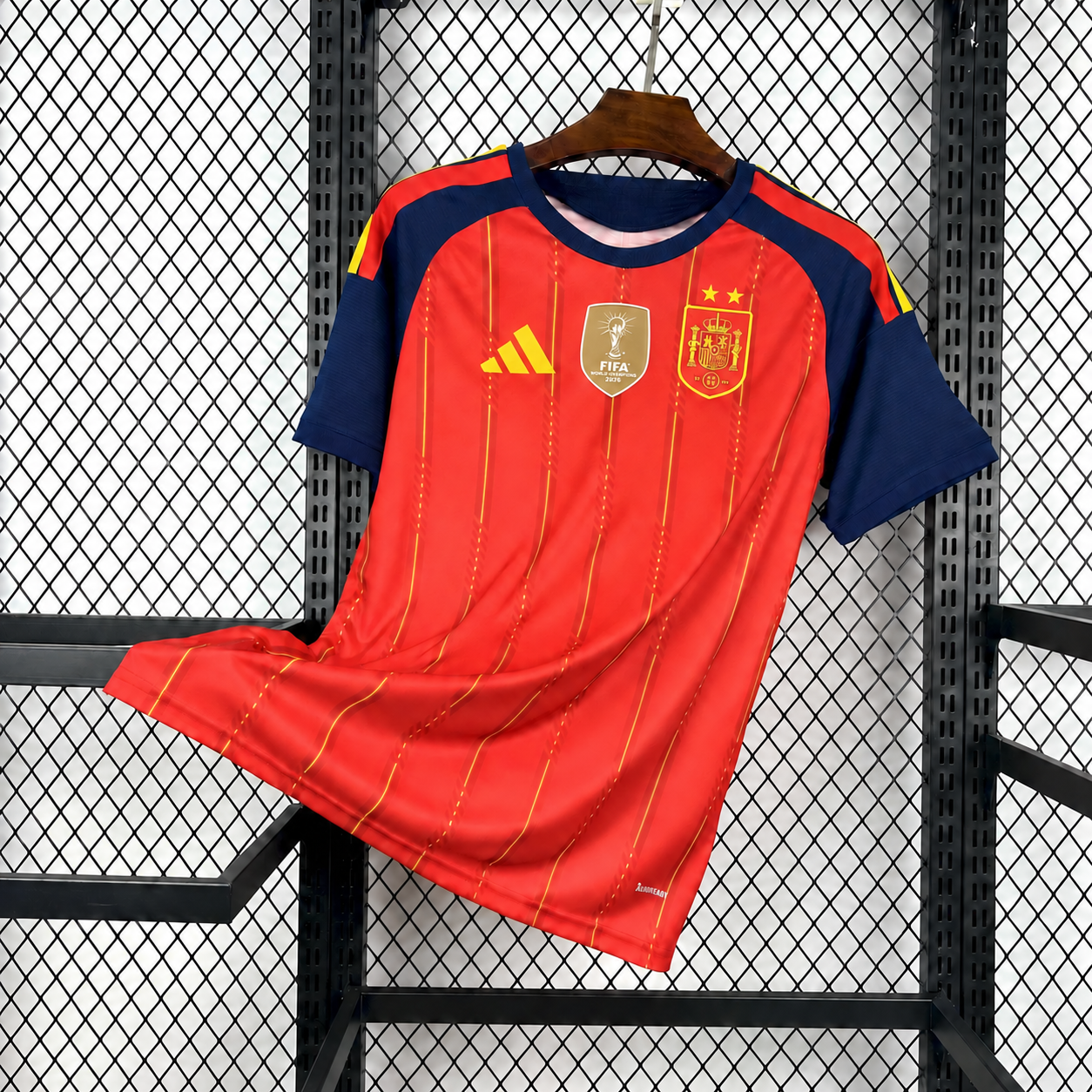
A store shirt image illustrates the garment discussed. It does not depict a match incident.
The collar, colours and crest are reasons a supporter may choose a shirt. They are not evidence about whether a particular match incident was holding. The Spain red-and-navy home shirt listing, for example, describes a short-sleeve design with gold vertical lines. It makes no claim here that the garment resists pulling or reproduces a player-issued shirt.
If you are choosing a shirt for supporting Spain, use the Spain collection to compare the actual listings. Keep that purchase separate from the rules discussion. No shirt makes holding an opponent acceptable, and a commercial photograph cannot establish what happened during a match.
A separate rule: removing a shirt
Pulling an opponent's garment and taking off your own shirt in a celebration are different topics. We cover the latter in the shirt-off celebration guide. Read the relevant explanation rather than assuming that all incidents involving a shirt receive the same decision.
Summary
Start with the holding rule, then examine the complete incident. Use the official guidance to frame your questions, and separate observation from interpretation. When the evidence is incomplete, an explicit limitation is more accurate than a definitive verdict based on a still image.
Sources checked on 10 October 2026: IFAB Law 12 and UEFA holding/pushing guidance. This is desk research, not professional refereeing advice. FootballTHJORE sells the shirts linked in the separate supporter section; no match-use or durability testing is claimed.

 USD
 ANG(ƒ)
 LKR(₨)
 EGP(EGP)
 BZD(BZ$)
 CRC(¢)
 MAD(DH.)
 OMR(RO.)
 KES(KSh)
 GHS(₵)
 UGX(USh)
 RSD(RSD)
 RON(lei)
 PGK(K)
 CDF(CDF)
 UYU($U)
 KZT(〒)
 PKR(Rs)
 MNT(₮)
 ARS(ARS$)
 COP(COP)
 MVR(Rf)
 IQD(د.ع)
 BDT(Tk)
 ZMW(ZK)
 NAD(N$)
 JMD(J$)
 AOA(Kz)
 MMK(K.)
 PEN(S/.)
 MOP(MOP$)
 BND(B$)
 LAK(₭)
 VND(₫)
 NGN(₦)
 KHR(៛)
 TWD(NT$)
 CNY(¥)
 SAR(S.R.)
 BHD(BD.)
 QAR(QR.)
 KWD(K.D.)
 UAH(₴)
 IDR(Rp)
 MYR(RM)
 AED(AED)
 JPY(円)
 INR(Rs)
 TRY(₺)
 CLP(CLP)
 KRW(₩)
 ZAR(R)
 SEK(Kr)
 ILS(₪)
 HKD(HK$)
 THB(฿)
 PLN(zł)
 NZD(NZ$)
 NOK(Kr)
 MXN(MXN$)
 HUF(Ft)
 CZK(Kč)
 SGD(S$)
 PHP(₱)
 DKK(kr.)
 CHF(CHF)
 BRL(R$)
 RUB(₽)
 CAD(CA$)
 AUD(A$)
 GBP(£)
 EUR(€)
 Barcelona
 Real Madrid
 Manchester United
 Inter Miami
 Manchester City
 Fc Bayern
 Ac Milan
 Chelsea
 Juventus
 Arsenal
 PSG
 Liverpool
 Inter Milan
 Santos FC
 Roma
 Portugal
 Al Nassr
 Atletico Madrid
 Everton
 Everton
 Germany
 Ajax
 Mexico
 Napoli
 Columbia
 Sporting lisbon
 France
 Tottenham
 Morocco
 Real Betis
 Brazil
 USA
 ltalia
 Argentina
 England
 Borussia Dortmund
 Spain
 Japan
 Netherlands
 Adidas
 Nike
 Puma
 NB
 Kappa