Choosing an Argentina retro jersey often begins with a person rather than a product. You remember Maradona turning towards a camera, Batistuta preparing to shoot, a goalkeeper facing another penalty or Messi moving through a crowded defence. The team is easy to name. The shirt can be harder to place. Argentina's familiar sky-blue and white stripes belong to several periods, while a blue away shirt might bring back a completely different moment from the one you first had in mind.
A useful choice connects three things: the football memory, the shirt's role and the details of its front. A goalkeeper's spectacular patterned top tells a different story from an outfield player's striped home jersey. Two blue away designs can belong to the same national tradition while arranging their colours in entirely different ways. Even the same player can lead you towards more than one historical year, depending on which part of his career matters to you.
For anyone choosing a retro Argentina football shirt through those connections, this guide compares six design groups from FootballTHJORE's Argentina range: a 1990 goalkeeper shirt, 1994 away, 1998 home, 2006 home and away, and 2014 away. The comparisons use the merchant's year and role labels and the linked product photographs. Historical sources explain the football behind those labels; they do not establish that the current garments were made in those years, worn in those matches or authenticated as original period pieces. The aim is to help you find a design that fits the memory you want to keep.
A save, a goal or a final: choose your starting memory
A remembered player is a helpful beginning, but a remembered action is often more precise. If the scene involves a goalkeeper stretching towards a penalty, start with the goalkeeper option. If it involves a familiar forward in broad vertical stripes, the home designs are more relevant. If you remember a dark blue front, keep the away choices open until you can place the collar or pattern. These starting points lead to different products, even when all the memories belong to the same national team.
The year becomes useful when it narrows a player's story. Maradona's 1994 tournament appearance is a different reference from the earlier moments that are most often associated with his name. Messi's first World Cup in 2006 belongs to a different stage of his career from the 2014 final. A buyer who remembers the player clearly but the year vaguely can easily choose a shirt that represents a different chapter. That may still be a welcome shirt, but resolving the chapter makes the choice more personal and deliberate.
You do not need to remember every statistic. A small clue can be enough: the opponent, the goalkeeper's patterned body, a black fold collar, a sweeping pale line or a blue front that becomes brighter towards the hem. The products below give those clues a concrete form. Rather than asking which Argentina shirt is universally best, ask which visible feature agrees with the scene you remember. This also helps when the memory comes from a photograph, a video watched years later or a family story rather than a match you saw live.
There are six main design groups here, although there are eight product links. The two additional listings are shorter-sleeve alternatives within the 2006 home and away families. They broaden the available garment choices without creating two new football periods. Keeping them in that supporting role makes the comparison easier to follow. You can settle the historical reference first and then consider the corresponding sleeve alternative, rather than allowing an extra product title to suggest a different tournament or another team's role.
It is also possible to choose through design alone. Perhaps you like the 1990 goalkeeper pattern without having a particular save in mind, or the 2014 blue bands without wanting to centre your choice on a player. The historical context still helps place the shirt, but it does not prescribe how you should enjoy it. The strongest purchase is one where the story and the design make sense together for you, whether the first attraction is a remembered moment or an arrangement of colour.
The goalkeeper in the 1990 story
The 1990 Retro Argentina Goalkeeper Long Sleeve is the most visually separate option in this group. Its main photograph shows black sleeves, green lines around the shoulders and edges, and a densely patterned body containing red, yellow and blue triangles with larger red motifs. It does not use the familiar sky-blue and white home stripes as its organising feature. The role label and the visual difference work together: this is the option to examine when the remembered figure was defending the goal.
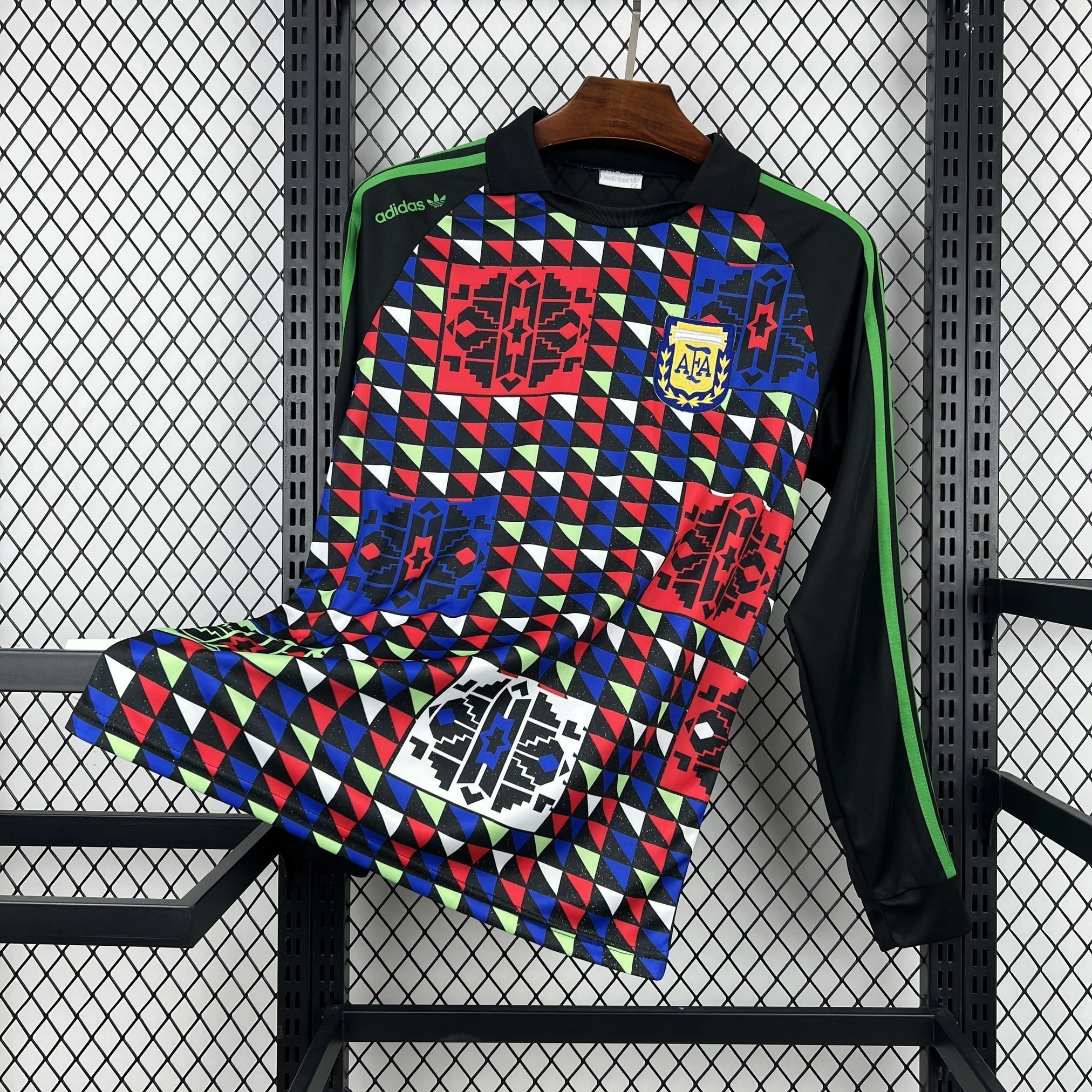
Sergio Goycochea gives that role a particularly strong connection to 1990. FIFA's account describes how he stepped in after Nery Pumpido's injury and made two shootout saves against Yugoslavia, then two more against Italy, as Argentina reached the final. That is a specific goalkeeper story within a tournament also closely associated with Maradona. Remembering the campaign does not mean the player at the centre of your memory was wearing an outfield shirt. FIFA's Goycochea retrospective supplies the historical distinction.
On the product front, the black sleeves do an important visual job. They provide large quieter areas on either side of a much busier body. That contrast allows the central pattern to remain emphatic without spreading the same density of triangles down the whole arm. Green at the shoulders and edges adds a separate outline. If the feature you remember is the vivid torso between dark sleeves, it is this combination that makes the listing worth examining, rather than the presence of one particular colour in the pattern.
The pattern also works at two scales. Small multicoloured triangles create a closely packed background, while the larger red motifs interrupt that smaller rhythm. A shopper attracted to the shirt's graphic character may respond to either layer. From farther away, the larger red elements and black sleeves are likely to be the clearest distinctions; closer inspection reveals the smaller repeated shapes. That is a different kind of visual interest from the broad, easily separated vertical stripes of the 1998 home or the gradual blue transition of the 2014 away.
This makes the goalkeeper shirt useful for a buyer who wants a substantial departure from an Argentina home jersey already in a collection. The difference is not just a new shade of blue or another collar. It changes the role of the garment, the dominant pattern and the relationship between body and sleeves. A second shirt chosen for that reason would add a clearly different front. Someone specifically looking to recall an outfield player's striped shirt, however, has a stronger match elsewhere in the selection.
The photograph includes another garment draped alongside the shirt. The comparison here concerns the goalkeeper top itself; the arrangement of objects in a photograph does not establish a shirt-and-shorts package. More importantly for recognising the top, the busy central panel and black sleeves remain readable as one design. Keep attention on that complete upper garment when comparing it with a remembered image, rather than letting a neighbouring item change your understanding of its colours or silhouette.
A later Maradona memory: the 1994 away design
The Argentina 1994 Away kit is shown as a short-sleeve royal-blue shirt with dark, jagged, tapering vertical graphics towards the left side of the photograph. A black fold collar with pale edging and black shoulder stripes gives it a firm upper outline. The body pattern is directional and unevenly distributed. It does not create the regular alternation of a sky-blue and white home shirt, and it does not spread colour across the front in the stepped horizontal bands of the 2014 away.
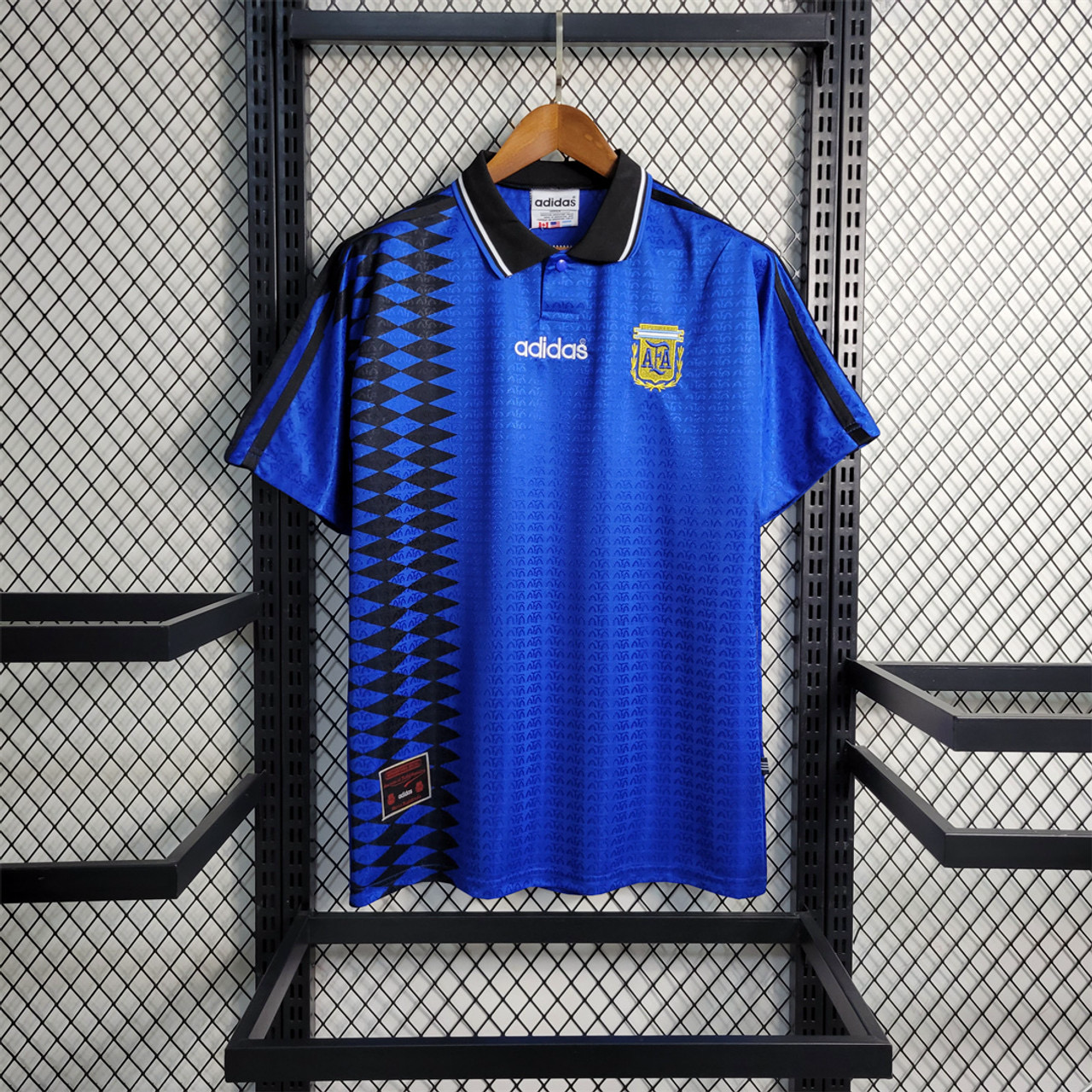
Maradona's final World Cup campaign in 1994 places this year in a different chapter from his earlier tournament appearances. FIFA's account of his World Cup career records two appearances and a goal in 1994, with Batistuta and Caniggia among the attacking players around him. It also includes his goal against Greece. That shared cast is useful when a memory centres on Maradona but also contains a younger forward or a particular combination of players. FIFA's retrospective of Maradona's four tournaments provides the period context.
The dark graphic is the most helpful visual clue in this listing. Its repeated shapes narrow and taper, creating a more irregular rhythm than conventional equal-width stripes. Because that pattern occupies one side more strongly in the front photograph, the royal blue has room to remain a broad field elsewhere. A vague memory of a blue Argentina shirt can therefore be made more precise: was the surface largely quiet, covered in fine curved lines, or marked by those dark angular shapes? This 1994 option gives the last answer.
The collar reinforces the distinction. A folded black collar creates a separate shape above the body, while its pale trim traces the edge. The black shoulder stripes repeat that darker accent across the top. Together, those details can matter as much as the body graphic when you are trying to recognise a remembered shirt. Someone who remembers a pronounced collar and angular decoration should examine this listing before the later away alternatives, whose main distinguishing features are curved side accents or horizontal changes in blue.
The year also helps prevent every Maradona-related memory from being compressed into the same image. A shirt can represent his later international period without being a stand-in for an earlier title-winning design. The 1994 away product has its own visible identity: blue ground, dark jagged pattern and a strong folded neckline. If that is the combination that attracts you, it deserves to be chosen on its own terms. There is no need to describe it as interchangeable with another blue Argentina shirt simply because the same celebrated name connects several eras.
For a buyer who enjoys bold graphics, the 1994 away and 1990 goalkeeper offer two different approaches. The goalkeeper front fills a central area with a dense multicoloured pattern, bounded by black sleeves. The away shirt uses a much more restricted blue-and-dark palette with larger directional marks. One supplies busyness through many small shapes and several colours; the other supplies it through the jagged edge and placement of repeated dark forms. Choosing between them can therefore begin with the kind of pattern you enjoy, as well as the player or role you remember.
The striped front for a Batistuta-era memory
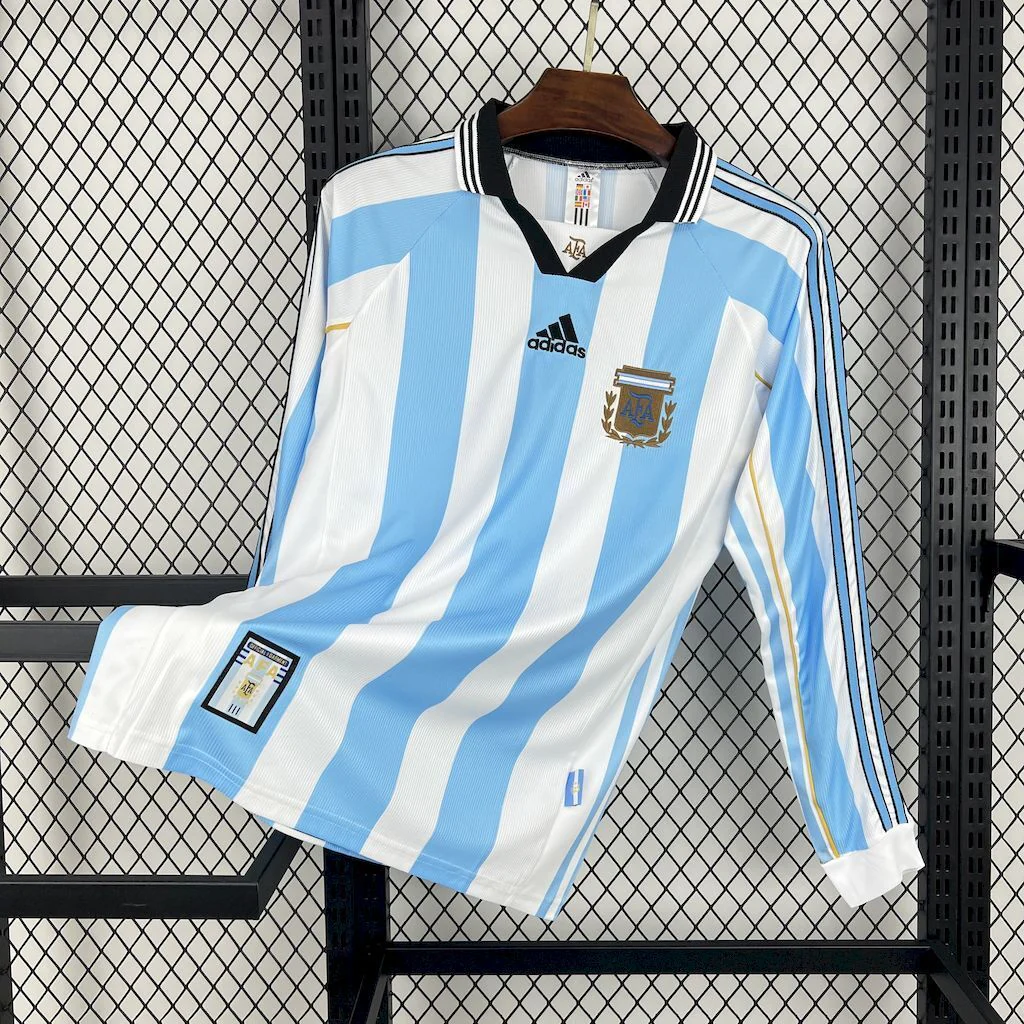
The 1998 Argentina Home Long Sleeve is the clearest broad-striped option at this point in the selection. Sky blue and white run vertically through the body, a black-and-white fold collar gives the neckline a strong border, and blue-and-white arm stripes carry detail along the long sleeves. Compared with the jagged dark forms on the 1994 away, the body is organised through regular, clearly separated light bands. It is a useful starting point when the memory is unmistakably an outfield player in Argentina's striped home identity.
The 1998 match against England supplies a specific reference point. FIFA records a 2–2 round-of-16 draw followed by Argentina's 4–3 shootout win, with Gabriel Batistuta and Javier Zanetti scoring during the match and goalkeeper Carlos Roa playing a decisive part in the penalties. Those are several distinct memories within one evening. A remembered Batistuta finish, Zanetti's movement or Roa's save points towards the same tournament but not necessarily the same shirt role. See FIFA's Argentina–England retrospective.
This helps when a memory is attached to a match rather than a single player. The product here is labelled home and depicts the striped outfield design. The 1990 goalkeeper item elsewhere in the selection should not become a substitute for every Argentina goalkeeper story just because both memories involve penalties. Keeping the year and role together avoids that confusion. It also lets you appreciate the 1998 home as a representation of the outfield side without pretending that every participant in the remembered scene wore the same top.
The fold collar is one of the best details for distinguishing this home front from the selected 2006 home. Both use sky blue and white, so colour alone will leave the two options unresolved. In the 1998 photograph, the neckline is a defined folded shape with dark contrast. The broad vertical stripes continue to provide the body's main organisation. The 2006 home, by comparison, introduces a sky-blue shoulder yoke and curved gold lines across the upper front, changing the relationship between the stripe field and the top of the shirt.
The long sleeves also contribute to the 1998 design's appearance. Their blue-and-white stripes give the arms a visible connection to the colours of the torso, while the dark collar provides a separate point of contrast near the face. This creates a combination of repeated light colours and one much darker upper boundary. If you remember a shirt with a strong collar and comparatively direct vertical body stripes, those details are more helpful than describing it simply as a classic Argentina home jersey.
For a person who values the broad-striped identity above all else, this option can feel more straightforward than the patterned away or goalkeeper alternatives. That does not make it visually featureless. The width of the body stripes, the fold at the neck and the arm detail all contribute to its character. A buyer can prefer that regularity because it is easier to connect to a particular photograph or player silhouette. The shirt's appeal may lie precisely in how clearly those few large elements remain separated from one another.
Batistuta can also connect a buyer's memories across more than one tournament. The 1994 away and the 1998 home therefore provide an instructive pair: the player-era association overlaps, while the designs diverge sharply. If your recollection is mainly about a forward rather than a colour, ask which front belongs to the image you want to recall. A black folded collar appears in both general impressions, but the dark jagged blue body of one and the broad sky-blue/white stripes of the other lead to very different purchases.
Riquelme's team and Messi's first World Cup
The 2006 options are useful because a single year can hold several memories at once. Some supporters begin with Riquelme's passing; others with a flowing team move or the first glimpse of Messi at a senior World Cup. Those associations should not be collapsed into one player's later image. The two home/away designs provide different visual routes into the same period, and the extra short-sleeve listings offer alternatives within those routes. The central decision is which 2006 front fits your recollection, rather than how many separate product names appear.
FIFA's account of Argentina's 6–0 victory over Serbia and Montenegro recalls Cambiasso finishing a move of 24 consecutive passes, with Crespo supplying the final backheel. That is a team memory with many players involved, rather than a moment owned only by the scorer. A buyer who recalls the movement of the ball through the side may reasonably want a shirt to represent that collective performance. FIFA's Cambiasso retrospective anchors the association to 2006.
The 2006 Retro Argentina Home Long Sleeve shows blue-and-white vertical body stripes beneath a sky-blue shoulder yoke. Curving gold-coloured lines sweep around the upper front, while black stripes mark the shoulders. This is a more layered arrangement than the 1998 home. The vertical body bands are still the strongest national-team cue, but they interact with a coloured area across the top and a thin curved line cutting through the upper composition. Those features give the front a distinct period reference.
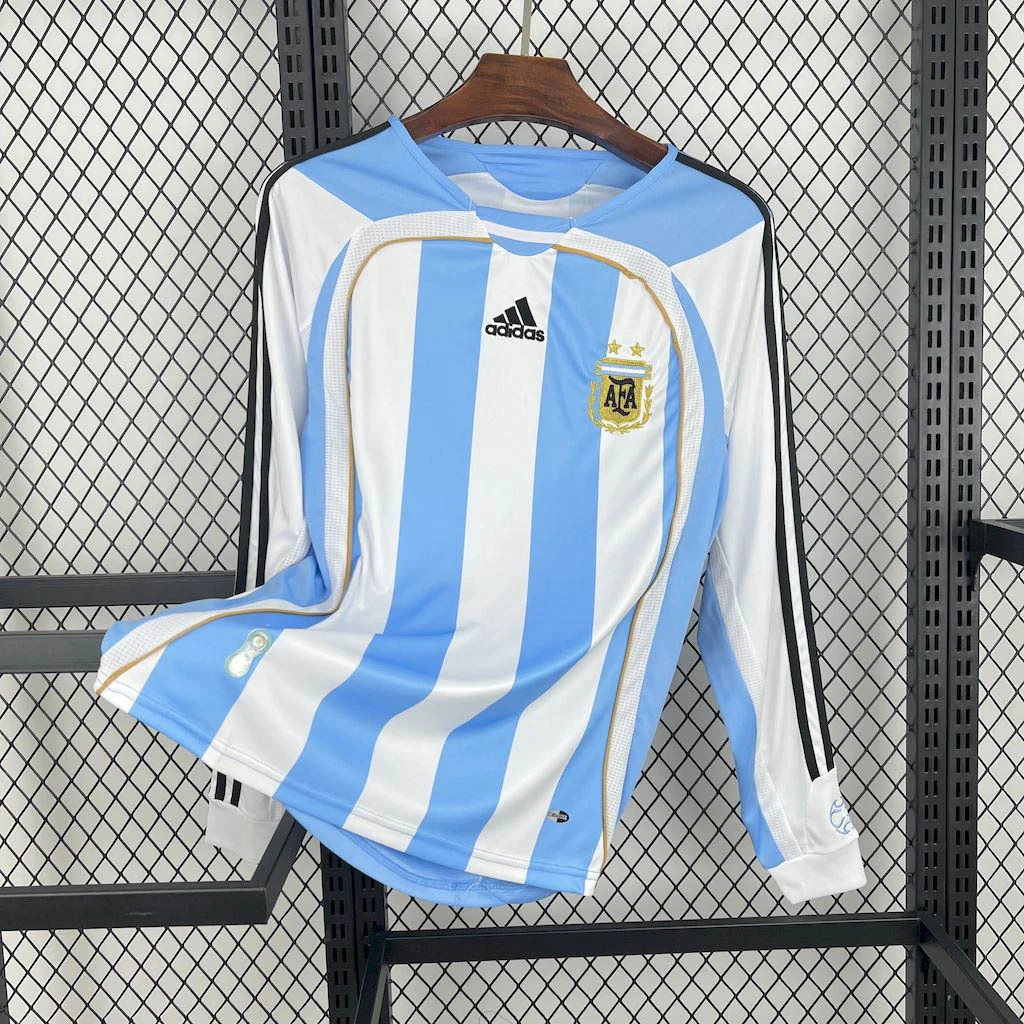
The yoke changes how the stripes meet the shoulder area. Instead of allowing the whole upper impression to be dominated by repeated vertical bands, it introduces a broader sky-blue region near the top. The gold line then supplies another direction, curving across that part of the front. Someone trying to distinguish the two selected striped home shirts can use this combination as a practical clue. The 1998 collar-led front and the 2006 yoke-and-curve arrangement remain recognisably Argentina while giving different shapes to the area around the upper chest.
The 2006 Argentina Away Long Sleeve takes the comparison into navy. Sky-blue areas curve around the shoulders and sides, and fine pale-gold lines add another curved accent. Rather than dividing the central body into sky-blue and white bands, this front leaves a much darker main field and moves the lighter blue towards the edges. It is a useful choice if the memory you want to preserve involves a dark Argentina shirt with sweeping side detail, rather than the more regular rhythm of the home stripes.
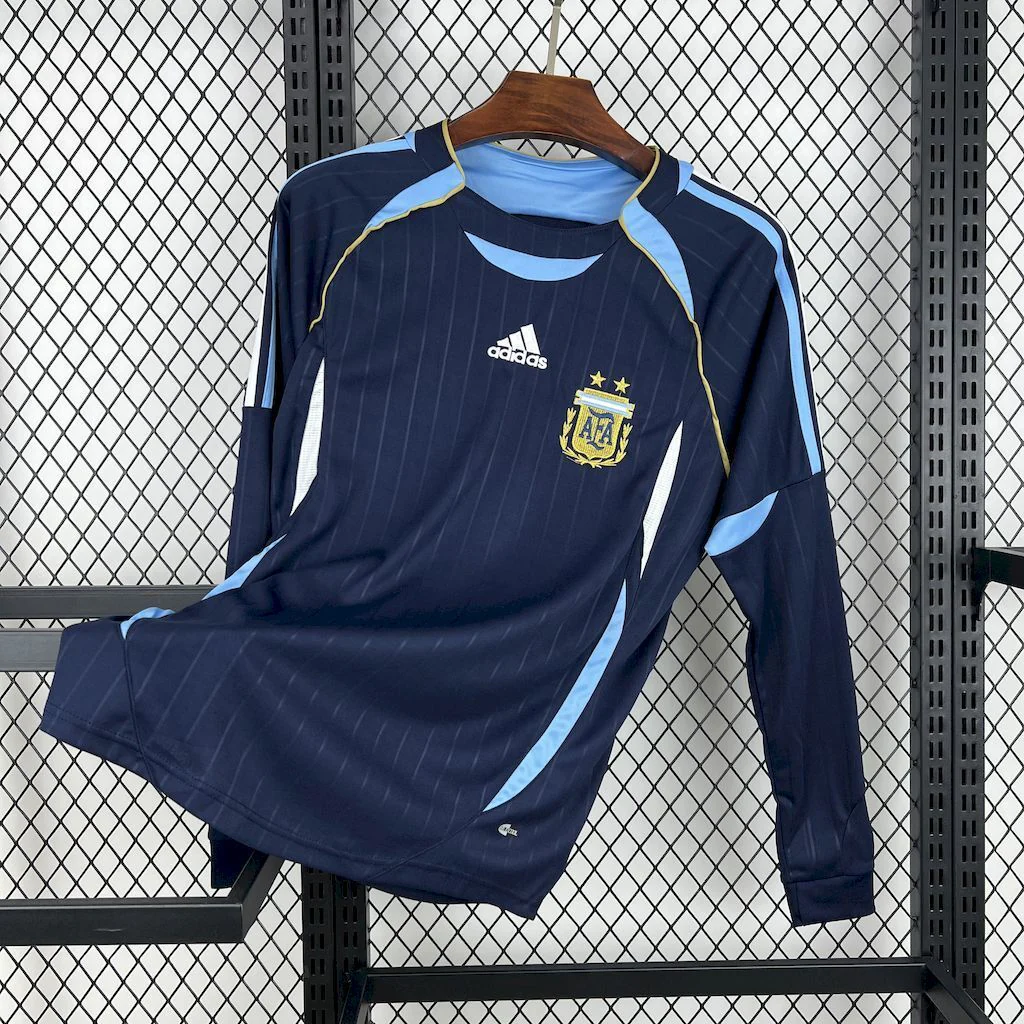
The home and away therefore share a sense of curvature without creating the same front. On the home, the curved line crosses an arrangement already divided into vertical bands and a sky-blue upper section. On the away, curved lighter-blue areas shape the borders of a dark body. If you like the period's sweeping lines, either might appeal. If you specifically remember vertical stripes, the home is the clearer match; if you remember the dark centre and lighter sides, the away offers that relationship directly. The design evidence can refine a year you already know.
Messi's place in that team supplies another useful distinction. FIFA dates his World Cup debut to 16 June 2006 against Serbia and Montenegro and identifies his shirt number then as 19. The familiar later association with number 10 should not erase that earlier chapter. This is historical context for a player-led choice, not a reading of tiny printing in the product pictures or a promise about available name sets. FIFA's account of Messi's debut makes the period difference explicit.
Riquelme's connection with Messi also helps explain why a 2006 shirt may mean different things to different buyers. FIFA recalls the two playing in that side, Messi scoring his first World Cup goal in the 6–0 win and Argentina later being eliminated by Germany on penalties. A memory centred on the experienced playmaker and one centred on the emerging forward can therefore point to the same tournament without being the same story. FIFA's historical Riquelme–Messi reference supports that shared context.
The two shorter alternatives are the Argentina 2006 home kit and Argentina 2006 Away Kit. Their photographs show the same general home and away families with shorter sleeves. The home retains its vertical bands, light-blue upper area, gold curve and dark shoulder stripes; the away retains the navy and curved sky-blue shoulder/side arrangement. Consider these after choosing the front, as alternate sleeve shapes within the period you have already identified.
The blue shirt and the 2014 finalist's story
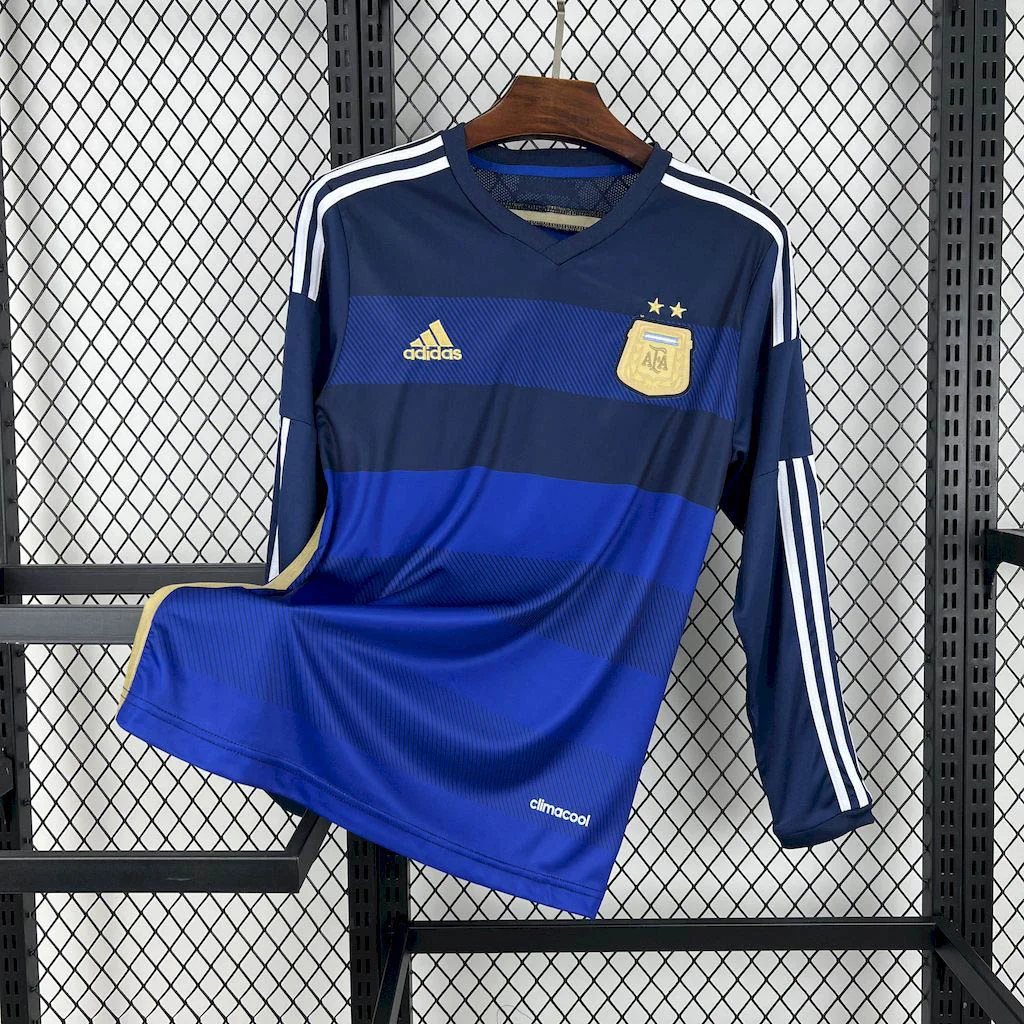
The 2014 Retro Argentina Away Long Sleeve offers a third distinctive blue away treatment. The upper body is navy, then a sequence of stepped horizontal bands leads towards a brighter blue lower section. White stripes run along the arms, with gold-coloured crest and logo details on the front. The main change in colour happens across the height of the torso. It is a very different arrangement from the dark vertical graphics of 1994 or the light-blue curved sides of 2006.
The 2014 tournament gives a later Messi memory a precise setting. Argentina reached the final in Rio de Janeiro, where Germany won 1–0 after extra time through Mario Götze's goal. That result matters when choosing the story attached to a dated shirt: this is a finalist's period, not a World Cup-winning Argentina campaign. The disappointment can be part of the memory rather than a reason to dismiss it. UEFA's final report records the match and outcome.
FIFA also records Messi receiving the tournament's Golden Ball. A buyer may therefore remember both an outstanding individual tournament and a team that finished just short of the trophy. Those two ideas can coexist without rewriting the result. The shirt's emotional connection might be the run to the final, the expectation surrounding the team or the image of a player at that stage of his career. FIFA's review of the 2014 tournament supplies that broader context.
The product's horizontal colour change provides a strong identifying feature even without a player name. Navy at the top creates a dark setting for the chest details, while the lower blue becomes progressively more prominent through the banded transition. This gives the torso a top-to-bottom progression. If you remember an Argentina away shirt that appears darker near the shoulders and brighter lower down, this listing is worth comparing closely. The memory is more specific than “blue Argentina,” which could otherwise lead to all three away designs in this guide.
The arm stripes contribute another direction. They travel along the long sleeves while the body changes through horizontal stages. The combination gives the arms and torso different visual rhythms: linear white accents at the sides, stacked changes of blue through the middle. The gold-coloured chest details add a small warmer contrast against that predominantly cool palette. This makes the shirt interesting even for a buyer whose main attraction is its design rather than a single tournament image.
Compared with the 2006 away, the location of the lighter blue is especially revealing. In 2006, lighter colour curves around the shoulders and sides, shaping the edge of the navy field. In 2014, the stronger transition happens down the body itself. Both can have a dark upper impression, but they distribute their brighter colour differently. A person remembering a sweeping side panel should follow one route; a person remembering a stepped change towards a brighter lower front should follow the other.
This is also a useful way to distinguish two Messi-related purchases. The player connects 2006 and 2014, yet the fronts represent different periods and arrangements. Choosing the 2006 away for the earlier career chapter is a different decision from choosing the 2014 away for a final-era memory. You do not have to rank the entire career to make that choice. It is enough to decide which stage is meaningful and whether the curved sides or the horizontal blue transition matches the image you want your shirt to recall.
Resolve a close choice with the front design
Once the remembered year or player has narrowed the options, the front can settle a close choice. The most useful features are large enough to identify reliably: the overall direction of the graphic, the placement of the brighter colour, the shape of the collar and the division between torso and sleeves. These features allow a practical comparison without relying on tiny badge stars or trying to decipher small printed text. They also help when your original memory is incomplete and you want the design that most closely captures its visual character.
For the two home designs, begin at the top of the shirt. The 1998 front makes its folded neckline a strong dark reference, with broad stripes doing most of the work below. The 2006 home combines the stripe field with a larger sky-blue upper area and the gold curve. If your memory of a striped shirt includes an obvious change across the shoulders, that second arrangement is a useful lead. If it centres on the collar and simple repetition of broad bands, the 1998 option provides the closer visual starting point.
The arms provide another way into a partly remembered image. On the 1998 home, blue-and-white arm stripes continue the light palette of the body. On the 2006 home, black shoulder stripes introduce a darker accent against the sky-blue upper section. This is useful when a player's raised arm obscures part of the chest in the photograph you remember. The visible shoulder colour can supply information that the hidden body cannot. It should agree with the collar or yoke, rather than being treated as an isolated sign that identifies a whole shirt by itself.
The black shoulder detail on the 1994 away gives a different example. Here it accompanies a black folded collar and a royal-blue patterned body, whereas the dark lines on the 2006 home sit above sky-blue and white stripes. A remembered dark shoulder alone leaves those possibilities open. Pairing it with the nearest large feature resolves the ambiguity: a folded black neckline and blue field in one case, or a light-blue upper area leading into vertical white bands in the other. This is particularly helpful when the strongest part of a memory is the player's head and shoulders, rather than a clear view of the entire torso.
For the away designs, look at the direction of the contrast. The 1994 dark shapes repeat vertically with jagged edges; the 2006 lighter accents bend around the sides; the 2014 changes stack horizontally down the torso. That creates three distinct routes for the eye. The underlying blue family is shared, but the movement within the design is different. A buyer who remembers a graphic rather than a neckline can use this direction as the most effective separator before considering a particular player association.
Gold-coloured details create another possible false friend between the later away shirts. The 2006 photograph uses fine pale-gold curves as part of the lines shaping the front. On the 2014 photograph, gold is visible in the compact chest marks, while blue bands organise the main body. Remembering a warm accent against navy therefore does not settle the year. Its form matters: a line that travels through the composition has a different visual role from a small crest or logo sitting on a darker upper field. This distinction remains useful even when you cannot read the lettering inside a mark.
The goalkeeper shirt stands apart because its body contains several bright colours at once and its sleeves create a strong dark frame. It should not be treated simply as a fourth alternative blue front. Its graphic density and role are both different. If you want a shirt that changes the visual character of an existing Argentina collection most dramatically, that is a meaningful reason to consider it. If you want a close companion to a striped outfield jersey, one of the away designs may create a more directly related home-and-away association.
Sleeve length can finish the choice without taking over the whole comparison. The linked 1998 home, 1990 goalkeeper and 2014 away are long-sleeve options; the 1994 away photograph is short sleeved. The 2006 home and away each have the additional shorter alternative already linked. These are the actual choices in this selection. Once the memory and front design are settled, the sleeve shape tells you which of the available listings most closely matches your preference, rather than suggesting a new period where there is only another version of the same front.
When a familiar moment needs one more clue
Some football memories recur in surprisingly similar forms. A striker scores three times, a goalkeeper saves two penalties, or a spectacular finish becomes the goal you associate with a whole tournament. The action can feel unmistakable while still leaving the year uncertain. Before choosing a dated jersey, the opponent often supplies the missing information. This is more useful than adding further names to a shortlist: it separates moments that sound alike but belong to different periods, then lets the actual shirt details finish the identification.
Batistuta's World Cup hat-tricks provide a clear example. FIFA records his three goals against Greece in 1994 and another three against Jamaica in 1998. In each case, a penalty completed the treble. A recollection of Batistuta celebrating a third goal, or striking the ball forcefully from the spot, therefore needs the opponent to distinguish those two tournaments. FIFA's account of the two hat-tricks connects Greece with the earlier campaign and Jamaica with France four years later. Those are separate landmarks within the same forward's career, not two descriptions of one afternoon.
For this selection, that distinction takes you towards either the 1994 period or the 1998 period before you decide whether the available design is the one you want. If you recall Maradona sharing the scene, the earlier reference becomes especially relevant; if the memory is specifically the Jamaica match, the later year is established. The shirt's role remains a separate part of the choice. A product carrying the correct year can be a meaningful tribute to a campaign, while a buyer seeking a particular pictured front will also want the pattern and home-or-away identity to agree.
Two famous 2006 goals can likewise merge in recollection. The long passing move ending with Cambiasso was against Serbia and Montenegro. Maxi Rodríguez's winner against Mexico was a different kind of moment: a left-footed volley in extra time during the round of 16. FIFA's interview with Rodríguez recounts how that strike sent Argentina into the quarter-finals and was voted Goal of the Tournament. If the remembered action is a ball being controlled before a dramatic volley, Rodríguez supplies the relevant association; if it is a succession of passes before a close combination, Cambiasso does. FIFA's Rodríguez interview separates the Mexico story from the earlier team move.
That distinction changes the personal reason for choosing 2006 even though it does not create another shirt design. You might want the year because it recalls patient collective play, or because one difficult individual finish stayed with you. The listed home and away remain the two visual families to compare. Matching the body you remember is then a more productive step than searching for a third design based solely on a different goal scorer's name. A match memory and a design category answer different parts of the same buying decision.
The words “two penalty saves” also need care. They can describe Goycochea's part in a 1990 shootout, but they also describe Sergio Romero's saves against the Netherlands in the 2014 semi-final. UEFA records a goalless match followed by Argentina winning the shootout 4–2, with Romero stopping Ron Vlaar and Wesley Sneijder. The goalkeeper and opponent distinguish that later route to a final. UEFA's Netherlands–Argentina report places it in 2014. The patterned 1990 goalkeeper top should therefore not be chosen as an exact visual answer to a memory of Romero simply because both stories concern successful shootouts.
There is no Romero-labelled goalkeeper design among the six groups compared here. A shopper whose interest is specifically the goalkeeper's appearance in that later match has reached a useful limit of this selection. The 2014 away can represent the outfield team's period, but it answers a different visual request. Recognising that distinction prevents a memorable match from being used to justify whichever old Argentina shirt happens to be available. It also leaves room for a perfectly deliberate broader choice: commemorating the campaign through an outfield design rather than trying to recreate the goalkeeper's look.
If a player's name or number is central to the purchase, keep the period association separate from the store's actual printing options. A historical fact such as Messi wearing 19 at the 2006 World Cup does not establish which name sets can be ordered on a current product. The established football shirt personalisation guide explains how to work from the exact listing's options. A clear period choice should come first, so any later personalisation decision supports the story you intended rather than accidentally pointing towards another chapter.
The result of this process may be one clear choice, two plausible fronts or the discovery that the remembered garment is outside the selection. All three are useful outcomes. The important progress is that the uncertainty has become specific: a year, an opponent, a player role or a visible detail. You can then choose a retro Argentina jersey for a reason that survives beyond the product title, with a clearer sense of the football moment it represents and the design you actually enjoy.
Summary: give the memory a specific shirt
An Argentina retro jersey becomes easier to choose when the remembered player or match is connected to a role and a visible front. The 1990 goalkeeper option offers the dense patterned body and dark sleeves. The 1994 away brings royal blue, jagged dark graphics and a folded collar. The 1998 home supplies broad light stripes and a strong neckline, while the 2006 home and away introduce their own upper yokes, curves and side accents. The 2014 away is distinguished by its stepped progression from navy into brighter blue.
Choose the story first, then use those details to resolve the closest alternatives. A goalkeeper memory, a later Maradona-era reference, a Batistuta-era striped front and two different Messi chapters need not lead to the same garment. Follow the individual links for the design you have identified, or use the Argentina shirt collection to continue from that clearer starting point. The right shirt is the one whose period, role and appearance agree with the football memory you want it to represent.

 USD
USD
 ANG(ƒ)
 LKR(₨)
 EGP(EGP)
 BZD(BZ$)
 CRC(¢)
 MAD(DH.)
 OMR(RO.)
 KES(KSh)
 GHS(₵)
 UGX(USh)
 RSD(Din.)
 RON(lei)
 PGK(K)
 CDF(CDF)
 UYU($U)
 KZT(〒)
 PKR(Rs)
 MNT(₮)
 ARS(ARS$)
 COP(COP)
 MVR(Rf)
 IQD(د.ع)
 BDT(Tk)
 ZMW(ZK)
 NAD(N$)
 JMD(J$)
 AOA(Kz)
 MMK(K.)
 PEN(S/.)
 MOP(MOP$)
 BND(B$)
 LAK(₭)
 VND(₫)
 NGN(₦)
 KHR(៛)
 TWD(NT$)
 CNY(¥)
 SAR(S.R.)
 BHD(BD.)
 QAR(QR.)
 KWD(K.D.)
 UAH(₴)
 IDR(Rp)
 MYR(RM)
 AED(AED)
 JPY(円)
 INR(Rs)
 TRY(₺)
 CLP(CLP)
 KRW(₩)
 ZAR(R)
 SEK(Kr)
 ILS(₪)
 HKD(HK$)
 THB(฿)
 PLN(zł)
 NZD(NZ$)
 NOK(Kr)
 MXN(MXN$)
 HUF(Ft)
 CZK(Kč)
 SGD(S$)
 PHP(₱)
 DKK(kr.)
 CHF(CHF)
 BRL(R$)
 RUB(₽)
 CAD(CA$)
 AUD(AUD)
 GBP(£)
 EUR(€)
 Barcelona
 Real Madrid
 Manchester United
 Inter Miami
 Manchester City
 Fc Bayern
 Ac Milan
 Chelsea
 Juventus
 Arsenal
 PSG
PSG Liverpool
 Inter Milan
 Santos FC
 Roma
Roma Portugal
 Al Nassr
 Atletico Madrid
 Everton
 Everton
 Germany
 Ajax
Ajax Mexico
 Napoli
 Columbia
 Sporting lisbon
 France
 Tottenham
 Morocco
 Real Betis
 Brazil
 USA
USA ltalia
 Argentina
 England
 Borussia Dortmund
 Spain
Spain Japan
Japan Netherlands
 Adidas
 Nike
Nike Puma
Puma NB
NB Kappa
Kappa